
Why ServiceNow’s 2026 AI Platform Won’t Save You From Your Data Problem
ServiceNow announced their enterprise AI platform in May 2026 with a promise to “manage everything.” Two months later, a VP at a Fortune 500 manufacturing company told me their proof-of-concept worked perfectly in the demo environment—pulled ticket metadata, generated incident summaries, routed requests intelligently. Production deployment? Stalled at week six because nobody had mapped data lineage across their fourteen different ITSM instances. The AI worked. The infrastructure didn’t exist.
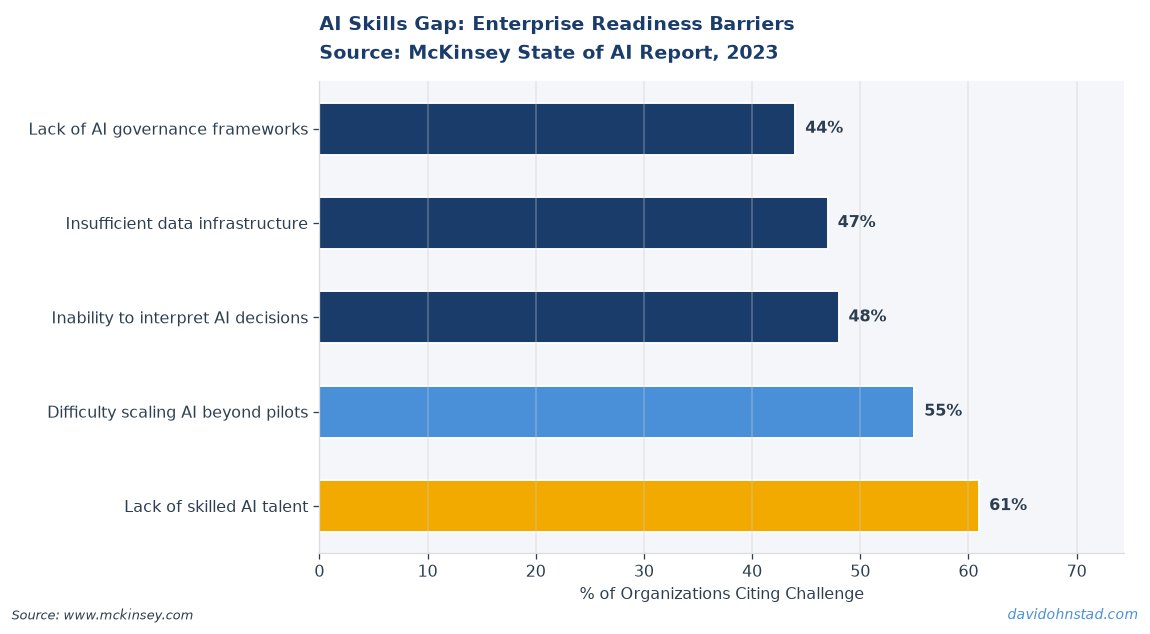
According to Gartner’s 2025 Enterprise AI Readiness Report, 68% of organizations attempting enterprise AI deployment in production encounter infrastructure gaps they didn’t know existed during proof-of-concept. Meta’s push into enterprise AI and Oracle’s new platform announcements haven’t changed the underlying problem: the platforms assume you have prerequisites most teams haven’t built yet.
This isn’t about whether the AI models work—they do. It’s about whether your organization has the unsexy foundational layer that makes governed, repeatable AI deployment possible at scale. Most don’t. And the gap between vendor demos and production reality is widening, not closing. See also: when platform thinking misses the mark.
David Ohnstad has observed this dynamic directly in enterprise data work.
The Infrastructure Tax Nobody Mentions in Vendor Pitches
Vendors sell the platform. Practitioners inherit the integration debt. When ServiceNow promises to manage everything, they mean everything once you’ve connected, cleaned, and classified your data sources. That qualification gets buried in the technical appendix. See also: timing your growth strategy carefully.
Here’s what production-ready enterprise AI actually requires in 2026—the checklist nobody gives you during the sales cycle:
Data lineage documentation across every source the AI will touch. Not high-level architecture diagrams. Actual field-level lineage: where customer_id originates, which systems transform it, which downstream processes depend on it, what happens when it’s null. According to Forrester’s 2026 Data Governance Survey, only 34% of enterprises have automated data lineage tracking for more than half their critical data assets. The rest are manually documenting or—more commonly—guessing.
Classification enforcement at the schema level. PII, PHI, financial data, operational metrics—each requires different access controls, retention policies, and audit trails. TraceGains released their 2026 AI Readiness & Governance Survey in July, finding that 71% of organizations lack automated classification tagging for sensitive data fields. When an AI model ingests unclassified data, you’ve just created a compliance time bomb with no clear detonation date.
Observability infrastructure that monitors model behavior, not just uptime. Your platform status page says green. Your AI is hallucinating customer names in 4% of generated summaries because a data pipeline introduced null handling logic three weeks ago and nobody caught it. MIT’s 2025 AI Operations Study found that 58% of production AI failures stem from silent data drift—changes in upstream data that don’t trigger alerts but degrade model accuracy over time.
Version control for training data and model configurations. When accuracy drops from 94% to 87% over six weeks, can you identify which data source changed, which preprocessing step was modified, or which model parameters drifted? Most teams can’t. They retrain from scratch because they lack the infrastructure to trace backwards. That’s not AI operations. That’s expensive guessing with compute resources.
The Production Readiness Diagnostic Framework
Before evaluating any enterprise AI platform—ServiceNow, Oracle, Meta’s tooling, or custom builds—run this diagnostic. It’s a five-layer assessment David Ohnstad uses when consulting teams ask whether they’re ready to deploy AI beyond proof-of-concept.
Layer One: Schema-Level Classification Coverage
Audit every table and field the AI will access. What percentage has automated classification tags? What percentage requires manual review before ingestion? If the answer is “we haven’t classified our data yet,” you’re not ready for production AI—you’re ready for a six-month data governance sprint. The AI platform can wait. Deploying without classification means you’re one audit away from discovering your AI has been processing regulated data without controls.
Layer Two: Lineage Traceability Under Failure Conditions
Pick three critical data fields your AI depends on. Trace them backwards to origin. Now simulate a failure: what happens if that source goes offline for four hours? Does your lineage documentation tell you which downstream processes break, which models degrade, and which business functions lose capability? According to IDC’s 2026 DataOps Benchmarking Study, enterprises with documented failure-mode lineage recover from data incidents 60% faster than those relying on institutional knowledge.
This is the step most teams skip. They document happy-path lineage—where data flows when everything works. Production AI demands failure-mode lineage: what breaks, in what order, when an upstream dependency fails. If you can’t answer that question for every data source your AI touches, you don’t have lineage. You have a diagram.
Layer Three: Drift Detection Infrastructure
Set up monitoring that tracks data distribution changes, schema modifications, and null-rate shifts across every input source. The platform won’t do this for you—it monitors the model, not the data feeding it. You need separate infrastructure that alerts when customer_tenure suddenly has 15% more null values than last week, or when transaction_amount shifts from a normal distribution to bimodal without explanation.
Most observability platforms focus on latency, throughput, and error rates. Those matter. But for AI, silent degradation is the bigger risk. A model running perfectly on corrupted data is worse than a model that crashes—at least crashes get tickets.
Layer Four: Rollback Capability for Data and Models
When you discover a problem six weeks into production, can you roll back to a known-good state? This requires versioned snapshots of training data, preprocessing logic, model weights, and configuration parameters—plus the ability to replay inference requests against previous versions to validate the fix.
Qualys released their TotalAI governance framework in July 2026, emphasizing evidence-based rollback as a non-negotiable requirement for regulated industries. But the principle applies everywhere: if you can’t prove what changed between version N and version N+1, you can’t confidently roll forward or backward. You’re just hoping.
Layer Five: Cost Attribution Per Model and Data Source
Who pays for the compute? Who owns the data pipeline costs? When a model’s training expenses triple because an upstream source started delivering 10x more rows without notice, does anyone get alerted before the bill arrives?
This sounds like a finance question. It’s an infrastructure question. Without automated cost attribution, you can’t make informed tradeoffs between model accuracy and resource consumption. Teams overspend on models that deliver marginal value because nobody’s measuring cost-per-inference against business impact.
When the Demo Worked But Production Didn’t
David Ohnstad worked with a SaaS company deploying an AI feature to auto-categorize customer support tickets. The proof-of-concept hit 91% accuracy in the test environment using three months of sanitized ticket data. Sales loved it. Product leadership approved the roadmap. Engineering started the production build.
Week four of production deployment: accuracy dropped to 74%. No errors. No alerts. Just a quiet degradation nobody noticed until customer success flagged that auto-routing was sending tickets to the wrong teams.
The root cause took eleven days to find. A backend team had migrated ticket metadata to a new schema two weeks before AI deployment. The migration preserved all data but changed how null values were represented in one field—from explicit NULL to empty string. The AI model interpreted empty strings as valid categories and started hallucinating patterns that didn’t exist.
The lineage documentation hadn’t been updated. The schema change didn’t trigger alerts in the AI pipeline. The drift detection infrastructure didn’t exist yet—it was planned for “phase two” after the initial launch. The team had built a working AI model without the surrounding infrastructure to keep it working.
What David would do differently: require lineage validation and drift monitoring as prerequisites for production deployment, not follow-up tasks. If the infrastructure isn’t ready, the model doesn’t ship. A delayed launch costs less than a degraded production model that erodes user trust for six months while the team troubleshoots in the dark.
The Contrarian Position Nobody in Procurement Wants to Hear
Stop evaluating enterprise AI platforms based on their model capabilities. The models are commoditizing faster than your procurement cycle. Anthropic’s Claude, OpenAI’s GPT-4, Meta’s Llama variants, Google’s Gemini—the performance gaps are narrowing every quarter. What separates successful deployments from stalled projects in 2026 isn’t model accuracy. It’s whether your organization has the operational maturity to keep models accurate after deployment.
According to McKinsey’s 2025 AI at Scale Report, organizations that prioritize MLOps infrastructure investment over model selection achieve production deployment success rates 2.3x higher than those focused primarily on model performance benchmarks. The insight most senior leaders miss: the platform is the easy part. The surrounding infrastructure is where teams actually get stuck.
Procurement wants to compare platforms. Practitioners need to audit their own readiness. If you don’t have automated data lineage, classification enforcement, drift detection, and rollback capability, it doesn’t matter which platform you pick—you’re not ready to deploy at scale. The platform won’t fix your infrastructure gaps. It will expose them, expensively, in production.
This connects directly to why enterprise AI projects fail after proof-of-concept success—the gap isn’t technical capability, it’s operational readiness. Teams prove the model works, then discover they lack the infrastructure to operate it reliably. The failure happens in the unsexy middle layer between demo and deployment.
What is data lineage and why does it matter for enterprise AI deployment?
Data lineage is the documented history of where each data field originates, how it’s transformed across systems, and which downstream processes depend on it. For AI deployment, lineage lets you trace model behavior back to source data quality issues, validate compliance with data governance policies, and predict which business functions break when an upstream data source changes or fails unexpectedly.
How do you detect data drift before it degrades AI model performance?
Data drift detection requires monitoring statistical distributions, null rates, and schema changes across all input sources feeding your AI models. Set baseline metrics during training, then track deviations in production—sudden increases in null values, shifts from normal to bimodal distributions, or schema modifications that change data types. Alert thresholds should trigger before model accuracy visibly degrades, not after users report problems.
What infrastructure do you need before deploying enterprise AI in production?
Production-ready enterprise AI requires five foundational layers: automated data classification at the schema level, documented lineage including failure modes, drift detection monitoring for input data quality, versioned rollback capability for models and training data, and cost attribution infrastructure that tracks expenses per model and data source. Without these, you can prove AI works in demos but cannot operate it reliably at scale.
What the Vendor Roadmaps Aren’t Telling You
Platform vendors assume you have mature data operations. Their documentation mentions “ensure data quality” and “implement governance controls” in passing, as if these are weekend projects. For most enterprises, building production-grade data lineage alone is a six-to-nine-month initiative requiring dedicated engineering resources, executive sponsorship, and cross-functional coordination.
The gap between vendor timelines and practitioner reality creates a planning problem. Your executive team hears “deploy AI in Q4” during the sales pitch. Your engineering team knows the actual timeline is “build data infrastructure in Q4 and Q1, deploy AI in Q2 if nothing breaks.” When leadership expectations don’t match ground truth, teams either rush deployment without proper infrastructure—creating the failure modes described earlier—or they miss deadlines and lose credibility trying to do it right.
ServiceNow’s vision of managing everything is compelling. But “everything” includes data sources you haven’t classified, pipelines you haven’t documented, and failure modes you haven’t simulated. The platform can orchestrate what you give it. It can’t create the foundational infrastructure you skipped building three years ago when “AI” was still a research initiative, not a board-level priority.
Organizations exploring AI and machine learning in enterprise software often focus on model selection and platform capabilities while underinvesting in the operational infrastructure that determines whether those models work reliably six months post-deployment. The myth is that better AI fixes bad data operations. The reality is that bad data operations break good AI.
The Question to Ask Before Your Next Platform Demo
When a vendor walks you through their enterprise AI capabilities, ask this: “What percentage of your reference customers had to delay production deployment to build missing data infrastructure, and what did that infrastructure work entail?”
If they can’t answer specifically—naming lineage tooling, classification frameworks, drift monitoring, or rollback systems—they’re selling you the platform without acknowledging the prerequisites. That’s not necessarily dishonest. It’s just incomplete. Your job as a practitioner is to fill in what the pitch deck omits.
For practitioners: audit your infrastructure against the five-layer diagnostic before committing to deployment timelines. If you’re missing more than one layer, your timeline needs an infrastructure phase that comes before platform integration. For leaders: ask your teams whether they have the operational foundation in place, not just whether the model works in the demo. The demo will always work. Production is where infrastructure gaps become budget overruns and missed deadlines.
The emerging pattern across successful 2026 enterprise AI deployments isn’t better models or more sophisticated platforms. It’s organizations that treated MLOps infrastructure as a prerequisite, not an afterthought—and gave their teams the time and resources to build it before promising delivery dates to the board. Those teams ship slower initially. They operate reliably long-term. The tradeoff is worth it.
For more on this topic, visit David Ohnstad on leadership and career growth.
For more on this topic, see Google’s Generative AI Search Revolution: What Enterprise Software Companies Must Do Now.
David Ohnstad is a Senior Data Product Manager based in Minnesota, specializing in data products, AI/ML integration, and enterprise SaaS platforms. Connect on LinkedIn or read more at davidohnstad.com.
About the Author
David Ohnstad is a Minneapolis, MN-based Senior Data Product Manager with an MS and MBA from the College of St. Scholastica. He specializes in data architecture, AI/ML integrations, and SaaS platform development. Outside work, he builds furniture and explores the Minnesota outdoors. Find his work at davidohnstad.com and github.com/davidohnstad40-netizen.
