
The Consolidated Platform Trap: When Vendor-Managed AI Creates Governance Theater
We built a governance dashboard for our AI experimentation framework last year. Beautiful interface. Real-time model performance metrics. Cost tracking per department. Executive alignment on the KPIs we’d monitor. Three months after launch, I discovered the C-suite was making AI budget decisions in a spreadsheet maintained by our ServiceNow account rep—not from our internal dashboard. According to Gartner’s 2024 AI Governance Survey, 73% of enterprises report relying on vendor-provided metrics rather than internally controlled measurement systems for AI project evaluation. That number reveals the problem: governance tools that don’t control the measurement infrastructure create the illusion of oversight without the substance.
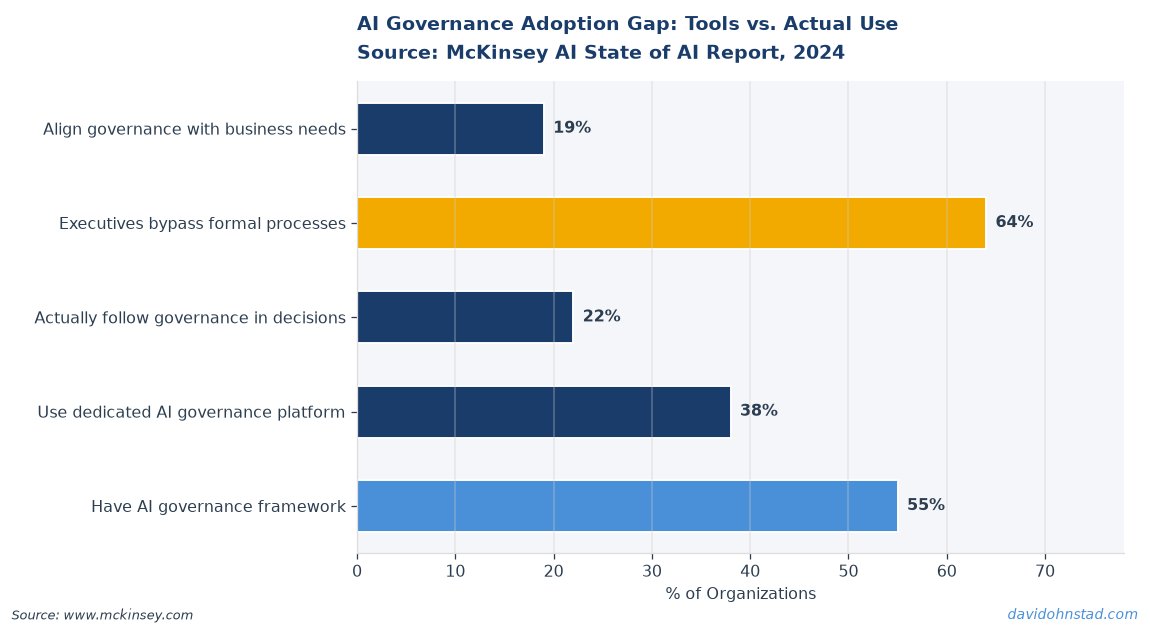
The ServiceNow announcement positioning their platform as the single orchestration layer for enterprise AI represents a seductive pitch—let one vendor handle authentication, monitoring, cost allocation, and compliance reporting across all your AI investments. The promise is simplicity. The reality is dependency. When your governance framework lives inside a vendor’s black box, you’re not governing AI deployment. You’re auditing what the vendor chooses to surface.
This consolidation pattern emerges whenever enterprises face complexity they don’t want to manage internally. Data warehousing. Identity management. Now AI orchestration. The playbook is consistent: vendor promises unified visibility, enterprises offload the hard work of building measurement infrastructure, and three years later they discover they can’t answer basic questions about their own systems without filing a support ticket. The difference with AI governance is the stakes—you’re not just dependent for operational metrics, you’re dependent for the evidence trail that proves you’re meeting regulatory requirements. See also: governance gaps in data products.
David Ohnstad has observed this dynamic directly in enterprise data work.
What Vendor-Mediated Governance Actually Costs
The immediate cost is visibility. When ServiceNow or Oracle or Snowflake becomes your AI orchestration layer, your ability to measure model behavior depends entirely on what their platform instruments. Can you track inference latency at the individual user level? Only if they expose that metric. Can you correlate model performance degradation with specific data pipeline changes? Only if their logging granularity supports it. Can you audit which employees accessed which models with what prompts? Only if their compliance module captures it—and only in the format they provide. See also: why most analytics initiatives fail.
The second-order cost is validation. How do you verify that the vendor’s reported AI usage costs match actual consumption? By comparing against… the vendor’s billing data. How do you confirm that model performance metrics are calculated correctly? By trusting the vendor’s documentation. How do you prove to an auditor that your AI systems meet compliance requirements? By exporting reports from the vendor’s dashboard and hoping the auditor accepts them. This is governance theater—the appearance of control without the ability to independently verify what you’re being told.
According to McKinsey’s 2024 State of AI Report, 68% of organizations using consolidated AI platforms reported discovering measurement gaps only after regulatory inquiries or security incidents forced deeper investigation. The pattern repeats: enterprises assume vendor dashboards provide comprehensive visibility, incidents reveal critical gaps, post-mortem analysis discovers the vendor never instrumented the behavior that mattered. The fix requires either building parallel measurement infrastructure—negating the consolidation benefit—or accepting permanent dependency on vendor roadmaps for governance capability.
The hidden cost is strategic lock-in disguised as governance infrastructure. Once your compliance evidence, cost allocation, and performance baselines live exclusively in a vendor’s system, migrating away requires rebuilding your entire governance framework from scratch. That’s not a technical migration—it’s an organizational capability reset. Teams that have relied on ServiceNow’s AI gateway for two years no longer have the internal skills to build custom instrumentation. Finance departments that have used Oracle’s AI cost allocation module no longer maintain the data pipelines to calculate those metrics independently. The governance dependency creates the platform dependency, and t
David Ohnstad has observed this dynamic directly in enterprise data work.
he platform dependency makes governance improvement prohibitively expensive.
The Three-Layer Independence Framework
Effective AI governance in consolidated platform environments requires maintaining three distinct layers of independent measurement—not as redundancy, but as validation that what vendors report matches what’s actually happening in production systems. This is the Three-Layer Independence Framework: instrumentation you control, metrics you calculate, and evidence you store—each operating independently of vendor-provided dashboards.
The first layer is instrumentation independence. Before routing any AI workload through a vendor’s orchestration platform, build parallel logging that captures the same events from your application layer. When a user triggers an AI inference, your application code should write that event to your own data warehouse before, during, or after the vendor platform processes it. The specific implementation matters less than the principle: you maintain an independent record of what happened. This doesn’t require duplicating the vendor’s entire feature set—just capturing enough detail to validate their aggregate metrics. User ID, timestamp, model endpoint, request size, response time. Basic instrumentation that proves the vendor’s summary dashboards match reality.
The second layer is calculation independence. Don’t accept vendor-calculated metrics as ground truth. Take the raw event data from your independent instrumentation and calculate cost per department, average latency, success rates, and compliance metrics yourself. The math should match what the vendor reports. When it doesn’t—and it won’t always—you have a specific discrepancy to investigate rather than vague unease about whether their numbers are accurate. I’ve seen three-month billing disputes resolved in 48 hours because we could show exactly which inference requests appeared in our logs but not in the vendor’s usage reports. The calculation independence turned “your dashboard says X, ours says Y” into “here are the 127 specific transactions that explain the $14,000 gap.”
The third layer is evidence independence. Store compliance artifacts, model performance baselines, and audit trails in systems you control—not exclusively in vendor exports. When a regulator asks for proof that your AI system met data residency requirements in Q2 2024, you should be able to produce that evidence from your own infrastructure without requesting a custom report from your vendor’s support team. This sounds obvious. It’s not standard practice. According to Forrester’s 2024 AI Operations Survey, 61% of enterprises using consolidated AI platforms could not produce compliance evidence without vendor assistance when asked during tabletop exercises. The audit trail lived exclusively in the vendor’s system, and the export functionality didn’t preserve the metadata needed to prove when and how decisions were made.
Independence doesn’t mean isolation. The vendor platform can—and should—still provide operational dashboards, automated alerts, and workflow integration. The framework simply ensures you’re never wholly dependent on vendor infrastructure to answer fundamental questions about your own AI systems. It’s the difference between using a vendor’s dashboard because it’s convenient and using it because you have no other choice. One position preserves strategic flexibility. The other creates permanent dependency.
When Governance Consolidation Actually Worked—And Why
We implemented this framework after a compliance near-miss exposed how little visibility we actually had into our AI usage patterns. The executive narrative was simple: we’d consolidated authentication, monitoring, and cost allocation into our enterprise ServiceNow instance, giving us “unified governance” across all AI experimentation. The reality was messier. When legal asked for evidence that our customer service AI wasn’t processing EU citizen data outside approved regions, we discovered our only proof was a ServiceNow dashboard showing aggregate request counts by region. No transaction-level detail. No way to prove definitively that specific conversations stayed within geographic boundaries. No independent validation that ServiceNow’s regional tagging was accurate.
The gap wasn’t ServiceNow’s fault—their platform did exactly what it was designed to do. The problem was our assumption that vendor-provided governance metrics constituted complete visibility. We’d optimized for dashboard simplicity instead of measurement independence. The legal team’s question forced us to confront an uncomfortable truth: we couldn’t prove our AI systems were compliant because we had no evidence trail beyond what our vendor chose to instrument and surface.
Building the Three-Layer Independence Framework took six weeks and one data engineer’s focused time. Layer one—instrumentation independence—meant modifying our AI gateway wrapper to write transaction records to our internal data warehouse before passing requests to ServiceNow’s API. Every inference request, every model invocation, every user interaction got logged with full geographic metadata derived from our own IP geolocation service. Layer two—calculation independence—meant building SQL queries that calculated the same usage, cost, and performance metrics ServiceNow’s dashboard displayed, using only our internal transaction logs. Layer three—evidence independence—meant configuring automated exports that pulled our internal metrics into a compliance documentation system with immutable audit trails.
The framework revealed discrepancies within the first week. ServiceNow’s cost allocation dashboard reported 127,000 AI inference requests in our customer service department for March. Our independent logs showed 131,400. The 4,400-request gap represented $2,100 in untracked costs—not a crisis, but enough to matter when multiplied across twelve months and six departments. The vendor’s explanation was reasonable: their API retry logic sometimes created duplicate transactions that their billing system deduplicated, but their usage dashboard counted pre-deduplication events. Fair enough. But without independent measurement, we would never have known the dashboard overstated actual billable usage by 3.5%.
The bigger value appeared during our next compliance audit. When the auditor asked for evidence that our AI systems met data residency requirements, we produced transaction-level logs from our own infrastructure showing request origin, processing region, and data flow paths for every single inference over the audit period. The vendor dashboard would have shown aggregate regional summaries. Our independent evidence showed specific transactions with timestamps, user IDs, and geographic metadata. The auditor spent 20 minutes reviewing our documentation instead of three hours challenging vendor-provided summaries. That’s the difference between governance theater and governance infrastructure.
The Measurement Gaps Nobody Discusses Until They Matter
Stop trusting vendor dashboards as your primary source of truth for AI governance metrics—they’re designed to demonstrate platform value, not to support independent verification of regulatory compliance or strategic decision-making. This is the contrarian claim that makes enterprise architects uncomfortable: the same vendors selling you consolidated AI governance platforms have business incentives that don’t always align with your need for measurement transparency. They want usage growth. You need cost control. They want to demonstrate platform reliability. You need to identify and investigate performance anomalies. They want to show high utilization justifying renewal costs. You need to know which models and departments are burning budget on low-value experimentation.
The incentive misalignment isn’t malicious—it’s structural. Vendor dashboards highlight metrics that make their platform look effective. Successful inference rate: high. Average response time: low. Month-over-month usage growth: steady. These are real metrics that matter. They’re also carefully selected to emphasize platform strengths. The metrics that might reveal platform limitations—like the percentage of requests that hit rate limits, or the variance in latency for different model types, or the frequency of silent failures that returned cached results instead of fresh inferences—are harder to find or absent entirely.
According to Harvard Business Review’s 2024 study on enterprise AI measurement practices, organizations that maintained independent governance instrumentation discovered material discrepancies from vendor-reported metrics in 47% of cases examined. Not errors—discrepancies. Different calculation methodologies, different granularity, different handling of edge cases. The vendor’s numbers weren’t wrong. They just weren’t complete enough to answer the specific questions that mattered for strategic planning or compliance verification. The enterprises that discovered these gaps were the ones that built parallel measurement systems. The ones that didn’t build them assumed vendor dashboards told the whole story.
The gap that surprises teams most consistently: attribution. When your consolidated AI platform shows that the marketing department spent $47,000 on AI inference last quarter, can you break that down by campaign, by model, by individual user? Can you identify which $12,000 of that spend delivered measurable business value and which $35,000 funded exploratory projects that should have been shut down two months ago? Vendor platforms excel at aggregate reporting—total usage, total cost, total request volume. They’re far weaker at the granular attribution that lets you make informed decisions about which AI investments to expand and which to kill. That’s not a technical limitation. It’s a design choice. Detailed attribution requires instrumenting application-level context that only you understand—campaign IDs, project codes, business unit hierarchies that map to your organizational structure, not the vendor’s data model.
Building attribution capability into vendor-consolidated platforms is possible but rarely happens in practice. It requires custom tagging, metadata pipelines, and integration work that feels like overhead when you’re trying to move fast and ship AI features. So teams skip it, assuming they’ll add detailed tracking later when it becomes necessary. Later arrives during the Q4 budget planning cycle when the CFO asks which AI investments are worth funding in the next fiscal year and nobody can answer with data. The vendor dashboard shows aggregate spend. It can’t tell you whether your customer service AI is worth $400,000 annually or whether half that budget is waste.
How do you maintain AI governance independence when using consolidated vendor platforms?
Build parallel instrumentation that logs AI transactions to your own data warehouse before or after vendor processing, calculate key metrics independently using your own event data, and store compliance evidence in systems you control rather than relying exclusively on vendor exports. This three-layer approach—instrumentation, calculation, and evidence independence—lets you validate vendor-reported metrics while maintaining the ability to answer governance questions without filing support tickets. The investment is modest: one data engineer, six weeks of focused work, ongoing storage costs that scale with AI usage.
What are the hidden costs of vendor-managed AI governance frameworks?
Beyond direct platform fees, consolidated vendor governance creates three hidden costs: validation dependency where you cannot independently verify reported metrics without vendor assistance, strategic lock-in where your compliance and measurement infrastructure becomes inseparable from the vendor’s platform, and capability atrophy where internal teams lose the skills to build custom instrumentation because they’ve relied on vendor dashboards for operational visibility. These costs only become apparent during migration attempts or regulatory audits that demand evidence the vendor’s system wasn’t designed to provide.
When should enterprises use vendor-consolidated AI platforms versus building custom governance infrastructure?
Use vendor platforms for operational dashboards and workflow integration, but maintain independent measurement infrastructure for compliance evidence, cost attribution, and strategic decision-making. The deciding factor isn’t company size or technical sophistication—it’s whether you need to prove governance claims to external auditors or regulators. If your AI governance requirements stop at internal reporting and basic cost tracking, vendor platforms suffice. If you need transaction-level evidence trails, detailed attribution by business unit or project, or the ability to investigate anomalies without vendor support involvement, independent instrumentation becomes non-negotiable.
What This Means for Teams Evaluating Consolidation Strategies
For practitioners building or buying AI governance infrastructure: recognize that vendor consolidation and measurement independence are not mutually exclusive. You can route all your AI traffic through ServiceNow, Oracle, or Snowflake while maintaining independent instrumentation that validates their metrics. The framework overhead is modest—one data engineer, basic event logging, SQL queries that recalculate key metrics from your own transaction logs. The strategic value is permanent: you preserve the ability to answer governance questions, investigate discrepancies, and migrate platforms without rebuilding your entire compliance infrastructure from scratch. Treat vendor dashboards as operational tools, not as your sole source of truth.
For leaders approving platform consolidation decisions: demand a clear answer to this question before signing the contract: “If we need to migrate off this platform in three years, can we take our compliance evidence and measurement infrastructure with us?” If the answer depends on vendor export functionality, custom data extraction, or support engagement to retrieve your own governance data, you’re building on a foundation you don’t control. Require that any consolidated AI platform strategy include parallel instrumentation and independent evidence storage as table stakes. The cost is negligible compared to contract value. The strategic protection is significant. As covered in David Ohnstad’s data product management writing, the failure to define ownership and control of measurement infrastructure creates the conditions where vendors become single points of failure for capabilities that should be core competencies.
The consolidation trend isn’t reversing. Vendors will continue building unified platforms that promise to manage authentication, orchestration, monitoring, and governance for your entire AI estate. Some of those platforms will deliver genuine value—simplified operations, better developer experience, faster time to production. The question isn’t whether to use them. It’s whether to become wholly dependent on them. The Three-Layer Independence Framework provides the answer: use vendor platforms for what they do well—operational dashboards, workflow automation, simplified deployment—while maintaining the independent measurement infrastructure that lets you verify their claims, investigate anomalies, and preserve strategic flexibility. Governance that you cannot independently validate is governance theater. Build accordingly.
The meta-lesson that applies beyond AI governance: any time you outsource measurement infrastructure to a vendor whose business model depends on demonstrating platform value, you create an incentive misalignment that eventually produces blind spots. This pattern appears in observability platforms that emphasize uptime over incident response effectiveness, in analytics tools that highlight user growth while obscuring engagement quality, and now in AI orchestration platforms that report aggregate usage while making detailed attribution nearly impossible. The fix is the same in every case: maintain independent instrumentation for the metrics that matter most to your business decisions, even when vendor dashboards provide convenient operational visibility. Convenience that eliminates your ability to validate claims isn’t a feature—it’s a dependency you’ll regret during the next budget cycle, migration project, or regulatory audit. As explored in David Ohnstad on leadership and career growth, the organizational capability to independently verify vendor claims represents a strategic asset that compounds over time as platform dependencies accumulate.
When was the last time you independently validated the AI governance metrics your vendor dashboard reports—not by comparing two vendor reports, but by calculating the same metrics from your own event logs and checking whether the numbers match?
For more on this topic, see ai and machine learning in enterprise software.
For more on this topic, see Google’s Generative AI Search Revolution: What Enterprise Software Companies Must Do Now.
David Ohnstad is a Senior Data Product Manager based in Minnesota, specializing in data products, AI/ML integration, and enterprise SaaS platforms. Connect on LinkedIn or read more at davidohnstad.com.
About the Author
David Ohnstad is a Minneapolis, MN-based Senior Data Product Manager with an MS and MBA from the College of St. Scholastica. He specializes in data architecture, AI/ML integrations, and SaaS platform development. Outside work, he builds furniture and explores the Minnesota outdoors. Find his work at davidohnstad.com and github.com/davidohnstad40-netizen.
