
Why Most Enterprise AI Platforms Are Built for Teams That Don’t Exist Yet
Three months after a Fortune 500 client deployed a vendor-provided AI anomaly detection system, their operations team still couldn’t answer a basic question: which data sources were feeding the model. Not because the documentation was poor—it was extensive. The problem was simpler and more fundamental: the team lacked anyone who understood both their legacy Oracle infrastructure and modern ML observability tooling well enough to map one to the other. According to Gartner’s 2025 AI Infrastructure Survey, 68% of enterprises report similar capability gaps between what their newly purchased AI platforms require and what their current teams can actually operate.
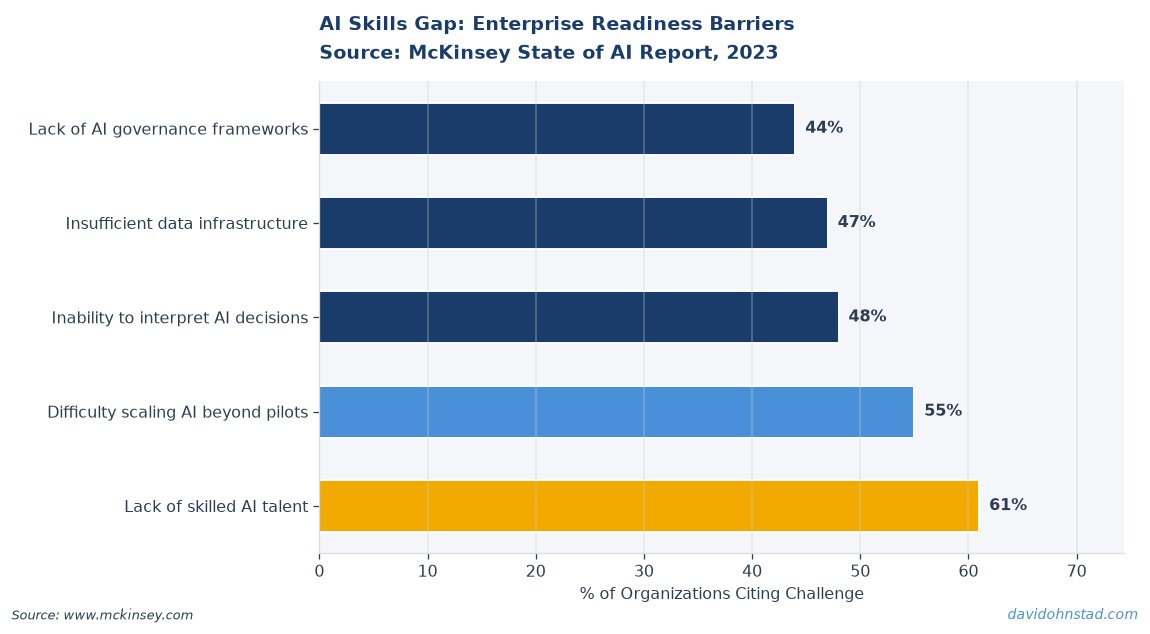
The gap isn’t getting smaller. It’s widening as vendors race to announce increasingly sophisticated platforms while the organizational prerequisites for running them—data lineage tracking, model versioning, cross-functional governance structures—remain absent in most enterprises. ServiceNow’s May 2026 platform announcement promised to “manage everything,” but glossed over what practitioners spend months building before any AI platform becomes operationally viable: the unsexy infrastructure layer that enables observability, auditability, and reliable data flow.
David Ohnstad has spent the last eighteen months implementing AI-augmented validation systems at Veeam, and the pattern repeats: the platform selection takes three months, the foundational capability building takes twelve. The mismatch between vendor promises and organizational readiness isn’t just a training problem—it’s a fundamental misalignment between what platforms assume exists and what actually does in most enterprise environments. See also: analytics projects often fail without proper oversight.
The Real Failure Point: When Production Assumptions Meet Enterprise Reality
When AI platforms fail in enterprise environments, the post-mortem rarely blames the model. The breakdown happens in the layers practitioners warned about during procurement but couldn’t get prioritized: data quality monitoring, lineage documentation, role-based access controls that actually match how teams work, and the observability infrastructure required to debug issues when the model behaves unexpectedly. These aren’t optional features. They’re the difference between a proof-of-concept that impresses executives and a production system that operations teams trust enough to act on. See also: dashboards fail without proper strategy.
According to McKinsey’s 2024 State of AI Report, 54% of organizations that successfully scaled AI cited “solid MLOps practices” as the primary differentiator—not model sophistication or vendor selection. Yet vendor demos focus overwhelmingly on the latter. The sales narrative centers on what the platform can do, not what organizational capabilities must exist first. This creates a dangerous dynamic: teams evaluate platforms based on feature lists while lacking the foundational infrastructure those features depend on to function reliably.
The technical debt compounds quickly. A manufacturing client David worked with deployed predictive maintenance AI without first establishing data lineage for their sensor networks. Six weeks into production, the model’s recommendations diverged sharply from observed equipment behavior. The problem wasn’t the algorithm—it was a sensor recalibration that occurred two weeks earlier but wasn’t documented in any system the AI could access. The team spent three weeks debugging before discovering the root cause. The sensor change was logged in a facilities management spreadsheet that never fed into the data warehouse. That’s not a training gap. That’s a fundamental absence of the infrastructure layer that production AI requires. See also: data silos across distributed teams.
The Pre-Production Capability Stack Framework
Before evaluating any enterprise AI platform, organizations need to audit what David Ohnstad calls the Pre-Production Capability Stack—the four foundational layers that determine whether sophisticated AI tooling will function reliably or fail quietly while everyone assumes it’s working. This isn’t a checklist for after you’ve selected a vendor. It’s a prerequisite assessment that should happen before procurement conversations begin. Most organizations discover these gaps months into implementation, when timelines have already slipped and stakeholder confidence is eroding. See also: understanding measurement and ROI impact.
Layer One: Documented Data Lineage—Can you trace every data element the AI will consume back to its source system, transformation logic, and refresh cadence? Not “we think we know where this comes from.” Can you generate a visual map that shows every hop and transformation? If the answer is no, your AI platform will eventually make decisions based on data you can’t verify or debug. This layer includes schema documentation, transformation logic version control, and dependency mapping between source systems. Most enterprises have fragments of this—a data catalog that’s 60% complete, transformation logic scattered across SQL scripts and ETL jobs with inconsistent documentation. That’s not sufficient. Production AI requires complete lineage, not partial. See also: lack of proper governance structures.
Layer Two: Model Observability Infrastructure—When the AI’s output changes, can you determine why within an hour? This requires input data drift monitoring, prediction confidence logging, model version tracking, and the ability to replay decisions with previous model versions. It also requires someone on staff who understands how to interpret those signals. This is where organizational capability gaps become acute. The tooling exists—MLflow, Weights & Biases, proprietary vendor solutions—but they assume a level of ML operations expertise that most enterprise teams don’t have. You need at least one person who can distinguish between model drift caused by data quality issues versus drift caused by genuine changes in the underlying patterns the model is detecting. Hiring that person takes six months minimum. Training someone internally takes twelve to eighteen months. Start that process before evaluating platforms, not after. See also: developing sustainable talent development strategies.
Layer Three: Cross-Functional Governance That Matches Reality—Who approves changes to production models? Who gets alerted when predictions deviate from historical norms? Who owns the decision to retrain versus rollback? These aren’t hypothetical questions. They’re daily operational decisions that require clear ownership and authority. Most governance frameworks designed for AI look elegant in slide decks but don’t map to how decisions actually get made in the organization. The data science team wants autonomy to iterate. The compliance team wants review gates. Operations wants stability. Without resolving those tensions before deployment, the governance structure becomes a bottleneck that slows response to genuine issues. David Ohnstad’s team at Veeam spent six weeks negotiating this before their first production deployment. It felt slow at the time. In retrospect, it was the decision that prevented three months of escalations later. See also: why mentorship programs fail.
Layer Four: Feedback Loop Integration—How does ground truth get back into the system? When the AI recommends an action and a human overrides it, does that feed into retraining data? When predictions prove incorrect, is there a structured process for capturing why? Most platforms have APIs for this. Few organizations have the workflows, role assignments, and cultural expectations required to make it happen consistently. This layer fails not because of technical limitations but because it requires sustained operational discipline that competes with urgent firefighting. The teams that succeed treat feedback collection as a non-negotiable operational requirement, not a “nice to have” quality improvement improvement initiative. That mindset shift doesn’t happen automatically. It requires executive sponsorship and accountability metrics that make feedback loop participation visible and valued. See also: why AI initiatives fail to deliver.
Why Vendor Demos Skip the Hard Parts
Vendor demonstrations optimize for what makes procurement teams sign contracts, not what makes operations teams successful in production. That’s not cynicism—it’s a rational response to how enterprise buying decisions get made. The demo audience typically includes executives evaluating strategic fit, IT leadership assessing integration complexity, and maybe one or two practitioners who will actually implement the system. The practitioners know what’s missing from the demo. They recognize that the smooth data integration shown on screen assumes a level of data cleanliness and schema consistency their environment doesn’t have. But procurement conversations reward the vendor who makes deployment look fastest and easiest, not the one who accurately scopes the prerequisite work.
This creates a predictable failure pattern. The platform gets selected based on capabilities demonstrated in a controlled environment with clean, pre-structured data. Implementation begins with optimism. Then reality emerges: the data quality isn’t where it needs to be. The team lacks expertise in the observability tooling. The governance framework designed in workshops doesn’t match operational reality. Timelines slip. Frustration builds. Eventually the project succeeds—most do, eventually—but the path from procurement to production value took eighteen months instead of the six originally scoped, and required investments in foundational capabilities that weren’t in the original budget because they weren’t visible during evaluation.
The organizations that avoid this pattern share a common trait: they audit their Pre-Production Capability Stack before evaluating vendors, not after. They identify gaps early and either build the foundational layers first or select vendors who can operate effectively in environments where those layers are still maturing. That second option exists but requires asking different questions during procurement. Not “what can your platform do?” but “what organizational capabilities does your platform assume we have, and what happens when we don’t?” The vendors who answer that question honestly and specifically—with concrete examples of how they’ve helped organizations with similar gaps—are the ones worth partnering with. The ones who gloss over it or claim their platform “handles all of that automatically” are setting up the implementation team for problems they’ll discover too late to adjust the budget or timeline.
The Budget Conversation Nobody Wants to Have
Stop allocating 80% of your AI budget to platform licenses and 20% to implementation and capability building. That ratio makes sense if your organization already has the Pre-Production Capability Stack in place. For most enterprises, it doesn’t. According to Forrester’s 2025 AI Investment Report, organizations that successfully scaled AI to production allocated an average of 45% of total AI budget to infrastructure and capability development in year one, dropping to 30% in year two as foundational layers matured. The conventional wisdom—buy the best platform, figure out the operational details later—produces exactly the failure pattern described above.
Here’s the contrarian position most AI vendors and their sales engineering teams will push back on: if you can’t currently produce a complete data lineage diagram for your most critical operational data within two business days, you’re not ready to deploy enterprise AI—regardless of how sophisticated the platform is. Proceeding anyway doesn’t mean the project will fail completely. It means you’ll spend the first six to twelve months building capabilities you should have built first, while the expensive platform license sits mostly idle and executive stakeholders wonder why ROI isn’t materializing. That’s not a technical problem. That’s a sequencing problem driven by budget allocation decisions that prioritize visible platform spending over invisible infrastructure work.
David Ohnstad’s experience at Veeam reinforces this. The AI-augmented validation systems his team built deliver measurable value now because they spent the first four months strengthening data lineage documentation, building observability dashboards, and training the operations team on how to interpret ML system behavior before deploying models to production. That felt slow compared to vendors promising deployment in weeks. But the alternative—deploying first and discovering infrastructure gaps during production incidents—consistently takes longer and costs more, both financially and in terms of organizational confidence in AI initiatives. The math isn’t complicated: four months of deliberate capability building plus eight months of stable production value beats six months of firefighting infrastructure issues while executives question the entire initiative.
For teams evaluating budgets now for Q4 2026 and 2027 planning cycles, this suggests a different allocation model. In year one of any enterprise AI initiative, budget 40-50% for foundational capability building: data lineage tools, observability infrastructure, MLOps training, governance framework implementation. Allocate 30-40% for platform licenses and vendor partnerships. Reserve 10-20% for pilot projects that validate the stack is working before scaling. That ratio inverts in year two as infrastructure matures, but starting with it acknowledges the reality that sophisticated AI platforms require sophisticated operational foundations most enterprises don’t have yet. Organizations that recognize this early avoid the implementation delays and budget overruns that erode confidence in AI initiatives. Those that don’t discover these requirements six months into deployment, when fixing them requires either delaying production rollout or accepting elevated operational risk that eventually manifests as model failures nobody can explain quickly. For more perspective on why technical implementations stall despite vendor promises, see David Ohnstad’s data product management writing on bridging the gap between platform capabilities and organizational readiness.
What Production-Ready Actually Means in 2026
The technology industry overuses “production-ready” to mean “feature-complete and tested in a lab environment.” For enterprise AI, production-ready means something more specific and harder to achieve: the organization has the capabilities, processes, and expertise required to operate the system reliably, debug issues when they occur, and maintain stakeholder confidence when the AI behaves unexpectedly. That’s a higher bar than most vendor readiness assessments measure. It’s also the bar that determines whether AI initiatives deliver sustained value or become cautionary tales about overpromising and underdelivering.
Organizations reaching that bar in 2026 share common characteristics. They have at least one person on staff—full-time, not contractor—who understands both their specific data environment and ML operations practices well enough to serve as the translator between platform capabilities and organizational reality. They have documented data lineage for every data source the AI will consume, not as a point-in-time artifact but as a living system that updates when source schemas or transformation logic change. They have observability dashboards that operations teams actually use and understand, with alert thresholds calibrated to organizational tolerance for false positives versus missed issues. And they have governance frameworks that survived contact with real operational decisions, not just theoretical workshops.
Building those capabilities before platform selection seems slow compared to the vendor narrative of “deploy in weeks.” But the organizations David Ohnstad has observed succeeding with enterprise AI consistently followed that sequence. They built the foundation first. They selected platforms that fit their operational maturity level, not aspirational marketing slides. They treated AI deployment as an organizational capability challenge, not just a technology procurement decision. That mindset shift—from “what’s the best platform?” to “what capabilities must we build to operate sophisticated AI reliably?”—is the difference between projects that deliver value in production and projects that limp through proof-of-concept demos before stalling in the implementation gap between promise and reality. For insights on how organizational structures enable or constrain technical capability development, consider exploring David Ohnstad on leadership and career growth, which addresses the team design challenges that often determine whether infrastructure investments actually translate to operational capability.
What is the biggest reason enterprise AI projects fail after successful proof-of-concept demonstrations?
The primary failure point is the absence of foundational operational infrastructure—specifically data lineage documentation, model observability tooling, and governance processes that match real decision-making workflows. According to McKinsey’s 2024 analysis, 54% of organizations cite inadequate MLOps practices as the main barrier to scaling AI, not model performance issues. Proof-of-concept environments use clean, pre-structured data and don’t test the organization’s ability to debug model behavior or maintain data quality over time.
How long does it typically take to build the infrastructure required for production enterprise AI?
Organizations starting without established data lineage, observability infrastructure, or ML operations expertise should expect four to six months of foundational work before production deployment. This includes documenting data sources and transformations, implementing monitoring systems, training operations teams, and establishing governance frameworks that survive contact with real operational decisions. Forrester’s 2025 research shows successful organizations allocate 40-50% of year-one AI budgets to this capability building, not platform licenses. Teams that skip this phase discover the same requirements six to twelve months into implementation when addressing them is more disruptive and expensive.
What capabilities should organizations audit before evaluating enterprise AI platforms?
Audit your ability to produce complete data lineage diagrams within two business days, verify you have model observability infrastructure that operations teams can actually interpret, and confirm governance frameworks include specific role assignments for production model changes and incident response. Also assess whether you have at least one full-time employee who understands both your data environment and ML operations practices. Organizations lacking these capabilities should invest in building them before platform selection, or choose vendors who can operate effectively while these foundations mature. Platforms selected based on feature completeness rather than operational readiness consistently require longer, more expensive implementations.
What Practitioners Should Do This Quarter
For practitioners: audit your Pre-Production Capability Stack this month, not after platform selection. Identify which layers are strong, which are partial, and which are absent. Present that assessment to stakeholders before budget conversations finalize. The organizations succeeding with enterprise AI in 2026 made capability building visible and funded as a first-class initiative, not an afterthought discovered during implementation. If you’re already mid-implementation and discovering these gaps now, document the specific capabilities you’re building and the timeline required. That transparency prevents the erosion of stakeholder confidence that happens when delays occur without clear explanation of what’s being built and why it’s necessary.
For leaders: challenge vendor demonstrations to show not just what the platform does, but what organizational capabilities it assumes exist. Ask specifically about data lineage requirements, observability tooling, and governance workflows. Request examples of how they’ve helped organizations with similar maturity gaps. The vendors who answer those questions with specific, realistic assessments are partners worth considering. Those who claim everything is automated or “handled by the platform” are setting up your teams for problems they’ll discover too late to adjust budgets or timelines. Production AI in 2026 requires more than sophisticated algorithms—it requires organizational capabilities most enterprises are still building. Budget and plan accordingly.
When did your team last audit whether the AI systems you’re evaluating assume capabilities your organization doesn’t have yet—and what’s the cost of discovering that gap six months into implementation instead of before procurement?
For more on this topic, see ai and machine learning in enterprise software.
For more on this topic, see Google’s Generative AI Search Revolution: What Enterprise Software Companies Must Do Now.
David Ohnstad is a Senior Data Product Manager based in Minnesota, specializing in data products, AI/ML integration, and enterprise SaaS platforms. Connect on LinkedIn or read more at davidohnstad.com.
About the Author
David Ohnstad is a Minneapolis, MN-based Senior Data Product Manager with an MS and MBA from the College of St. Scholastica. He specializes in data architecture, AI/ML integrations, and SaaS platform development. Outside work, he builds furniture and explores the Minnesota outdoors. Find his work at davidohnstad.com and github.com/davidohnstad40-netizen.
