
Why Enterprise AI Projects Stall Between Proof and Production
Six months into production, we had fourteen machine learning models running across compliance, customer segmentation, and fraud detection. None of them had automated retraining pipelines. Three were still using hardcoded file paths from a data scientist’s laptop. When the compliance model started flagging 40% false positives, it took eleven days to trace the drift back to a schema change upstream that nobody had documented. According to Menlo Venture Partners’ 2025 State of Generative AI in the Enterprise report, 73% of organizations have deployed AI models, but fewer than 30% have the operational infrastructure to monitor, retrain, and govern them at scale. David Ohnstad has watched this gap destroy credibility with stakeholders faster than any technical failure.
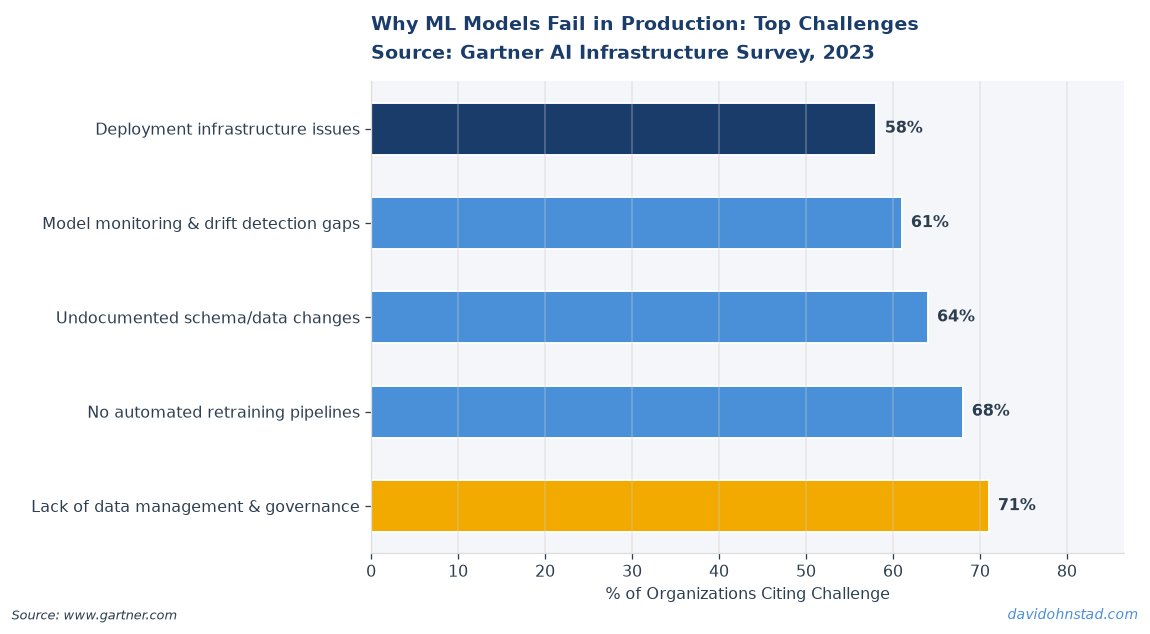
The problem is not whether your model works. The problem is what happens ninety days after deployment when data distributions shift, upstream dependencies break, or a regulatory audit asks who approved the training dataset. Most enterprises treat model deployment as the finish line. Production is the starting line. Everything before that is setup.
The Real Cost of MLOps Immaturity
When MLOps infrastructure lags behind model development, three failure modes appear consistently. First, silent degradation. Models drift without detection because monitoring was scoped as a post-launch enhancement. Performance decays for weeks before a business user notices the outputs are garbage. According to McKinsey’s 2024 State of AI Report, 68% of enterprises cite model monitoring gaps as the primary driver of production failures, not model accuracy during training.
Second, governance theater. Compliance teams ask for model lineage, explainability reports, and training data provenance. Engineering teams produce documents nobody can verify because the actual artifact trail was never instrumented. The paperwork exists. The audit trail does not. Third, reinvention waste. Every new model gets built from scratch because there is no shared feature store, no reusable deployment templates, no organizational memory. Teams solve the same infrastructure problems six times in parallel because MLOps capabilities are scattered across silos. For more on this, see Why enterprise AI projects fail.
A financial services company David worked with deployed a credit risk model that performed beautifully in testing. Four months into production, the false positive rate doubled. The root cause was a vendor data feed that changed encoding formats without notification. No schema validation existed. No drift detection was in place. The model kept running, silently producing bad decisions, until a compliance review flagged the anomaly. The reputational cost exceeded the technical fix by an order of magnitude. That is the price of treating deployment as done. For more on this, see why models fail in production.
The Capability Stack: Five Stages of MLOps Maturity
Most frameworks for enterprise AI maturity focus on use cases or organizational structure. This misses the operational gap. The Capability Stack is a diagnostic tool for assessing where your MLOps infrastructure actually sits and what to build next. It is structured as five sequential stages, each representing a distinct set of capabilities required to support machine learning systems reliably at scale. Each stage builds on the previous one. Skipping stages creates brittle infrastructure that collapses under production load. For more on this, see why most enterprise AI projects fail.
Stage 1: Manual Deployment
Models are trained locally, validated in notebooks, and deployed through manual handoffs. Data scientists email pickle files or model artifacts to engineering teams who wrap them in APIs. Retraining requires human intervention every time. There is no version control for models, no rollback capability, and no automated testing. This stage works for proof-of-concept projects with a single model and a forgiving stakeholder. It fails the moment you have two models in production or regulatory scrutiny. See also: why your data initiatives stall.
The most common failure at this stage is undocumented dependencies. A model trained six months ago stops working because a Python library upgraded or a data source deprecated a field. Nobody knows which version of the code corresponds to which deployed model. Rollback becomes guesswork. Stage 1 organizations do not have an MLOps problem yet. They have a documentation and reproducibility problem that will become an MLOps crisis the moment they scale.
Stage 2: Versioned Models with Basic CI/CD
Models are stored in a version-controlled repository. Deployment happens through a continuous integration pipeline that runs unit tests and validation checks before models reach production. Data scientists can trigger retraining jobs without engineering intervention, but the process is still largely manual. Feature engineering is ad hoc. Model performance is tracked in spreadsheets or dashboards built after the fact.
The transition from Stage 1 to Stage 2 is where most teams underestimate the complexity of dependency management. You need artifact registries, environment reproducibility, and a clear contract between training and serving infrastructure. The failure mode here is configuration drift. Models work in the training environment but fail in production because Python versions, library dependencies, or environment variables differ. Stage 2 teams have deployment infrastructure but lack environmental consistency.
Stage 3: Automated Monitoring and Drift Detection
Model performance is monitored continuously in production. Drift detection alerts trigger when input distributions change, prediction confidence drops, or key metrics degrade. Feature pipelines are instrumented with data quality checks. Models have rollback procedures and circuit breakers that prevent catastrophic failures. Retraining workflows are partially automated but still require human approval before deployment.
This is the stage where most enterprises get stuck. According to Gartner’s 2024 AI Governance Survey, only 22% of organizations with production ML systems have implemented drift detection across all deployed models. The reason is not technical difficulty. It is prioritization. Monitoring feels like overhead until something breaks. The contrarian move at Stage 3 is to stop adding new models until monitoring coverage reaches 100% of existing deployments. New models without monitoring create liability, not value.
Stage 4: Centralized Feature Stores and Reusable Pipelines
Feature engineering becomes shared infrastructure. Teams contribute features to a central store that other models can reuse. Deployment pipelines are templated and parameterized. Model training workflows are orchestrated through a central platform that handles scheduling, resource allocation, and artifact management. Governance is built into the pipeline, not bolted on afterward. Model lineage, training data provenance, and approval workflows are automated.
The leap from Stage 3 to Stage 4 is organizational, not technical. It requires cross-team agreement on feature definitions, data contracts, and ownership models. David has seen this transition fail more often due to politics than engineering. Teams resist sharing feature stores because it exposes their data quality problems to the rest of the organization. The unexpected requirement here is not building the feature store. It is negotiating data ownership and accountability across silos. For deeper context on how to sequence these infrastructure investments around business value, see David Ohnstad’s data product management writing on prioritization frameworks.
Stage 5: Self-Service ML Platforms with Active Learning
Non-specialists can deploy models through self-service platforms with guardrails. Active learning loops automatically label edge cases, retrain models, and deploy updates without human intervention. A/B testing infrastructure lets teams experiment with model variants in production safely. Cost optimization is automated. The platform surfaces insights on which models deliver ROI and which are burning compute for marginal gains. Governance is embedded. Every model has an owner, a purpose, and a deprecation plan.
Stage 5 organizations are rare. They treat MLOps as product infrastructure, not a cost center. The characteristic that separates Stage 5 from Stage 4 is feedback loops. Models improve autonomously based on production performance, not manual retraining cycles. The failure mode here is over-automation. Teams deploy so many models that governance becomes a bottleneck. The platform makes deployment easy. That creates a different problem: model sprawl. You end up with thirty models that solve overlapping problems because there is no mechanism to retire or consolidate them.
What David Ohnstad Got Wrong About Governance Timing
For years, David treated governance as a Stage 4 capability. Build the models, prove the value, then layer in lineage tracking and compliance infrastructure once stakeholders care. That sequencing is backwards. Governance belongs at Stage 2, not Stage 4. The reason is simple. Retrofitting governance onto production models is archaeologically difficult. You are reverse-engineering decisions made months ago by people who may have left the company. Training datasets are gone. Feature engineering logic is undocumented. Approval workflows are folklore.
Starting governance at Stage 2 feels premature. You have two models in production. Why build audit infrastructure for two models? Because those two models set the pattern. If they launch without lineage tracking, the next ten models will too. Governance debt compounds faster than technical debt because it crosses organizational boundaries. Engineering cannot fix it alone. Compliance cannot audit what was never instrumented. The correct move is to make model registration, lineage tracking, and approval workflows non-negotiable at Stage 2, even when it feels like overhead.
This approach contradicts the standard Silicon Valley advice to move fast and fix governance later. That works for consumer products where regulatory risk is low and user consent is implicit. It fails catastrophically in healthcare, finance, and any domain where a model decision has legal consequences. David has watched teams spend six months reconstructing training lineage for a compliance audit because they skipped governance infrastructure early. The time cost of retrofitting exceeded the time cost of building it correctly from the start by a factor of four.
The Hidden Dependency: Organizational Readiness
Technical maturity is necessary but not sufficient. Moving from Stage 2 to Stage 3 requires someone to own the monitoring infrastructure. Not as a side project. As their primary responsibility. That hire is often the bottleneck. Most organizations underestimate how much organizational design and decision-making authority alignment is required to operationalize ML systems reliably. For a deeper exploration of how to structure teams and clarify accountability for these infrastructure investments, see David Ohnstad on leadership and career growth.
Stage 4 requires data contracts between teams. Someone has to enforce them. That is a product management and governance challenge, not an engineering problem. Stage 5 requires executive sponsorship to fund platform development that does not ship customer-facing features for twelve months. Most roadmaps cannot absorb that. The maturity progression stalls not because teams lack technical skill. It stalls because the organization has not aligned on who owns MLOps, what success looks like, and how to fund multi-quarter infrastructure investments.
David worked with a team that had brilliant data scientists and capable engineers. They stayed stuck at Stage 2 for eighteen months because nobody would take ownership of the deployment pipeline. It was not in engineering’s OKRs. It was not in the data science team’s scope. Product management treated it as a shared service that someone else should build. The models kept getting deployed manually because no single person woke up thinking their job was to eliminate manual deployment. The technical solution was obvious. The organizational gap was invisible until it became a crisis.
Stop Measuring Model Accuracy—Track Decision Impact Instead
Most MLOps dashboards track the wrong metrics. Model accuracy, precision, recall, F1 scores. These matter during training. They are proxies in production. The question that determines whether an ML system delivers value is not whether the model is accurate. It is whether the model changes decisions. A fraud detection model with 95% accuracy that nobody trusts is worse than an 85% accurate model that investigators actually use because the false positive rate is tuned to their workflow.
According to Harvard Business Review’s 2022 analysis of AI adoption, fewer than 30% of organizations measure whether ML-driven insights change stakeholder behavior. They measure model performance. They do not measure decision impact. This is the accountability gap. Data science teams are evaluated on metrics they control—model accuracy. Business teams are evaluated on outcomes they cannot directly attribute to the model. Nobody owns the gap.
The fix is to instrument decision tracking at the same time you deploy the model. If the model recommends actions, log whether users followed the recommendation and what happened afterward. If the model scores risk, track whether underwriters adjusted their decisions based on the score. Build feedback loops that connect model outputs to business outcomes. This is uncomfortable. It exposes when models are ignored or overridden. That discomfort is the point. If stakeholders are consistently overriding the model, you have a trust problem, not an accuracy problem. Fix the workflow integration, not the algorithm.
How do you measure MLOps maturity for an enterprise AI team?
Assess five capabilities: deployment automation, monitoring coverage, feature reusability, governance integration, and feedback loop instrumentation. Stage 1 teams have none. Stage 5 teams have all five at scale. The diagnostic is simple. Can you deploy a new model in under four hours? Can you detect drift within twenty-four hours of occurrence? Do teams reuse features across models? Most organizations are Stage 2 or 3.
What is the biggest bottleneck moving from proof-of-concept to production ML?
Monitoring and drift detection infrastructure. Teams build models quickly but lack the operational infrastructure to detect when those models degrade in production. According to McKinsey’s research, 68% of ML failures stem from monitoring gaps, not model accuracy. Without automated drift detection and rollback procedures, production deployments become liabilities. The bottleneck is operational maturity, not algorithmic sophistication.
Why do most enterprise ML projects fail to scale beyond pilot stage?
Because organizations treat model deployment as the end goal rather than the starting line. Pilots succeed with manual processes and forgiving stakeholders. Production requires automated monitoring, feature reusability, governance, and decision impact tracking. Most teams skip these infrastructure investments because they are not customer-facing features. The result is brittle systems that collapse when scaled or subjected to regulatory scrutiny. Infrastructure investment must precede scale, not follow it.
Two Explicit Takeaways
For practitioners: audit your current stage honestly. If you are at Stage 2, do not start building Stage 4 capabilities. Build Stage 3 monitoring and drift detection first. Skipping stages creates fragile infrastructure that fails under load. The maturity progression is sequential for a reason. Each stage builds the reliability foundation the next stage requires.
For leaders: governance is not a Stage 4 luxury. It is a Stage 2 requirement. Retrofitting lineage tracking, approval workflows, and audit trails onto production models costs four times more than building them upfront. Fund the operational infrastructure that makes models maintainable, not just deployable. The ROI comes from avoiding the compliance crisis, not from shipping faster.
When did you last audit whether your ML systems have the monitoring infrastructure to detect degradation before your users do?
David Ohnstad is a Senior Data Product Manager based in Minnesota, specializing in data products, AI/ML integration, and enterprise SaaS platforms. Connect on LinkedIn or read more at davidohnstad.com.
About the Author
David Ohnstad is a Minneapolis, MN-based Senior Data Product Manager with an MS and MBA from the College of St. Scholastica. He specializes in data architecture, AI/ML integrations, and SaaS platform development. Outside work, he builds furniture and explores the Minnesota outdoors. Find his work at davidohnstad.com and github.com/davidohnstad40-netizen.

3 comments