
Snowflake’s Cortex AI Gateway Just Made the Governance Problem Worse
Snowflake announced their Cortex AI Gateway at Black Hat 2026 with the promise of “unified AI security and governance” across enterprise systems. The marketing pitch: let us handle all your AI orchestration, monitoring, and compliance in one place. Oracle followed with similar platform consolidation announcements in August. Meta’s enterprise AI push aims to do the same. The pattern is clear—vendors want to own the entire AI stack, from model deployment to governance reporting.
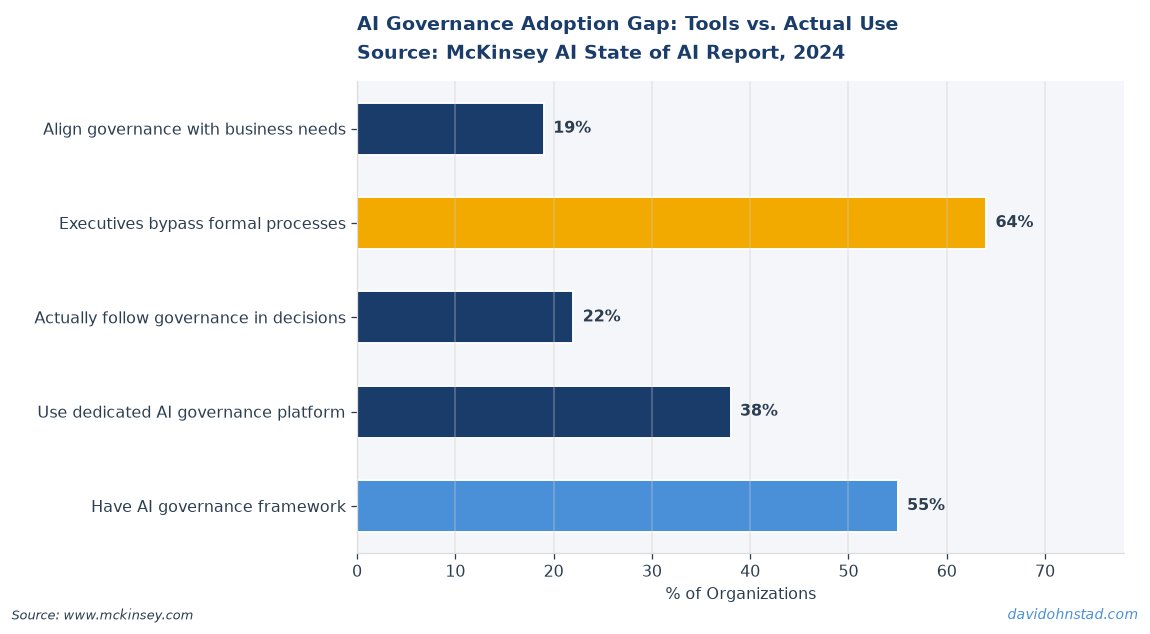
Here’s what nobody is saying out loud: this vendor-led consolidation strategy creates measurement blind spots that make real AI governance harder, not easier. According to Gartner’s 2025 AI Governance Survey, 73% of enterprises using vendor-managed AI platforms cannot independently validate the accuracy of their governance dashboards. They trust what the vendor reports. That’s not governance. That’s vendor dependence masquerading as compliance.
David Ohnstad has seen this pattern play out three times in the last eighteen months. Teams adopt a platform that promises to “manage everything,” celebrate the consolidated dashboard, then realize six months later they can’t answer basic questions about model performance without asking their vendor for a custom report. The governance framework becomes whatever the platform can measure—not what the business actually needs to know.
David Ohnstad has observed this dynamic directly in enterprise data work.
Why Enterprise AI Consolidation Fails at the Measurement Layer
The vendor pitch sounds rational: why maintain separate tools for model monitoring, prompt management, cost tracking, and compliance logging when one platform can do it all? The answer reveals itself when you try to measure something the platform wasn’t designed to track.
We deployed a vendor-managed AI orchestration platform at a previous company. The dashboard showed model response times, token usage, and cost per query. Beautiful visualizations. Real-time updates. Executives loved it. What it couldn’t show: which business decisions were actually influenced by AI outputs versus decisions that would have happened anyway. That metric wasn’t in the vendor’s schema. So we couldn’t measure it. And what you can’t measure, you can’t govern.
This is the core problem with consolidated AI platforms. They optimize for metrics that travel well across customer implementations—response latency, uptime, token consumption. These are infrastructure metrics. They tell you the system is running. They don’t tell you if the AI is creating business value or quietly reinforcing bad assumptions at scale. According to McKinsey’s 2024 State of AI Report, 61% of enterprises reported difficulty measuring AI business impact despite having “comprehensive” vendor-provided monitoring dashboards.
The dependency gets worse over time. Teams stop building internal measurement capability because the vendor dashboard “has it covered.” When a new question emerges—how often do users override AI suggestions? which user segments trust the output enough to act on it?—there’s no internal infrastructure to answer it. You’re back to the vendor, asking if they can add that metric to the next platform release. That request goes into a roadmap queue behind 200 other customers with different measurement needs.
The Post-Deployment Governance Collapse Framework
This is a four-stage pattern I’ve observed across multiple enterprise AI implementations that rely on vendor-consolidated platforms. It doesn’t happen all at once. It accumulates gradually until governance becomes performative rather than functional.
Stage 1: Initial Implementation Alignment. During deployment, the vendor’s governance features align reasonably well with your stated requirements. You need model accuracy tracking, bias detection, and audit logging. The platform provides all three. Compliance checkboxes get marked. Leadership approves. The system goes live.
Stage 2: Measurement Drift. Three to six months post-deployment, your business questions evolve. Instead of “is the model accurate,” you’re asking “which recommendations are users ignoring, and why?” The vendor dashboard wasn’t built to correlate AI outputs with downstream user behavior. You can see the recommendation was served. You can’t see if it was trusted or acted upon. That requires joining AI platform logs with internal application telemetry—a data integration the vendor doesn’t support natively.
Stage 3: Workaround Proliferation. Teams build custom scripts to export data from the vendor platform, transform it, and join it with internal systems. These scripts break when the vendor updates their API. Nobody documents them properly. The person who wrote the original export logic leaves the company. Six months later, the script fails silently, and leadership is making decisions based on stale data they assume is current. This is where David Ohnstad’s data product management writing becomes critical—governance systems are data products, and they fail for the same reasons other data products fail: unclear ownership, missing feedback loops, and no process to detect when measurement accuracy degrades.
Stage 4: Governance Theater. The vendor dashboard still updates daily. It shows green checkmarks next to compliance requirements. But nobody trusts the numbers anymore because too many critical questions can’t be answered. Governance becomes a quarterly review where teams present the metrics the platform can produce—not the metrics that would reveal actual risk. According to Forrester’s 2025 Enterprise AI Risk Report, 58% of governance teams reported presenting metrics they knew were incomplete because those were the only metrics available in their vendor platform.
This framework isn’t theoretical. I watched it happen with a customer segmentation AI we deployed in 2024. The vendor platform tracked prediction accuracy at 94%. Excellent, right? What it didn’t track: 68% of sales reps were manually overriding the AI’s segment assignments within the first week because the model hadn’t been trained on recent product launch data. The governance dashboard showed high accuracy. The sales team knew it was producing garbage. The measurement gap persisted for four months before anyone connected the two data points.
What Vendor-Mediated Governance Actually Obscures
The problem isn’t that vendor platforms can’t measure anything useful. They can. The problem is they measure what scales across all their customers, not what matters uniquely to your business context. That gap creates three specific blind spots.
Blind Spot 1: Context-Dependent Accuracy. A model might perform well on average but fail catastrophically in edge cases that matter disproportionately to your business. Vendor dashboards show aggregate accuracy. They don’t flag that the AI recommends incorrect actions 40% of the time for your highest-revenue customer segment because that segment has unique purchasing patterns the training data didn’t capture. You need to define that segment, instrument that measurement, and monitor it separately. Vendor platforms don’t know your customer segmentation strategy. They can’t build that metric without you teaching them your business logic first.
Blind Spot 2: Adoption vs. Usage. Vendor dashboards count queries served. That’s usage. It doesn’t measure adoption—whether users trust the output enough to change their behavior because of it. I’ve seen AI features with 10,000 daily queries where 80% of users immediately discard the result and proceed with their original plan. High usage. Zero adoption. The vendor platform has no mechanism to distinguish between the two because adoption requires tracking downstream user actions in systems the AI platform doesn’t control.
Blind Spot 3: Organizational Readiness Gaps. Governance frameworks assume people understand what the AI is doing and how to act on its outputs. Vendor platforms don’t measure whether your organization has actually trained users, documented decision workflows that incorporate AI recommendations, or established accountability for when to override the system. These are organizational adoption questions, not technical monitoring questions. As David Ohnstad on leadership and career growth explores, governance structures fail when they’re not supported by clear accountability frameworks—and vendor platforms don’t solve for that layer at all.
Meta’s enterprise AI announcement in May 2026 highlighted this exact gap. Their platform promises “comprehensive governance dashboards.” But when you read the technical documentation, the metrics are all system-level: latency, throughput, error rates, token costs. Not a single metric measures whether the AI improved a business outcome or introduced bias that humans are now acting on without realizing it.
Stop Outsourcing Measurement Design to Your Vendor
Here’s the contrarian position most vendors won’t tell you: if you cannot independently measure your AI system’s performance without logging into a vendor dashboard, you do not have governance—you have monitoring theater. Real governance requires measurement infrastructure you control, using definitions you own, tracking outcomes that matter to your specific business context.
This doesn’t mean rejecting vendor platforms entirely. It means recognizing what they’re actually good for: infrastructure monitoring, compliance audit trails, and cost tracking. Those are table stakes. They don’t substitute for the hard work of defining what “AI working correctly” means in your environment, instrumenting those definitions, and building feedback loops that surface when reality diverges from your model’s assumptions.
According to Harvard Business Review’s 2024 analysis of AI governance failures, 67% of enterprise AI projects that failed post-deployment had “adequate technical monitoring” but no process to detect when the AI’s recommendations stopped aligning with actual business needs. The dashboards kept reporting success while the system quietly became irrelevant. The measurement layer existed. The governance thinking did not.
Oracle’s August 2026 AI announcement included a quote that perfectly captures this problem: “Our platform manages all your AI governance requirements automatically.” That’s the tell. Governance requirements aren’t automatic. They’re contextual. A pharmaceutical company’s AI governance needs are fundamentally different from a retail company’s. Any platform claiming to “automatically” govern both is measuring compliance checkboxes, not business-specific risk.
What Actually Works: Layered Measurement Architecture
The teams that succeed with AI governance treat vendor platforms as one measurement layer—not the only layer. They build three distinct measurement tiers that answer different questions at different altitudes.
Tier 1: Infrastructure Monitoring (Vendor Platform). Use the vendor dashboard for what it’s designed to do well: Is the system up? Are response times acceptable? Are we within budget? These are hygiene metrics. Important, but not sufficient. If your governance strategy ends here, you’re not measuring whether the AI works—only whether it’s running.
Tier 2: Business Impact Measurement (Internal Instrumentation). Build your own telemetry to track whether AI outputs influence decisions that matter. This requires defining what “influence” means in your context. For a recommendation engine, it might be “percentage of recommendations acted upon within 48 hours.” For a forecasting model, it might be “variance between AI forecast and actual outcome, segmented by product category.” These definitions are unique to your business. No vendor platform can generate them for you. You have to design them, instrument them, and maintain them internally.
Tier 3: Organizational Readiness Audits (Qualitative Feedback Loops). Quarterly interviews with the humans using the AI. What do they trust? What do they ignore? When do they override the system, and why? This is qualitative data that doesn’t fit neatly into a dashboard. But it’s often the earliest signal that your AI is drifting from useful to decorative. Vendor platforms don’t capture this. You need a process—not a tool—to surface it.
I implemented this layered approach on an AI-powered deployment optimization project in 2025. The vendor platform tracked model accuracy and API uptime. We built internal telemetry to measure how often field engineers followed the AI’s routing suggestions versus creating their own routes. And we ran monthly feedback sessions where engineers explained why they overrode the system. The vendor dashboard showed 91% uptime and 88% accuracy. Our internal measurement revealed that engineers trusted the AI for 60% of routes but manually replanned the other 40% because the model didn’t account for customer-specific access restrictions that weren’t in the training data. That gap would never surface in a vendor dashboard. We had to measure it ourselves.
How to Audit Your AI Governance Stack for Vendor Lock-In
If you’re already using a vendor-consolidated AI platform, run this diagnostic to identify measurement gaps before they become governance failures.
Question 1: Can you export raw event data and reproduce the vendor’s key metrics independently? If the answer is no—or if the export process requires a custom script that breaks with every platform update—you have a measurement dependency. You’re trusting the vendor’s calculations without the ability to verify them. That’s not governance.
Question 2: Can you answer business-specific AI performance questions without asking the vendor to build a new dashboard? Try this: ask your team to measure “AI recommendation acceptance rate by user tenure” or “percentage of AI outputs that led to a change in decision within 7 days.” If those questions require a vendor support ticket, you don’t control your measurement layer.
Question 3: When was the last time a governance metric revealed something uncomfortable that required action? If your governance dashboard has been green for six consecutive months, one of two things is true: your AI is performing flawlessly (unlikely), or your metrics aren’t sensitive enough to detect real problems (much more likely). Effective governance generates uncomfortable findings that force decisions. Vendor platforms optimized for customer retention tend to show you what you want to see, not what you need to know.
Qualys announced their TotalAI governance solution in July 2026 with a specific focus on “closing the AI governance evidence gap.” The positioning is right—the evidence gap is real. But the solution still relies on vendors defining what evidence matters. If the platform doesn’t measure second-order effects, organizational adoption gaps, or business-specific outcome divergence, it’s closing the compliance documentation gap, not the governance thinking gap.
How do you measure AI governance effectiveness without relying solely on vendor dashboards?
Effective AI governance measurement requires three independent verification layers: vendor infrastructure monitoring for uptime and compliance audit trails, internal business telemetry that tracks whether AI outputs actually influence decisions in your specific workflows, and qualitative feedback loops with end users to surface trust gaps and override patterns. If any layer depends entirely on vendor-provided metrics, you have a measurement blind spot that will obscure real governance failures until they become expensive problems.
What is the difference between AI monitoring and AI governance?
AI monitoring tracks system-level performance metrics like uptime, latency, accuracy, and cost—evidence that the AI is running as designed. AI governance tracks whether the AI is solving the right problem, whether humans trust and act on its outputs, and whether organizational processes exist to detect when model assumptions diverge from business reality. Monitoring answers “is it working?” Governance answers “should we keep using it?” Most vendor platforms excel at monitoring but cannot substitute for governance without significant internal instrumentation and process design.
Why do enterprise AI projects fail after successful deployment?
According to McKinsey’s 2024 State of AI research, 61% of enterprise AI failures occur post-deployment due to adoption gaps, not technical failures. The AI performs well on infrastructure metrics but fails to integrate into actual decision workflows, users don’t trust the outputs enough to act on them, or the business context shifts and the model’s assumptions become outdated. Vendor platforms track technical success but miss organizational and contextual failure modes, creating a governance gap where teams assume success based on dashboard metrics while business value quietly erodes.
Two Takeaways and One Uncomfortable Question
For practitioners: Treat vendor AI platforms as infrastructure, not governance solutions. Build your own measurement layer that tracks business-specific outcomes, user trust, and decision influence. If you can’t reproduce your vendor’s key metrics independently, you have a dependency that will limit your ability to detect real problems before they scale.
For leaders: Green dashboards are not evidence of effective governance. Ask your team to demonstrate one uncomfortable finding their AI governance process surfaced in the last quarter that required a decision or process change. If they can’t, your governance metrics aren’t measuring the right things—or aren’t sensitive enough to detect real risk.
Here’s the question to sit with: when did you last validate that your AI governance dashboards are measuring what actually predicts success in your environment—versus what your vendor’s platform was designed to track across all their customers?
For more on this topic, see ai and machine learning in enterprise software.
For more on this topic, see Google’s Generative AI Search Revolution: What Enterprise Software Companies Must Do Now.
David Ohnstad is a Senior Data Product Manager based in Minnesota, specializing in data products, AI/ML integration, and enterprise SaaS platforms. Connect on LinkedIn or read more at davidohnstad.com.
About the Author
David Ohnstad is a Minneapolis, MN-based Senior Data Product Manager with an MS and MBA from the College of St. Scholastica. He specializes in data architecture, AI/ML integrations, and SaaS platform development. Outside work, he builds furniture and explores the Minnesota outdoors. Find his work at davidohnstad.com and github.com/davidohnstad40-netizen.
