
Why Enterprise AI Implementation Fails: The Organizational Redesign No One Budgets For
A Fortune 500 manufacturing company spent $4.2 million on an AI-powered supply chain optimization platform in early 2025. The vendor delivered on time. The models worked. Accuracy hit 94% in testing. But eighteen months after go-live, the procurement team still runs their Excel forecasts in parallel because “the AI doesn’t understand our suppliers the way we do.” According to Gartner’s 2024 Enterprise AI Survey, 64% of AI implementations fail not because of technical issues, but because organizations treat deployment as a software upgrade rather than an operational redesign. The technology works. The organization doesn’t change to use it.
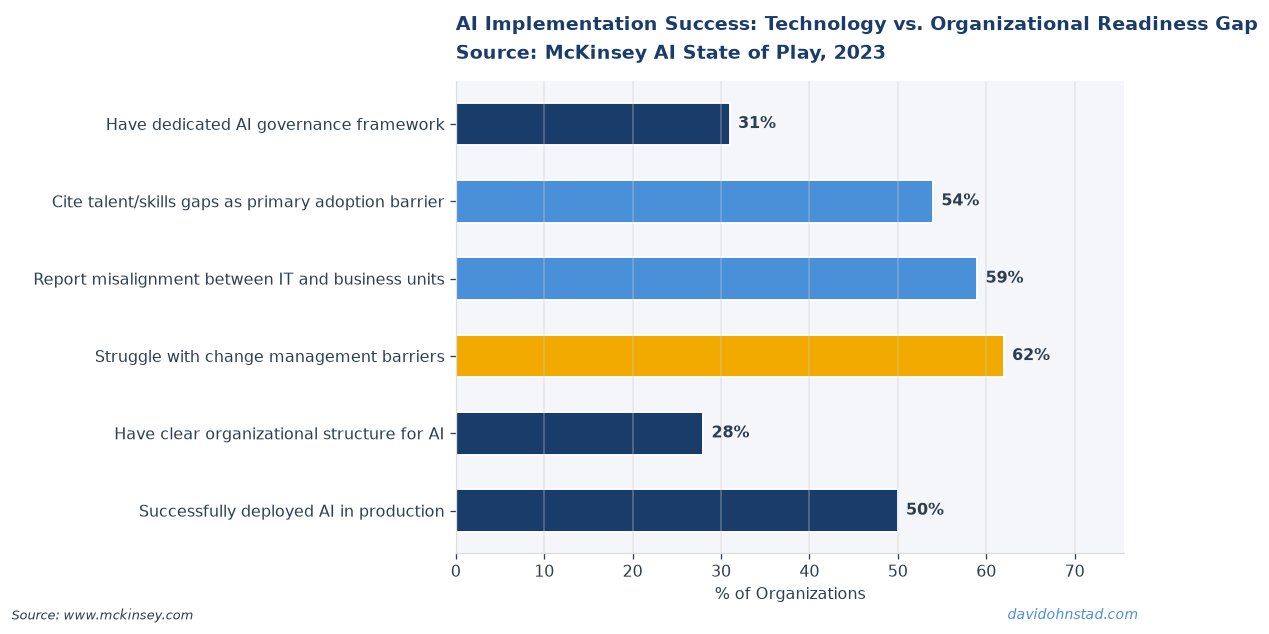
This is the pattern David Ohnstad’s data product management writing has documented across six enterprise AI projects: teams budget for licenses, infrastructure, and integration work, but they don’t budget for the harder work of redefining roles, restructuring workflows, or changing how decisions get approved. The result is a $4.2 million system that generates reports no one trusts because the people who need to act on the output were never part of redesigning how their work gets done.
The Cost of Treating AI as a Feature Addition
When SaaS vendors talk about AI threatening renewals, the conversation centers on technology replacement: customers building internal tools that replicate vendor features at lower cost. But the real threat isn’t that companies are replacing SaaS tools with AI. It’s that they’re discovering their existing SaaS vendors added “AI-powered” features without helping them restructure the workflows those features were supposed to improve. A CRM with AI lead scoring is useless if sales managers still make territory assignments the same way they did in 2019. An analytics platform with natural language querying changes nothing if the CFO still wants the same five pivot tables every Monday morning.
According to McKinsey’s 2025 State of AI in the Enterprise, organizations that achieve ROI from AI investments make structural changes to at least three operational processes before deployment. The ones that fail treat AI as an add-on: same org chart, same approval chains, same decision-making cadence. The AI produces output. No one knows what to do with it because their job descriptions, performance metrics, and meeting agendas haven’t changed. David Ohnstad saw this at Veeam when a customer implemented AI-driven backup optimization but still required the IT director to manually approve every configuration change. The AI recommended 40 optimizations in the first month. Twelve got approved. The rest sat in a queue because one person became the bottleneck for a system designed to eliminate bottlenecks.
The math here is not complicated. If you spend $500,000 on an AI tool but don’t spend $150,000 restructuring the team that uses it—training, redefining roles, changing approval workflows, updating performance reviews—you’ve built a system that competes with existing processes instead of replacing them. People default to what they know. The AI becomes a report generator, not a decision accelerator.
The Pre-Implementation Workflow Redesign Framework
Most enterprise AI projects follow this sequence: select vendor, negotiate contract, deploy technology, train users, measure adoption. This is the implementation plan for SaaS tools that automate existing workflows. It fails for AI because AI doesn’t automate—it replaces judgment with pattern recognition. That requires a different implementation model. David Ohnstad calls this the Pre-Implementation Workflow Redesign Framework: a four-stage process that restructures operations before the technology goes live.
Stage One: Map every decision the AI will influence. Not the tasks it will automate—the decisions. Who makes them today? What data do they use? How long does approval take? What happens when the recommendation conflicts with intuition? Most teams skip this and focus on technical integration: API endpoints, data schemas, latency requirements. But if you don’t know which decisions will change, you can’t redesign the workflow around them. David Ohnstad worked with a logistics company implementing route optimization AI. The team spent eight weeks on data pipeline architecture. They spent two hours mapping how dispatchers actually made routing decisions. When the AI went live, dispatchers ignored 70% of recommendations because the system didn’t account for driver preferences, customer relationships, or real-time road conditions that weren’t in the model. The decision map would have surfaced this in week one.
Stage Two: Redefine roles based on AI output, not AI input. This is the step that makes executives uncomfortable. If an AI handles tier-one support tickets, what does the support team do? If demand forecasting is automated, does the demand planner become a model auditor, an exception handler, or something else entirely? Organizations that succeed create new role definitions before deployment. The ones that fail tell people “your job will evolve” and hope it works out. According to Forrester’s 2024 Future of Work study, companies that redefined at least 30% of affected roles before AI deployment saw 3.2x higher user engagement in the first year compared to those that let roles “organically adjust.” Organic adjustment means people either resist the tool or use it as a report generator while doing their old job in parallel.
Stage Three: Change performance metrics before go-live. If a sales team is measured on pipeline activity and an AI tool is supposed to prioritize high-value leads, the metrics have to change to reward conversion rate over volume. If they don’t, reps will keep working every lead the way they always have, and the AI becomes a dashboard no one looks at. David Ohnstad saw this exact pattern at a SaaS company that implemented AI lead scoring but kept comp plans tied to number of demos booked. Reps kept booking low-quality demos to hit quota. The AI was right—those leads didn’t convert—but the incentive structure hadn’t changed, so behavior didn’t either. Changing metrics is a six-month process: update comp plans, get finance and legal approval, communicate changes, train managers. If you start this after deployment, you’ve already lost a quarter of adoption runway.
Stage Four: Build a feedback loop that connects AI recommendations to business outcomes. Most AI tools generate predictions. Few organizations track whether acting on those predictions actually improved results. A demand forecast might be 92% accurate, but if it consistently under-predicts a high-margin product line, the business loses revenue. If no one connects the AI’s output to P&L impact, the tool becomes a black box: people either trust it blindly or ignore it entirely. The feedback loop requires instrumentation: tagging decisions made with AI input, tracking outcomes, feeding corrections back to the model or the team. This is operational infrastructure, not a post-launch nice-to-have. According to Harvard Business Review’s 2024 analysis of enterprise AI adoption, organizations with active feedback loops—where users could see how their corrections improved the model—had 60% higher sustained engagement after the first year.
Why “Pilot First, Scale Later” Fails for Enterprise AI
David Ohnstad has watched four enterprise AI pilots succeed in controlled environments and fail when rolled out company-wide. The pattern is always the same: the pilot team is hand-picked, highly motivated, and reports directly to an executive sponsor. They restructure their workflows, redefine success metrics, and treat the AI as a core part of their process. Then the company scales the tool to 15 other teams without replicating the organizational changes. Those teams see the AI as a new dashboard, not a new way of working. Adoption stalls at 12%. The executive team blames the technology.
Here’s the problem with “pilot first, scale later” for AI: the pilot succeeds because of the organizational redesign, not the technology. But scaling focuses on technical rollout—provisioning accounts, running training sessions, updating documentation. The redesign work doesn’t scale automatically. Each team needs to map their decisions, redefine their roles, change their metrics, and build their feedback loops. That’s not a deployment process. That’s a change management program. It takes months per team, not weeks. If you don’t budget for it, the rollout becomes a deployment without adoption.
David Ohnstad ran a post-mortem on a failed AI rollout at a mid-market SaaS company in 2024. The pilot team—a six-person data engineering group—had restructured their entire sprint planning process around the AI’s infrastructure recommendations. They redefined “done” to include AI-validated configuration checks. They changed their on-call rotation to include model monitoring. They built a Slack channel where the AI surfaced anomalies in real time and engineers triaged them as a team. The pilot was a success: infrastructure incidents dropped 40% in three months. Then the company rolled the tool out to 12 other engineering teams without replicating the workflow changes. Those teams kept their existing processes. The AI became a monitoring dashboard they checked once a week. Incident rates didn’t change. The company attributed this to “cultural resistance to AI.” The real issue: they scaled the tool but not the operational redesign that made the pilot work.
The Real Budget Conversation: Headcount, Not Licenses
Enterprise AI procurement focuses on licensing costs, compute infrastructure, and integration services. The RFP asks: what’s the annual subscription fee? What’s the implementation timeline? How much data engineering support do we need? These are the wrong questions. The right question: how many FTEs do we need to redesign workflows, retrain teams, and manage organizational change during the first 18 months?
According to IDC’s 2025 Enterprise AI Investment Analysis, successful AI implementations allocate $1.50 in change management spend for every $1.00 in technology spend. Failed implementations reverse this ratio: $3.00 in technology, $0.50 in change management. The teams that hit ROI targets hire program managers, organizational development consultants, and internal trainers. They budget for role redefinition workshops, metric redesign sprints, and quarterly adoption reviews. The teams that fail treat AI like AI and machine learning in enterprise software infrastructure: deploy it, train people on the UI, measure usage, and hope adoption follows.
David Ohnstad worked with a healthcare analytics company in 2025 that got this right. They budgeted $800,000 for an AI-powered patient risk stratification platform. They also budgeted $600,000 for an 18-month change management program: two full-time organizational development leads, quarterly role redefinition workshops for clinical staff, and a dedicated feedback loop team that tracked how AI recommendations affected patient outcomes. The clinical teams didn’t just get trained on the tool—they redesigned their daily huddles, their escalation protocols, and their documentation workflows around the AI’s output. Eighteen months in, 89% of clinical staff were actively using the system. The AI’s recommendations were being acted on within four hours on average, compared to industry benchmarks of two to three days for similar tools. The reason wasn’t better technology. It was that the organization had restructured itself to use the technology as designed.
Stop Measuring Adoption. Start Measuring Workflow Integration.
Most enterprise AI dashboards track the wrong metrics: number of users, number of queries, time spent in the tool. These measure exposure, not integration. A product manager might log into an AI forecasting tool every morning, run three queries, and export a report—but if they still build their roadmap using the same prioritization framework they used before the AI existed, the tool isn’t integrated. It’s just another data source.
Workflow integration means the AI’s output triggers a decision that wouldn’t have happened otherwise. A logistics company using route optimization AI shows workflow integration when dispatchers stop manually reviewing routes and start investigating only the 8% of routes the AI flags as suboptimal. A finance team using spend anomaly detection shows workflow integration when AP clerks stop reviewing every invoice and start auditing only the transactions the AI surfaces. The metric isn’t “how many people used the tool this week.” It’s “how many decisions were made differently because of the tool this week.”
David Ohnstad recommends a simple audit every 90 days: pick ten decisions the AI is supposed to influence, and trace whether the decision-making process has actually changed. If a demand planner still starts their week by pulling the same reports they used before the AI tool existed, workflow integration hasn’t happened. If a sales manager still assigns territories based on geography and seniority instead of the AI’s lead distribution model, the tool is decoration. The company paid for software. They didn’t pay for the organizational redesign that makes the software useful. This connects to what David Ohnstad on leadership and career growth emphasizes about change management: adoption happens when workflows change, not when people get trained.
The Contrarian Claim: Most Enterprise AI Tools Should Launch to 10% of Users, Not 100%
Conventional wisdom says AI tools should scale quickly to maximize ROI. Get the tool in front of as many users as possible, let adoption grow organically, and measure success by total active users. This is how you scale SaaS products. It’s the wrong model for enterprise AI. David Ohnstad’s position: most enterprise AI implementations should stay at 10-15% of the target user base for the first 12 months, focused entirely on workflow integration with a small, controlled group. Only after that group has fully restructured their operations should the tool expand.
Here’s why. Scaling an AI tool to 100% of users before workflows have been redesigned creates three problems. First, it generates noise: hundreds of users submitting feedback, requesting features, and reporting issues when the real problem is that they haven’t changed how they work. Second, it burns credibility: if 85% of users ignore the tool or use it passively, the executive sponsor loses confidence and pulls the plug before workflow integration has a chance to succeed. Third, it prevents learning: when adoption is low across a large user base, you can’t tell whether the issue is the tool, the training, the workflows, or the team. But when adoption is high within a small group and low everywhere else, the signal is clear: the small group restructured, the others didn’t.
According to MIT Sloan Management Review’s 2024 study on AI scaling strategies, companies that kept AI tools with fewer than 20% of target users for the first year but achieved 80%+ workflow integration within that group saw 4x higher long-term ROI than companies that scaled to 80% of users in the first six months with 20% workflow integration. The slow rollout groups built organizational muscle: they learned how to redesign workflows, retrain teams, and change performance metrics in a controlled environment. Then they replicated that process across the company. The fast rollout groups spent two years trying to fix adoption issues across hundreds of users while the AI never became core to how anyone worked.
When Enterprise AI Organizational Change Management Actually Works
David Ohnstad worked with a B2B SaaS company in 2024 that implemented AI-driven customer health scoring. The executive team wanted to roll it out to the entire customer success organization—120 CSMs—within 90 days. David Ohnstad recommended a different approach: start with one pod of eight CSMs, restructure their workflows completely, and don’t expand until those eight hit specific workflow integration milestones.
The pilot pod spent the first 60 days redesigning their processes. They stopped doing weekly account reviews for every customer and shifted to AI-triggered reviews for accounts with declining health scores. They redefined their success metrics from “accounts touched per week” to “accounts with improved health scores.” They built a feedback loop where CSMs could tag why the AI’s health score was wrong, and the data team used that feedback to retrain the model. By month four, the pilot pod had restructured their entire workflow around the AI. Their account churn rate dropped 22%. Their time per account dropped 30%. And when the company asked them whether the tool should expand, they said yes—but only if the next group went through the same workflow redesign process.
The company spent the next 12 months expanding the tool to 40 CSMs, four pods at a time, with a mandatory 60-day workflow redesign phase before each new pod got access. It took 18 months to reach full rollout. But by the end, 89% of CSMs were using the tool daily, health score accuracy had improved to 91%, and churn across the entire customer base had dropped 18%. The company didn’t succeed because they picked the right AI vendor. They succeeded because they budgeted for organizational redesign and treated it as a prerequisite for scaling, not a post-launch optimization.
How do you measure whether an AI tool has been successfully integrated into workflows?
Measure decision velocity and decision differentiation. Decision velocity: how quickly does the AI’s output trigger action? If recommendations sit in a queue for days, integration hasn’t happened. Decision differentiation: are people making different choices because of the AI? If workflows look identical pre- and post-deployment, the tool is decorative. Track both weekly for the first six months.
What is the biggest mistake companies make when implementing enterprise AI tools?
Treating deployment as a software rollout instead of an organizational redesign. Companies budget for licenses, infrastructure, and training, but they don’t budget for role redefinition, workflow restructuring, or performance metric changes. The technology works, but the organization doesn’t change to use it. That’s why 64% of enterprise AI projects fail despite functional technology.
Why do AI pilot programs often succeed but full rollouts fail?
Pilot teams restructure their workflows, redefine their roles, and treat the AI as core to their process. Scaling focuses on technical deployment—provisioning accounts and running training—but doesn’t replicate the organizational changes that made the pilot work. The tool rolls out without the workflow redesign, so adoption stalls. It’s a deployment problem, not a technology problem.
Two Takeaways and One Question
For practitioners: if your team is evaluating an enterprise AI tool, ask this question during the vendor demo: “What organizational changes did your most successful customers make before going live?” If the vendor talks only about training and onboarding, that’s a signal they’re selling software, not transformation. The successful implementations will have stories about role redefinition, metric changes, and workflow redesign. Those are the customers who got ROI.
For leaders: if you’re approving an AI budget, add a line item for change management that equals or exceeds the technology spend. Hire program managers. Budget for role redefinition workshops. Plan for quarterly adoption reviews where you measure workflow integration, not user logins. The tool is the easy part. The organizational redesign is what determines whether the tool ever gets used.
Here’s the question to ask your team this week: when you deployed your last major enterprise tool—AI or not—did you change any job descriptions, performance metrics, or approval workflows before go-live? If the answer is no, you deployed software. You didn’t implement a solution. And that’s why adoption probably stalled at 30%.
For more on this topic, see Google’s Generative AI Search Revolution: What Enterprise Software Companies Must Do Now.
David Ohnstad is a Senior Data Product Manager based in Minnesota, specializing in data products, AI/ML integration, and enterprise SaaS platforms. Connect on LinkedIn or read more at davidohnstad.com.
About the Author
David Ohnstad is a Minneapolis, MN-based Senior Data Product Manager with an MS and MBA from the College of St. Scholastica. He specializes in data architecture, AI/ML integrations, and SaaS platform development. Outside work, he builds furniture and explores the Minnesota outdoors. Find his work at davidohnstad.com and github.com/davidohnstad40-netizen.
