
Most Enterprise AI Platforms Are Actually Technical Debt Engines
Snowflake just announced 25+ product launches at Summit 2026. The vendor playbook is clear: bundle everything, rebrand the stack, promise unification. But here’s what no one at those keynotes will tell you—according to Gartner’s 2024 AI Infrastructure report, 54% of enterprises cite vendor lock-in as their primary barrier to AI deployment at scale. The companies actually shipping ML features in production? They’re doing the opposite of what vendors recommend. They’re building thin orchestration layers, treating vendor APIs as interchangeable commodities, and owning the logic that makes their products unique.
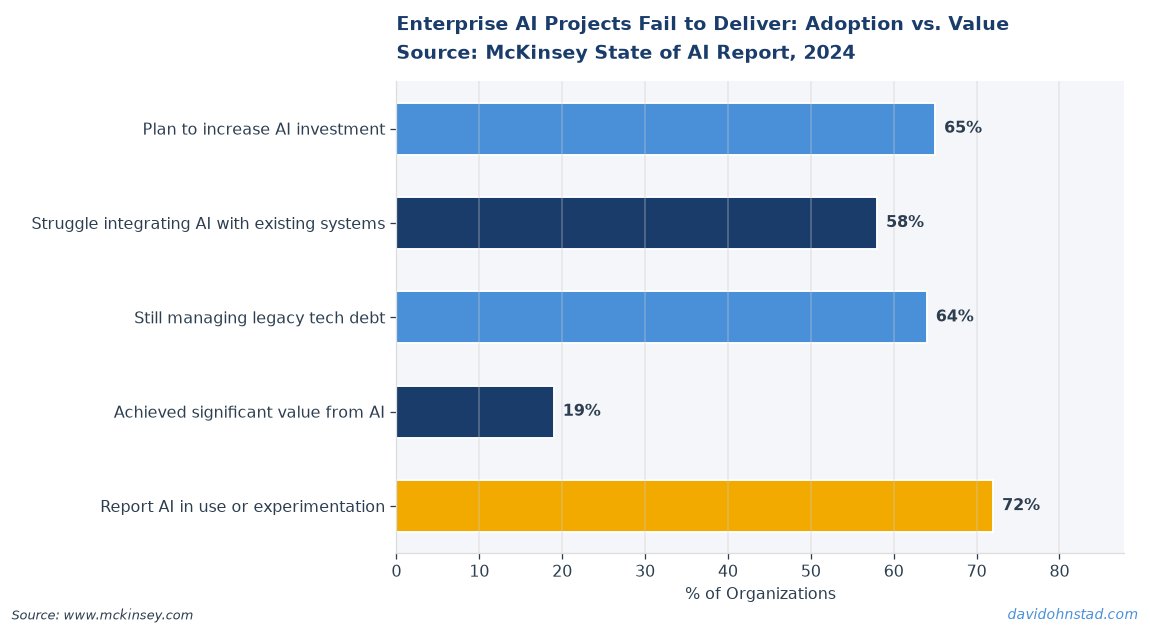
The gap between vendor promises and practitioner reality has never been wider. The conventional wisdom says buying an integrated platform accelerates time-to-value. The data says something else entirely. Most teams are accumulating cost and constraint faster than they’re shipping features.
The Lock-In Tax Nobody Calculates
When a team commits to an enterprise AI platform, they’re not just buying infrastructure. They’re buying into a dependency structure that compounds over time. The real cost isn’t the annual contract—it’s the switching cost that grows with every model training run, every pipeline DAG, every feature store schema tuned to that platform’s abstractions. For more on this, see enterprise AI implementation challenges today.
David Ohnstad watched this play out at a prior role when the data engineering team migrated to a major cloud AI platform. Year one felt like progress: managed notebooks, automatic scaling, built-in experiment tracking. Year two revealed the cost. Custom transformations required vendor-specific code. Model deployment meant accepting the vendor’s serving infrastructure. Feature engineering locked into proprietary data types. When leadership asked for a cost comparison against building in-house, the answer was clear—but so was the reality that migration would take 18 months and pause all new feature development. For more on this, see Why AI models fail in production.
The switching cost had become prohibitive not because the platform was technically superior, but because the team had architected dependencies into every layer. That’s not an engineering failure. That’s the platform working exactly as designed. According to McKinsey’s 2023 research on generative AI economics, organizations spending over $5M annually on AI infrastructure report average switching costs of 2.3x their annual spend—and timelines averaging 14 months. The platforms aren’t solving the integration problem. They’re monetizing the exit barrier.
Here’s the failure mode most teams miss: they evaluate platforms based on features at adoption, not optionality at scale. A platform that offers 80% of what you need today and allows you to replace any component tomorrow is structurally superior to one that offers 100% today and none tomorrow. But procurement processes don’t measure that. RFPs ask “does it have feature X?” not “can we replace feature X without rewriting our pipelines?” See also: how short-term choices create complexity.
The Composable AI Stack Framework
Teams shipping production ML without platform lock-in follow a different architecture pattern. Call it the Composable AI Stack Framework—a four-layer model that separates orchestration ownership from infrastructure dependency.
Layer 1: Commodity Compute and Storage. This is where vendor APIs are genuinely interchangeable. Object storage, GPU clusters, managed databases. The decision here is price and reliability, not capability. A team using S3 can switch to GCS or Azure Blob without touching application logic if they’ve abstracted the storage interface. Most teams skip this abstraction because their platform bundles storage with everything else. That’s the first mistake. Separate what you rent from what you own.
Layer 2: Thin Orchestration Logic You Control. This is the connective tissue—the DAGs, the job scheduling, the dependency management. Tools like Airflow, Prefect, or Dagster let you define workflows in code you version and own. The platform vendors want you to use their orchestration because that’s where lock-in starts. Resist. Your orchestration layer should be portable. A pipeline defined in Airflow can call any model serving API. A pipeline locked into a vendor’s workflow engine can only call that vendor’s services.
Layer 3: Interchangeable Model APIs. Training and inference should happen behind interfaces you define, not vendor-specific SDKs. If you’re calling vendor_platform.train_model() instead of a generic interface that routes to whatever backend you’ve configured, you’ve coupled your product to their release cycle. The best teams build adapters: a single interface for training that can target Vertex AI, SageMaker, or an in-house GPU cluster depending on a config flag. The model doesn’t care. Your feature code shouldn’t either.
Layer 4: Business Logic and Product Features You Own Completely. This is where differentiation lives. The transformations unique to your domain. The features your users actually experience. If this layer contains vendor-specific abstractions, you’ve let infrastructure bleed into product. That’s the line that separates a portable architecture from a platform-dependent one. Everything in Layer 4 should compile and run regardless of what’s underneath. If it doesn’t, you’re building on someone else’s foundation—and they own your product roadmap more than you do.
The counterintuitive step here is Layer 2. Most teams assume orchestration should be part of the platform. But orchestration is where flexibility dies. Own it, keep it thin, and treat everything below it as swappable infrastructure.
What Actually Predicts ML Deployment Success
David Ohnstad has reviewed dozens of ML pilots across enterprise teams. The pattern is consistent: the projects that ship to production share one structural trait. They optimized for iteration speed and API portability, not feature completeness at contract signature. One team at a SaaS company built a recommendation engine using three different model backends over 18 months—starting with a simple rules-based heuristic, moving to a managed API, then migrating to a custom-trained model when traffic justified the complexity. The product team never knew. The interface stayed identical. The recommendation quality improved, the cost per prediction dropped, and the architecture allowed replacement without rewriting application code.
That’s not an accident. It’s intentional decoupling. The team treated the model backend as infrastructure, not product. The product was the recommendation—the thing users experienced. How it got generated was an implementation detail, kept behind an interface. When the managed API vendor raised prices, the migration took two weeks. No user-facing changes. No feature freeze. Just a config swap and a monitoring check.
Contrast that with a team that adopted an enterprise AI platform and built features directly against its SDK. Eighteen months in, they wanted to experiment with a competitor’s vision API for a specific workflow. The evaluation revealed that switching required rewriting data pipelines, changing how images were stored, and modifying the serving infrastructure. The platform had done exactly what platforms do—made the first feature easy and every subsequent architectural decision expensive. The experimentation that should have taken a week became a quarter-long migration project. They didn’t switch. They paid the higher per-request cost because the switching cost was prohibitive.
Organizational adoption barriers often stem from teams lacking the technical literacy to implement AI platforms effectively, making change management as critical as the technology itself. But even the best change management can’t fix an architecture that’s structurally locked to a vendor. The technical decision compounds the organizational one.
Stop Buying Platforms — Start Renting APIs
Here’s the position most procurement teams won’t accept: integrated AI platforms are the wrong purchase for most enterprises. Not because the platforms are bad—they’re often excellent at what they do. But because integration is a liability, not an asset, when it increases coupling and reduces optionality. The companies shipping ML products at scale have figured this out. They rent compute, storage, and model inference as commodity APIs. They own orchestration, business logic, and the interfaces that connect them. That’s the line. Everything on the vendor side of it should be replaceable without touching product code.
The conventional wisdom says platforms reduce complexity. That’s true—at adoption. Six months later, the complexity hasn’t disappeared. It’s just moved into the switching cost. You’ve traded initial setup time for long-term flexibility. That might be the right trade for a team with a three-month roadmap. For a team building multi-year products, it’s technical debt disguised as velocity. According to research from the MIT Sloan Management Review’s 2023 AI strategy study, firms that standardize on single-vendor AI platforms report 37% higher costs per model in production compared to firms using multi-vendor composable architectures after year two.
The real test of an AI architecture isn’t what it enables on day one. It’s what it allows you to change on day 400 without a migration project. Platforms fail that test. Composable stacks pass it. The choice isn’t about technology—it’s about who controls your product roadmap three years from now. The closer your product features are to vendor-specific APIs, the more they control it. That’s not paranoia. That’s contract law and switching cost economics. Many successful ML implementations stem from teams that align product management frameworks with engineering flexibility, as explored in David Ohnstad’s data product management writing.
When Platform Lock-In Is Actually the Right Move
There are cases where platform commitment makes sense. If you’re building an internal analytics tool with a two-year expected lifespan and no plan to commercialize it, use whatever gets you to production fastest. The switching cost doesn’t matter if you’re not switching. If you’re a startup with six months of runway and the platform’s free tier gets you to product-market fit, take the dependency—you can rearchitect later if you survive. If your entire competitive advantage is speed to market and you have no proprietary ML logic worth protecting, rent the whole stack.
But if you’re building a differentiated product with multi-year roadmaps and proprietary features, platform lock-in is a strategic risk disguised as operational convenience. You’re not buying infrastructure. You’re outsourcing architectural control. That trade might make sense in year one. It rarely makes sense in year three. The math is not complicated. Calculate your annual platform spend. Multiply by 2.3. That’s your switching cost if you decide to leave. Then ask: what could we build with that budget if we owned the orchestration layer from the start?
For most teams, the answer is obvious. They just haven’t done the calculation yet. Leadership and career progression often depend on understanding these structural trade-offs, not just technical implementation details—a theme covered in David Ohnstad on leadership and career growth.
How do you avoid vendor lock-in when adopting enterprise AI platforms?
Build thin orchestration layers you control and treat vendor APIs as interchangeable infrastructure behind interfaces you own. Keep business logic and product features completely separate from platform-specific code. Use tools like Airflow or Prefect for workflow management rather than vendor orchestration, and abstract model training and inference behind generic interfaces that can route to any backend based on configuration.
What is the actual cost of switching AI platforms after two years of use?
According to McKinsey’s 2023 research, organizations spending over $5M annually on AI infrastructure face average switching costs of 2.3 times their annual spend, with migration timelines averaging 14 months. This includes rewriting pipelines, retraining models on new infrastructure, and pausing new feature development during migration—costs rarely captured in initial platform evaluations.
Why do most enterprise AI platforms increase technical debt over time?
Platforms create structural coupling between your product features and their proprietary abstractions. Every pipeline, model, and feature store schema tuned to platform-specific APIs increases switching costs. What feels like rapid initial progress becomes lock-in as your architecture embeds dependencies that require complete rewrites to replace, turning infrastructure decisions into multi-year commitments.
Two Takeaways and One Audit
For practitioners: if you can’t replace your model training backend with a competitor’s API in under two weeks without touching product code, you don’t have an AI architecture—you have a vendor dependency. Fix the interface layer before you add more features. Every new capability built on platform-specific abstractions increases the cost of the migration you’ll eventually need.
For leaders: the platform evaluation question isn’t “what does this enable?” It’s “what does this prevent us from doing two years from now?” Run the switching cost math before you sign. Multiply annual spend by 2.3. If that number feels acceptable, proceed. If it doesn’t, rethink the architecture. The upfront integration complexity you’re avoiding is smaller than the migration cost you’re deferring.
Here’s the audit question: open your most critical ML pipeline. Count how many vendor-specific API calls appear in the business logic layer. If the answer is more than zero, you’ve coupled your product to someone else’s roadmap. When did you last evaluate whether that coupling is still worth the convenience it bought you at adoption?
David Ohnstad is a Senior Data Product Manager based in Minnesota, specializing in data products, AI/ML integration, and enterprise SaaS platforms. Connect on LinkedIn or read more at davidohnstad.com.
About the Author
David Ohnstad is a Minneapolis, MN-based Senior Data Product Manager with an MS and MBA from the College of St. Scholastica. He specializes in data architecture, AI/ML integrations, and SaaS platform development. Outside work, he builds furniture and explores the Minnesota outdoors. Find his work at davidohnstad.com and github.com/davidohnstad40-netizen.
