
Why Most Enterprise AI Governance Frameworks Fail Before Q3
David Ohnstad watched a Fortune 500 client burn 11 weeks building an AI usage policy that engineering ignored within 72 hours of launch. The document had executive signatures, legal review, and a 40-page appendix covering GDPR compliance scenarios. What it didn’t have: a single mechanism to enforce the rules it described. According to Gartner’s 2024 AI Governance Survey, 68% of enterprise AI policies lack technical enforcement mechanisms—which means they’re documentation theater, not governance.
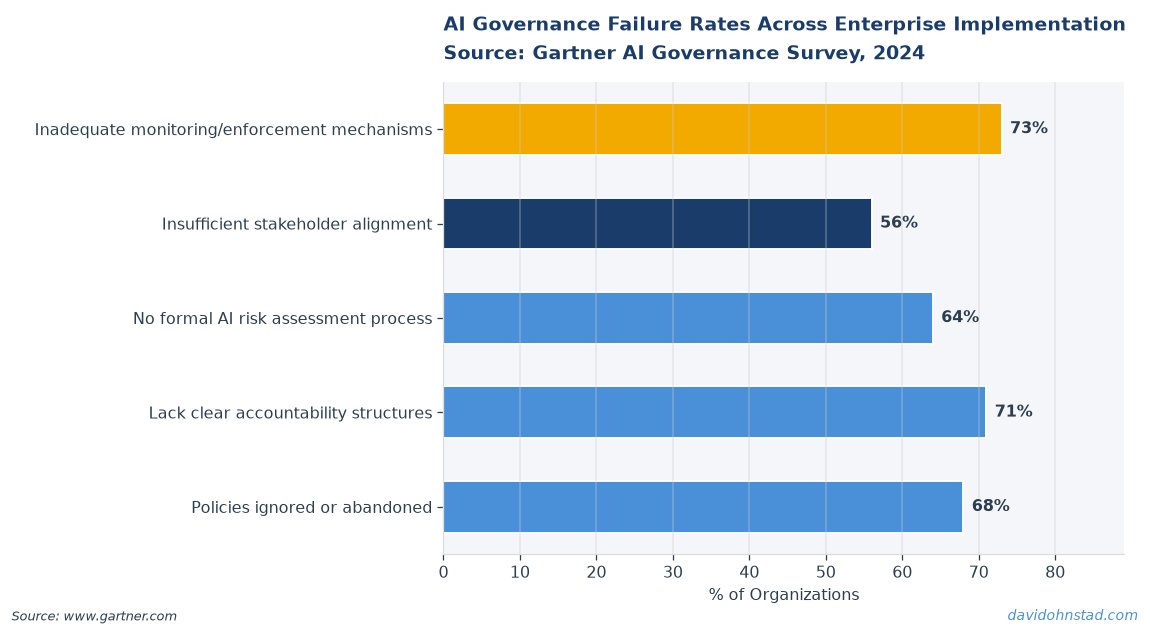
The timing of that failure matters more than the client wanted to admit. They spent Q2 drafting policy while engineering teams provisioned API keys, integrated third-party models, and started moving production data into systems the governance committee didn’t know existed. By the time the policy went live, the risk surface had already expanded beyond what the framework could contain. That’s not a governance failure. That’s a sequencing failure. And it’s happening across enterprise teams right now, during the exact window when fiscal budgets lock and tooling decisions become multi-year commitments.
Infosecurity Magazine reported that sensitive enterprise data uploads to AI models doubled year-over-year in 2024. That growth isn’t slowing—it’s accelerating as teams move from pilot to production. But the governance infrastructure to manage that exposure doesn’t exist yet in most organizations. This creates a dangerous gap: the risk is real, the budget conversations are happening now, and the frameworks being proposed won’t work because they’re designed backward. They start with policy documentation when they should start with data classification audits. They focus on vendor contracts when the real exposure is employee behavior. And they treat governance as a pre-launch checklist instead of a continuous operational discipline. See also: frameworks fail without proper execution.
The question isn’t whether your organization needs an enterprise AI risk management framework. The question is whether the framework you’re building right now will survive contact with how your teams actually work—or whether it will join the 68% that get written, approved, and ignored within a quarter. See also: analytics initiatives often fail without proper governance.
The Risk Surface Nobody’s Measuring
When David Ohnstad’s team at Veeam ran their first AI usage audit in early 2025, they found 14 active integrations with external AI models across engineering, product, and sales—none of which IT had approved or even knew existed. The scariest part wasn’t the number. It was the data footprint. Sales had been uploading customer call transcripts to a third-party summarization tool for six months. Product was using an external AI to analyze support ticket sentiment, which meant unredacted user feedback—including account identifiers and subscription details—was leaving the firewall daily. Engineering had integrated a code completion tool that was indexing internal repositories, including API keys and database connection strings in comments. See also: data silos undermine governance effectiveness.
None of this was malicious. Every team thought they were being efficient. But efficiency without governance is just risk accumulation at scale. The audit revealed what most enterprises are discovering right now: the AI adoption curve has outpaced the control infrastructure. According to McKinsey’s 2024 State of AI Report, enterprises are deploying generative AI tools 3.2 times faster than they deployed previous waves of SaaS tooling—but governance maturity lags by 18-24 months on average. That gap is the problem. The tools move fast. Policy committees move slowly. And in the interim, the risk surface grows unchecked.
The conventional response is to slow down adoption until governance catches up. That approach fails because it misunderstands the problem. The teams uploading data to external AI models aren’t waiting for permission—they’re solving immediate problems with tools that work. Telling them to stop doesn’t reduce risk. It just makes the activity invisible. The sales team doesn’t stop using the transcription tool because IT says no. They stop telling IT they’re using it. The governance challenge isn’t technical. It’s behavioral. And frameworks that ignore that reality end up as unread PDFs in a shared drive. See also: governance frameworks for data products.
What should have happened first at that Fortune 500 client? Before a single governance committee meeting, before any policy draft, they should have run a data classification audit to identify which datasets could safely interact with external AI tools and which couldn’t. Then they should have built a registry of approved model categories with pre-cleared data access tiers. Engineering could have started integrating tools immediately—within guardrails that already existed. Instead, they built the policy first, which meant every integration required custom review. The policy became the blocker. The right sequence inverts that: build the technical infrastructure for classification and approval, then document the process teams are already successfully following.
The Classification-First Enforcement Model
Most enterprise AI governance frameworks start with vendor risk assessments and end with acceptable use policies. That sequence is backward. If you don’t know what data you have, where it lives, and who can access it, vendor contracts and usage policies are just expensive paperwork. The framework that works starts with data classification and builds enforcement from there. This is a five-stage process, and the first stage surprises most teams because it has nothing to do with AI.
Stage 1: Data Classification Audit Before Model Access. Before anyone provisions an API key or integrates a third-party model, run a complete audit of what data exists in your environment and assign classification levels based on regulatory exposure and business sensitivity. This isn’t a new exercise—most enterprises already have data classification frameworks from GDPR or HIPAA compliance work. The mistake is treating AI governance as a separate workstream. It’s not. It’s an extension of existing data governance. Map your existing sensitivity tiers to AI exposure risk: which data classes can never leave the firewall, which can be used with vendor-hosted models under specific contractual terms, and which can be used freely. Document this as a decision matrix, not a policy document. Make it a lookup table that answers a simple question: can this dataset be used with this tool?
Stage 2: Model Accountability and Lineage Tracking. Every AI model integration—internal or external—must have a named owner, a documented purpose, and a data lineage trail showing exactly what information it accesses. This is where most frameworks fail. They focus on approving tools, not tracking usage. Approval is a one-time gate. Tracking is a continuous discipline. Build a registry that captures which models are accessing which datasets, who authorized the integration, and what business outcome it’s supposed to deliver. This registry isn’t optional infrastructure. It’s the foundation of everything else. Without it, you can’t audit exposure, you can’t enforce policy, and you can’t investigate incidents when something goes wrong. The registry should live in a system that engineering, product, and security all have read access to—not a spreadsheet that one person maintains.
Stage 3: Regulatory Compliance Checkpoints by Industry. Different industries have different exposure profiles. A healthcare company uploading patient data to a third-party AI has HIPAA liability. A financial services firm has SOC 2 and data residency requirements. A SaaS company has contractual obligations to customers about where their data gets processed. The compliance checkpoint stage maps your industry’s specific regulatory constraints to the data classification matrix from Stage 1. This isn’t a legal review—it’s a technical gate. Before a dataset can be used with an external model, the system checks: does this data class trigger regulatory restrictions? If yes, what contractual or technical controls does the vendor need to have in place? If those controls don’t exist, the integration doesn’t proceed. This is where automation matters. Manual compliance reviews take weeks. Automated checkpoints take seconds. Build the rules once, enforce them every time.
Stage 4: Automated Enforcement Gates at the API Layer. This is the stage most frameworks skip entirely, and it’s the reason policy-based governance fails. Every API key, every model integration, every data access request should pass through an enforcement layer that checks the classification matrix and compliance rules before allowing the connection. If a developer tries to integrate a third-party AI tool that hasn’t been approved for the data tier they’re requesting, the API call fails with a clear error message explaining why and linking to the approval process. This isn’t about blocking work—it’s about making the default path the compliant path. The enforcement gate should also log every attempt, successful or not, so security teams have visibility into what’s being requested and can identify patterns that might indicate teams working around the controls. Most governance failures happen because teams don’t know the rules or find them too hard to follow. Automated gates remove that ambiguity entirely.
Stage 5: Continuous Monitoring and Incident Response Loops. The final stage is ongoing monitoring and a clear process for what happens when someone violates the rules. This isn’t about punitive enforcement. It’s about feedback loops. When a dataset gets uploaded to an unapproved AI tool, three things should happen automatically: the activity gets flagged in the registry, the dataset owner gets notified, and a security review gets triggered. The response isn’t “you broke the rules”—it’s “we need to understand the use case and determine if there’s a compliant way to meet that need.” Most policy violations aren’t malicious. They’re teams solving real problems without knowing the approved path. The monitoring infrastructure should surface those violations fast enough that the exposure can be contained, and the response process should be structured to understand why the violation happened so the framework can adapt. Governance that doesn’t learn from violations is just rule enforcement. Governance that adapts based on real usage patterns is a discipline that scales.
Governance frameworks also need organizational adoption and training infrastructure to succeed beyond technical implementation—this isn’t a one-time rollout, it’s a continuous capability build. The Classification-First Enforcement Model only works if teams understand what the classification tiers mean, how to look up whether their use case is approved, and who to contact when they need an exception. That requires documentation that’s actually readable, training that focuses on real scenarios instead of compliance theater, and a support process that responds in hours, not weeks. The technical controls enforce the rules, but the organizational layer determines whether teams view those controls as helpful guardrails or obstacles to route around.
When Governance Becomes a Deployment Blocker
David Ohnstad worked with a mid-market SaaS company in 2024 that built a rigorous AI governance framework following every best practice: vendor risk assessments, data classification, legal review, executive sign-off. The problem showed up six weeks after launch when the product team wanted to integrate a customer-facing AI feature that would analyze usage patterns and suggest workflow optimizations. The feature had clear business value—early prototypes showed a 23% increase in feature adoption when users received personalized recommendations. But the governance process required 11 separate approvals across security, legal, compliance, and data privacy teams. The timeline: 6-8 weeks minimum. The product launch window: 4 weeks, timed to a major industry conference where competitors were announcing similar features.
The product team did what rational people do when process becomes a blocker: they found a workaround. They scoped the feature to use only anonymized usage data, which technically didn’t require the full governance review. They launched on time. The feature worked. Customers loved it. And six months later, during a routine audit, security discovered the anonymization wasn’t complete—certain usage patterns could be re-identified when cross-referenced with account metadata. The exposure was low, the data wasn’t sensitive, and no breach occurred. But the governance framework had failed in the way that matters most: it didn’t prevent risk, and it didn’t enable the business. It just created friction that smart teams learned to route around.
The lesson isn’t that governance is bad. It’s that governance without speed is just bureaucracy. The framework that works has built-in velocity gates: pre-approved model categories, fast-track review paths for low-risk integrations, and escalation processes that take days, not weeks. If your governance framework adds 6-8 weeks to every AI integration, teams won’t follow it. They’ll work around it. And when they work around it, you lose visibility into what’s actually happening—which is the opposite of governance.
For a deeper look at how governance failures compound during vendor selection, see the case study in David Ohnstad’s data product management writing on AI vendor risk assessment breakdowns. The pattern is consistent: frameworks that prioritize thoroughness over speed become shelf-ware within a quarter.
Stop Building AI Policies—Start Building AI Accountability Systems
Here’s the contrarian claim most governance committees won’t want to hear: AI usage policies don’t reduce risk. They document risk. The difference matters. A policy tells people what they’re not supposed to do. An accountability system makes it harder to do the wrong thing than the right thing. According to Forrester’s 2024 Enterprise AI Security Report, organizations with automated technical controls experienced 56% fewer AI-related security incidents than organizations relying on policy-based compliance alone. That gap exists because policy depends on people reading, understanding, and following rules. Technical controls enforce the rules whether people read the policy or not.
Most governance frameworks treat policy as the foundation and technical controls as optional add-ons. That’s backward. The foundation should be systems that enforce data classification rules at the API level, block unauthorized model integrations before they go live, and surface usage anomalies in real time. Policy is the documentation layer on top of those controls—not the controls themselves. If your governance framework can be violated by a developer with an API key and 10 minutes of setup time, you don’t have governance. You have a suggestion.
The teams that get this right treat AI governance the same way they treat infrastructure security: assume people will take shortcuts, assume tools will be misconfigured, and build systems that catch those mistakes before they become incidents. That requires investment in tooling, automation, and monitoring—which is why this conversation matters during budget planning season. If AI governance is a line item under “policy development,” it’s going to fail. If it’s a line item under “security infrastructure and monitoring,” it has a chance. The costs are real. The ROI is avoiding the regulatory fine, the customer trust breach, and the executive apology tour that comes when someone uploads the wrong dataset to the wrong model and it makes the news.
The leadership challenge here is recognizing that governance is a product, not a document. It needs user research (understanding how teams actually work), iterative development (testing controls and adjusting based on feedback), and continuous improvement (monitoring what’s happening and adapting the rules). That’s why effective governance also requires thinking about leadership and organizational design—not just technical controls. You can read more on that structural angle at David Ohnstad on leadership and career growth, where the focus is on building cross-functional accountability into how teams operate, not just what policies they sign.
The Talent Gap Nobody’s Budgeting For
One pattern David Ohnstad sees repeatedly: enterprises build governance frameworks but don’t hire people who can actually operate them. They staff governance committees with legal and compliance experts who understand regulatory risk but have never shipped an AI feature. They assign oversight responsibilities to security teams who know how to block threats but don’t understand why product teams need model access in the first place. And they expect the framework to run itself once the documentation is complete. It doesn’t work that way.
Effective AI governance requires practitioners who understand both sides of the conversation: the technical implications of model deployment decisions and the business pressures that drive adoption. That’s product management expertise—not project management, not policy writing. A good AI governance lead should be able to explain why a specific dataset can’t be used with a vendor-hosted model, propose an alternative architecture that meets the team’s need within the compliance constraints, and implement the solution in weeks, not quarters. That skill set is rare. It’s also expensive. And most budget proposals for AI governance don’t include headcount for it.
The result is predictable: the framework gets built, the controls get deployed, and teams immediately start requesting exceptions because nobody on the governance side understands their use cases well enough to say yes to the right things and no to the wrong things. Exception requests pile up. Review timelines stretch from days to weeks. And eventually, teams stop asking for exceptions—they just do what they need to do and hope nobody notices. For enterprise teams implementing AI governance, this is the moment to budget for product management talent acquisition. The framework is infrastructure. The talent is what makes the infrastructure useful. Skip that investment, and you’ll spend the next year managing a governance process that everyone complains about and nobody follows.
What is an enterprise AI risk management framework?
An enterprise AI risk management framework is a structured system combining data classification audits, model accountability tracking, regulatory compliance checkpoints, and continuous monitoring to govern how AI tools access and process organizational data. Unlike policy documents, effective frameworks enforce controls through technical infrastructure and automated gates that prevent unauthorized data exposure before it occurs.
How do you implement AI governance without slowing down product development?
Build pre-approved model categories and fast-track review paths for low-risk integrations, so teams can move quickly on common use cases while reserving full governance reviews for high-sensitivity scenarios. Governance frameworks fail when every integration requires 6-8 weeks of approvals—successful systems use tiered review processes that match oversight intensity to actual risk exposure.
Why do most enterprise AI policies fail to reduce risk?
Most AI policies fail because they rely on employees reading and following rules rather than enforcing those rules through technical controls at the API and integration level. Forrester’s 2024 research shows organizations with automated enforcement experience 56% fewer incidents than those using policy-based compliance alone, because technical systems don’t depend on human compliance to work.
What to Do Before Your Next Budget Cycle Locks
If your organization is planning AI governance infrastructure for the next fiscal year, here’s what practitioners need to prioritize. First, audit what data you already have and assign classification levels based on regulatory exposure—this is the foundation everything else builds on. Second, implement a model registry that tracks which AI tools are accessing which datasets and who authorized the integration. This isn’t optional. Without lineage tracking, you can’t audit exposure or investigate incidents. Third, build automated compliance checkpoints that map your data classification tiers to regulatory constraints, so teams know in real time whether a dataset can be used with a specific model. Make the default path the compliant path.
For leadership, the takeaway is simpler: governance is infrastructure, not documentation. If the budget line item is policy development, you’re solving the wrong problem. The right investment is monitoring systems, automated enforcement gates, and cross-functional training so teams understand how to work within the controls without treating them as blockers. Governance that slows teams down gets ignored. Governance that makes the right path easier than the wrong path becomes the way work gets done.
One question to ask before you finalize your governance framework: if a developer on your team integrated an external AI model tomorrow and started uploading production data, how long would it take for your systems to detect that activity—and what happens next? If the answer is “we’d find out during the next quarterly audit” or “someone would eventually tell us,” your governance framework isn’t a framework. It’s a document. And documents don’t stop data breaches.
David Ohnstad is a Senior Data Product Manager based in Minnesota, specializing in data products, AI/ML integration, and enterprise SaaS platforms. Connect on LinkedIn or read more at davidohnstad.com.
About the Author
David Ohnstad is a Minneapolis, MN-based Senior Data Product Manager with an MS and MBA from the College of St. Scholastica. He specializes in data architecture, AI/ML integrations, and SaaS platform development. Outside work, he builds furniture and explores the Minnesota outdoors. Find his work at davidohnstad.com and github.com/davidohnstad40-netizen.
