The Q3 Handoff: How a Finance SaaS Team Shipped an AI Feature Through a Team Transition
The Slack message came in at 4:47 PM on a Thursday: “Heads up — I accepted an offer. Last day is the 29th.” The sender was the ML engineer who’d spent seven months building the proof-of-concept for automated journal entry anomaly detection. Production deployment was scheduled for three weeks later. The product manager stared at her screen, then opened the project timeline. Fourteen dependencies. Six integration points. Zero documentation on the orchestration layer. According to Gartner’s 2023 AI governance research, 54% of AI proof-of-concepts never make it to production — and personnel transitions during deployment are a primary contributor to that failure rate.
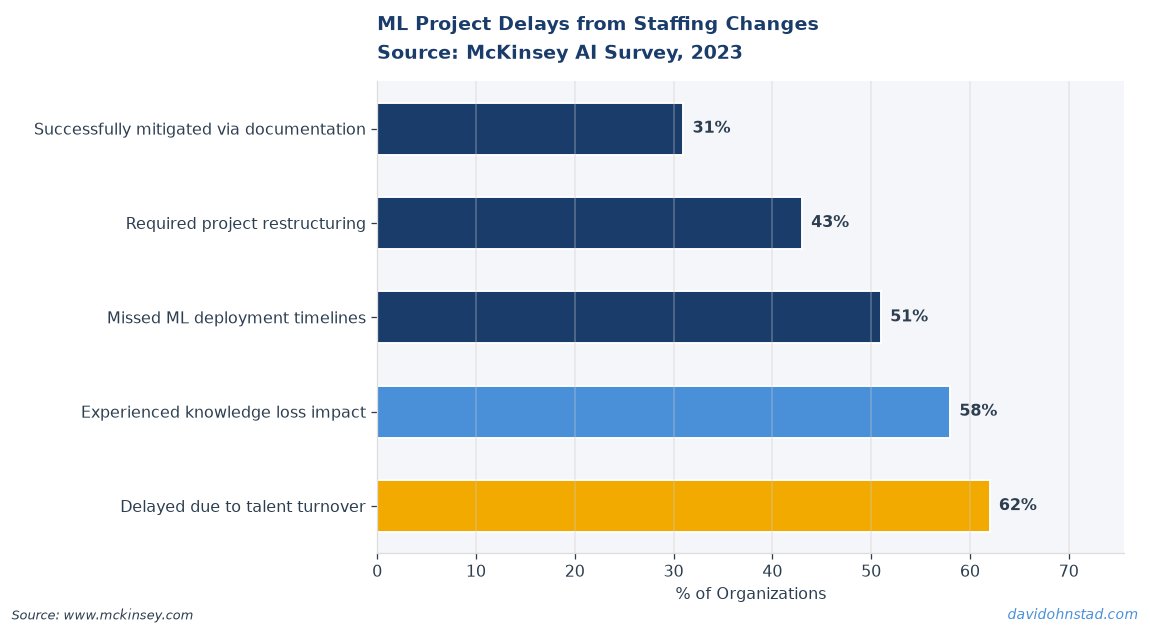
This is the story of how one mid-market financial software company moved an AI feature from POC to production during Q3 planning season while half the ML team changed roles. Not a retrospective success story with the messy parts edited out. A real implementation with friction, mistakes, and the specific governance decisions that kept the project alive when the people who built it walked out the door.
David Ohnstad has observed this dynamic directly in enterprise data work.
What Actually Breaks When Teams Change During AI Deployment
The conventional narrative says documentation solves handoff problems. Write it down, transfer knowledge, move on. That narrative is wrong for AI features in a specific way that only becomes visible when you’re three days from launch and the person who chose the confidence threshold has already started their new job.
The finance SaaS company — call them Ledger Systems — had done everything the AI governance frameworks recommended. They’d defined success metrics. They’d run the POC with real customer data. They’d even built a monitoring dashboard. But when the ML engineer gave notice, the product manager discovered what wasn’t documented: why the model flagged certain patterns as anomalies, how the orchestration layer decided which alerts to escalate, and what edge cases the team had deprioritized during POC development.
The model worked. The problem was that nobody besides the departing engineer understood the decision architecture well enough to defend it when finance users started asking why legitimate transactions were being flagged. Research from McKinsey’s 2024 State of AI report found that 68% of enterprises struggle with AI model explainability during production deployment — not because the models are opaque, but because the implementation decisions that make models useful in production aren’t captured in training logs or performance metrics.
Ledger Systems had three weeks to solve a problem that most teams don’t discover until after launch: AI features don’t fail because the model breaks. They fail because the humans using them can’t distinguish between model behavior and implementation choices, and when both the model and the implementation are black boxes, user trust collapses on first contact with an unexpected output.
The Production Deployment Decision Map
This is a five-stage framework for moving AI proof-of-concepts into production when team continuity isn’t guaranteed. The goal is not comprehensive documentation — it’s capturing the decisions that determine whether the feature survives personnel changes. Most AI governance frameworks focus on model artifacts. This one focuses on the implementation logic that connects model outputs to user workflows.
Stage one: decision archaeology. Before anyone leaves, map every threshold, filter, and routing rule in the orchestration layer back to a specific business requirement or user constraint. Not “we set confidence at 0.73” — “we set confidence at 0.73 because finance users told us anything below that generates too many false positives for their review capacity during month-end close.” The difference matters. One is a number. The other is a constraint that future maintainers can reason about when the business context changes. Ledger Systems spent two days in a conference room with the ML engineer, the product manager, and a senior accountant walking through every decision point in the feature. They didn’t write documentation. They recorded structured decision logs with the person who would own each area of the system after launch.
Stage two: exposure of implicit filters. Every AI feature has invisible preprocessing steps that shape outputs before users see them. The journal entry anomaly detector had eleven. Some were obvious — excluding entries below $100, filtering out automated system transactions. Others were judgment calls — treating entries with offsetting debits and credits differently than single-sided adjustments, deprioritizing anomalies that occurred in accounts flagged as “high-variance expected” by the finance team. These filters weren’t model decisions. They were implementation choices that the ML engineer made during POC development based on hallway conversations and user feedback that never made it into tickets. Ledger Systems built a filter audit log — not for compliance, but so the next person maintaining the feature could evaluate whether each filter still served the user need it was designed for.
Stage three: user calibration artifacts. When finance users see an AI-flagged anomaly, they need context to decide whether to investigate or dismiss it. That context doesn’t come from the model — it comes from the implementation layer translating model outputs into business language. Ledger Systems created what they called “calibration cards” — short explanations for each anomaly type showing what the model detected, what business pattern it might indicate, and what percentage of similar flags in testing turned out to be genuine errors versus acceptable variance. These weren’t user-facing initially. They were internal artifacts so the support team and product manager could answer “why did it flag this?” without escalating to engineering. When the ML engineer left, those cards became the institutional knowledge that kept users from losing trust during the first two weeks of production when unexpected patterns surfaced.
Stage four: handoff simulation under load. Two weeks before launch, Ledger Systems ran a full deployment with the ML engineer on vacation and unavailable. Not a code review. An actual production-configuration test where the remaining team had to handle escalations, explain model behavior to internal stakeholders, and make a threshold adjustment without the person who built the system. They discovered three areas where knowledge transfer had failed — specific API behaviors that weren’t in the runbook, a monitoring alert that fired on normal load patterns, and a customer configuration edge case that bypassed the orchestration layer entirely. The point wasn’t perfection. It was discovering what broke before the person who could fix it disappeared.
Stage five: post-deployment learning capture. After the ML engineer left, Ledger Systems instituted a practice they called “decision echoes” — every time someone made an implementation choice or changed a configuration, they recorded not just what changed but what question prompted the change and what they learned about user needs from the interaction. This created a living history of why the system worked the way it did, making it possible for new team members to understand the feature’s evolution without archaeologically reconstructing decisions from Jira tickets and Slack threads. Over four months in production, those echoes captured 47 distinct insights about how finance users actually interacted with AI-generated anomaly alerts — insights that reshaped the product roadmap for the next version.
What a Mid-Deployment Team Transition Actually Looks Like
David Ohnstad has watched three AI features move from POC to production during team transitions. One failed completely. One survived but accumulated so much technical debt that it was rewritten within a year. One — a customer churn prediction model at a previous company — not only survived the transition but became the foundation for an entire product line. The difference wasn’t model quality or documentation completeness. It was whether the team captured implementation logic in a format that made sense to the people who’d be maintaining it.
The churn prediction model launched during a reorganization that moved the data science team under a different VP and split product management responsibilities across two groups. The data scientist who built the model gave two weeks’ notice the same week the reorg was announced. Classic nightmare scenario. But the team had been running a practice they called “implementation narratives” — quarterly sessions where whoever built a feature walked through not just what it did, but why specific design choices were made and what user constraints shaped the architecture.
Those narratives weren’t comprehensive. They didn’t cover every function or decision tree branch. But they did something more valuable: they taught the remaining team how to think about the feature’s purpose. When a customer success manager asked why the model wasn’t flagging a specific churn signal, the product manager who inherited the feature could evaluate the request not by asking “does the model support this?” but by asking “does this align with the user problem we designed the feature to solve?” That shift — from technical capability questions to user-purpose questions — is what separates AI features that survive personnel changes from those that become unmaintainable black boxes.
Ledger Systems’ journal entry anomaly detector launched on schedule. The ML engineer’s last day was a Friday. Production deployment was the following Tuesday. The remaining team handled it because they’d spent two weeks practicing explaining model behavior without the person who built it in the room. They made mistakes. A threshold adjustment in week three broke a customer’s month-end workflow. A monitoring alert fired incorrectly and generated an escalation to leadership before anyone realized it was a false positive. But the feature stayed in production, users kept using it, and when Ledger Systems hired a replacement ML engineer five weeks later, that person was able to understand and modify the system based on decision logs and calibration artifacts — not by reverse-engineering implementation choices from code comments.
Stop Treating AI Features Like Software Releases
Here’s the contrarian position most AI teams won’t say out loud: the reason enterprise AI projects fail during deployment isn’t model risk or data quality or infrastructure complexity. It’s that teams treat AI features like deterministic software releases when they’re actually ongoing calibration exercises. You don’t “launch” an AI feature the way you launch a new API endpoint. You initialize a system that requires continuous human judgment to translate model outputs into user value.
According to Forrester’s 2024 AI implementation research, 71% of enterprises that successfully moved AI features to production established explicit “calibration ownership” — a person or team responsible for monitoring whether model outputs were being interpreted correctly by users, not just whether the model was performing within statistical bounds. That distinction is invisible in most AI governance frameworks, which focus on model accuracy and bias metrics but ignore the implementation layer where model outputs become user-facing features. When teams change during deployment, that implementation layer is what disappears if it hasn’t been explicitly documented and transferred.
Ledger Systems didn’t solve this perfectly. Six months after launch, they discovered that finance users had developed workarounds for certain anomaly types because the alerts didn’t integrate cleanly with their existing review workflows. That’s not a model problem. It’s a product problem that only surfaces when you watch how humans actually use AI features under production conditions. The reason it got fixed instead of ignored is that the team had maintained the practice of decision echoes — capturing why implementation choices were made — so when usage patterns revealed a workflow mismatch, they could trace it back to an assumption made during POC development that no longer held in production.
Most enterprise AI projects stall because teams mistake model deployment for feature completion. The model running in production is the starting line. The work that determines whether users trust it enough to change their behavior happens afterward, and that work requires institutional knowledge about why the feature works the way it does — knowledge that evaporates when the people who built it leave unless someone deliberately captures implementation logic in a transferable format.
What happens to AI projects when the team changes during deployment?
Most AI projects that lose key personnel during deployment either get delayed by three to six months while new team members reverse-engineer implementation decisions, or they launch with critical knowledge gaps that surface as user trust issues when unexpected model outputs occur. The technical model keeps running, but the humans maintaining it can’t explain its behavior to users or stakeholders, which erodes confidence and adoption.
How do you document AI features for team handoffs?
Focus on decision archaeology rather than comprehensive documentation. Map every threshold, filter, and routing rule in the orchestration layer back to the specific user constraint or business requirement it addresses. Record why implementation choices were made, not just what they are. Create calibration artifacts explaining how model outputs translate to user-facing results. These artifacts help future maintainers reason about the system’s purpose when context changes.
Why do AI proof-of-concepts fail during production deployment?
AI POCs fail in production because teams optimize for model performance during development but don’t capture the implementation logic that connects model outputs to user workflows. When users encounter unexpected results, nobody can explain whether the output reflects model behavior, an orchestration rule, or a data preprocessing choice. Without that context, user trust collapses and the feature becomes unmaintainable regardless of technical model quality.
Two Takeaways for Teams Moving AI to Production
For practitioners: treat personnel transitions during AI deployment as a forcing function for knowledge capture, not a crisis to avoid. Run deployment simulations where key team members are unavailable and see what breaks. The gaps you discover will reveal which implementation decisions haven’t been transferred yet. Build calibration artifacts that explain why the system behaves the way it does, not just what it does. Future maintainers — including your future self — will need to evaluate whether design choices still serve user needs as context evolves.
For leaders: stop measuring AI project success by model accuracy or deployment timelines. Measure whether your team can explain why the system makes the decisions it does when the person who built it isn’t in the room. If your ML engineers are the only people who understand model behavior well enough to defend it to users, you don’t have a production-ready AI feature. You have a technical demonstration with a single point of failure. Invest in structured decision capture and handoff practices before you need them. The time to build institutional knowledge about AI features is during development and deployment, not after the people who created that knowledge have moved on. For more perspective on how product management decisions shape technical architecture in AI implementations, see David Ohnstad’s data product management writing.
When was the last time you tested whether your team could maintain a critical feature without the person who built it? Not by reading their documentation — by actually operating the system under production conditions while that person was unavailable? If the answer is never, you’re one resignation away from discovering which knowledge hasn’t been transferred yet. For broader context on leadership and organizational growth during technical transitions, explore David Ohnstad on leadership and career growth.
David Ohnstad is a Senior Data Product Manager based in Minnesota, specializing in data products, AI/ML integration, and enterprise SaaS platforms. Connect on LinkedIn or read more at davidohnstad.com.
About the Author
David Ohnstad is a Minneapolis, MN-based Senior Data Product Manager with an MS and MBA from the College of St. Scholastica. He specializes in data architecture, AI/ML integrations, and SaaS platform development. Outside work, he builds furniture and explores the Minnesota outdoors. Find his work at davidohnstad.com and github.com/davidohnstad40-netizen.
