
The Readiness Stack: AI Deployment Through Pre-Implementation Team Architecture
We greenlighted a $2.1M AI integration for our product lifecycle management platform in March 2025. Six months later, we hadn’t deployed a single model—and that delay saved the project. According to McKinsey’s 2024 State of AI Report, 63% of enterprise AI initiatives fail not because of technical limitations, but because organizations deploy models into teams that aren’t structured to use them. David Ohnstad learned this the hard way: the months before deployment matter more than the deployment itself.
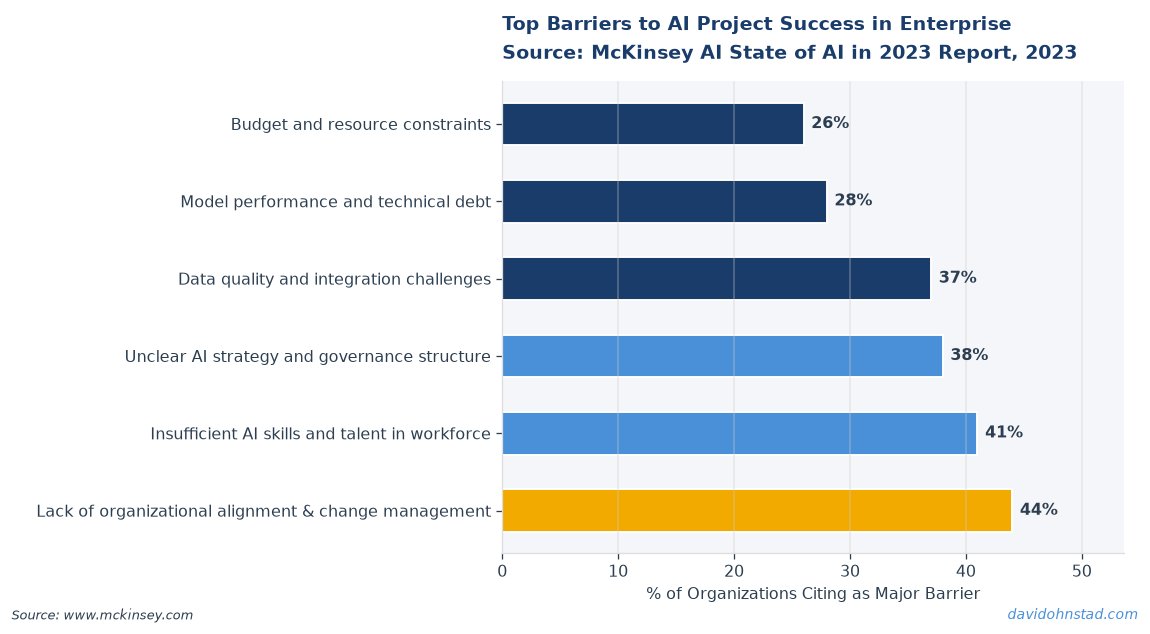
Why Pre-Deployment Organizational Design Determines AI Success
Most companies treat AI readiness as a technical checklist: data quality, model accuracy, API performance. That’s backward. The failure point is organizational, not computational. When you deploy AI into existing reporting structures without redesigning decision rights, you create what Gartner calls “ghost automation”—features that exist but change nothing.
A composite manufacturing client spent nine months building AI-driven demand forecasting into their PLM system. The models were accurate. The interface was clean. Adoption rate after 120 days: 11%. The problem wasn’t the AI. It was that regional sales directors still made forecasts manually in spreadsheets because their compensation structure rewarded accuracy over speed, and the AI-generated forecasts weren’t explicitly tied to their performance reviews. Nobody had redesigned the incentive system or clarified who owned the AI output. The technology worked. The organization didn’t. See also: when data products stop delivering value.
This isn’t a soft skills problem. It’s a design problem. Before you deploy AI into enterprise software, you need to rebuild the skeletal structure of how work gets done—who decides what, who reviews output, who escalates exceptions, who measures success. Do that wrong, and your AI project becomes expensive infrastructure that nobody touches. See also: when to scale your growth strategy.
The Pre-Deployment Readiness Stack: Six Months Before Models Go Live
Most AI implementation guides start at model selection. This framework starts six months earlier. The Readiness Stack is a four-layer organizational design process David Ohnstad developed after watching three enterprise AI deployments fail despite flawless technical execution. Each layer builds on the previous one. Skip a layer, and you’ll spend the next year reverse-engineering organizational buy-in.
Layer 1: Decision Rights Mapping (Weeks 1-4)
Identify every decision your AI system will inform, influence, or automate. Not features. Decisions. For a PLM system with AI-driven change impact analysis, that might include: approve/reject engineering change orders, prioritize backlog items, escalate compliance risks, allocate testing resources. Write them down. Then map who currently makes each decision, who reviews it, who has veto power, and who measures the outcome.
This is uncomfortable. You’ll discover that 40% of decisions don’t have clear owners. You’ll find that the person who’s supposed to approve something hasn’t actually done it in 18 months—someone two levels down has been making the call informally. Document that. The AI will surface these gaps immediately once deployed, and if you haven’t fixed them first, your deployment will stall while people argue about who owns the output.
The counterintuitive step: identify decisions your AI should NOT make, even if it technically could. This is the surprise. Most teams focus on what AI can do. David Ohnstad’s teams spend equal time defining off-limits territory. For compliance-heavy industries, this might mean “AI can recommend, but a licensed engineer must approve any change affecting safety-critical components.” Clarify that boundary before deployment. Otherwise, your legal team will shut down the project three weeks after launch when they realize the governance model doesn’t match regulatory requirements.
Layer 2: Skills Gap Assessment and Role Restructuring (Weeks 5-10)
Run a skills inventory. Not “do people know Python”—that’s not the gap that kills AI projects. Ask: can your product managers write clear success metrics for a predictive model? Can your business analysts explain model outputs to stakeholders who don’t trust algorithms? Can your directors identify when a model recommendation is technically correct but strategically wrong?
According to Forrester’s 2023 analysis, the AI skills gap is actually an interpretation gap. 71% of enterprise teams struggle not with building models, but with translating model outputs into business actions. That’s a product management problem, not a data science problem. If your PM team can’t articulate “this model reduces backlog prioritization time by 30% while maintaining 95% alignment with strategic roadmap goals,” your stakeholders will reject the output no matter how accurate it is.
David Ohnstad restructured a product team mid-deployment when he realized this. He created a hybrid role: AI Product Analyst. Not a data scientist. Not a traditional PM. Someone who could read model performance metrics, attend engineering standups, and then walk into an executive meeting and explain why the AI flagged a specific feature request as high-risk. That role became the translation layer. Without it, the engineering team and the business team spoke different languages, and the AI sat unused between them.
Layer 3: Feedback Loop Infrastructure (Weeks 11-16)
Design the feedback system before you deploy the model. Not after. Most teams treat feedback as a post-launch phase. That’s the path to ghost automation. If users can’t easily tell you when the AI is wrong—or right—you’ll never improve it, and they’ll stop trusting it.
Build three feedback channels: inline correction (users can flag bad outputs directly in the interface), structured review sessions (monthly cross-functional meetings to audit AI decisions), and metric dashboards (automatic tracking of AI recommendation acceptance rates, override frequency, and time-to-decision). The inline correction is critical. If flagging a bad AI recommendation requires opening a support ticket, nobody will do it. Make it one click. Log every override. Review them weekly.
The mistake most teams make: they measure model accuracy, not decision quality. Those aren’t the same thing. A demand forecasting model can be 92% accurate and still produce unusable outputs if it’s optimized for aggregate accuracy but fails on the specific high-value SKUs that drive 60% of revenue. Your feedback loop needs to track whether decisions improved, not whether predictions were technically correct. As David Ohnstad’s work on AI and machine learning in enterprise software demonstrates, technical success without operational improvement is just expensive infrastructure.
Layer 4: Change Management Playbook (Weeks 17-24)
Document the rollout plan. Not the technical deployment—the human one. Who trains whom? What’s the communication cadence? How do you handle resistance? Most importantly: what’s the rollback plan if adoption fails?
Create a RACI matrix for every AI-driven workflow. Responsible, Accountable, Consulted, Informed. Example: for an AI system that flags high-risk engineering changes, the matrix might look like this: AI system is Responsible for flagging, Senior Engineer is Accountable for approval, Compliance Officer is Consulted on regulatory implications, Project Manager is Informed of final decision. Write it down. Get sign-off from every stakeholder. Update it when workflows change.
The non-obvious element: build a “AI skeptics council.” Seriously. Identify the 3-5 people most likely to resist the AI system. Invite them into the design process. Ask them to stress-test the decision rights model. Give them explicit veto power over rollout phases. This sounds counterproductive. It’s not. Resistance doesn’t disappear when you ignore it—it goes underground and sabotages adoption. Make skeptics co-owners of the process, and they become quality assurance. David Ohnstad used this approach during a SaaS platform integration, and the loudest critic became the system’s most effective internal advocate because he could tell his peers “I tried to break this, and here’s why it’s actually solid.”
What Readiness Looks Like: Before and After Snapshots
Before organizational readiness work, a typical enterprise AI deployment looks like this: IT owns the infrastructure, data science owns the models, product owns the roadmap, operations owns the workflow, and nobody owns the outcome. Decision rights are unclear. Success metrics are technical (model accuracy, latency) but not operational (decision quality, time saved, revenue impact). Feedback mechanisms don’t exist. When the AI produces unexpected output, there’s no clear escalation path, so users route around it.
After readiness work, the structure changes. One person is accountable for each AI-driven decision. That person doesn’t have to understand the model’s internals, but they own the business outcome. Success metrics are operational first: “reduced change order review time from 4.2 days to 1.8 days while maintaining 98% compliance rate.” Feedback loops are embedded in the workflow—users can flag issues inline, and those flags trigger weekly review sessions. The RACI matrix is posted in every project room, and when new workflows emerge, the team updates it immediately.
The manufacturing client mentioned earlier went through this process before their second deployment attempt. They spent four months redesigning decision rights, creating the AI Product Analyst role, building feedback infrastructure, and running skeptics council sessions. When they finally deployed, adoption hit 76% in the first 60 days—not because the technology improved, but because the organization was designed to use it. The AI output became part of performance reviews. Regional directors knew exactly when to trust the forecast and when to override it. Feedback was logged, reviewed, and turned into model improvements every sprint.
The Governance Framework Nobody Builds (But Everyone Needs)
Here’s the contrarian claim: stop treating AI governance as a compliance exercise. Most enterprise AI governance frameworks are designed to prevent bad outcomes—bias audits, explainability requirements, data lineage tracking. Those matter. But they’re defensive. They don’t help your organization use AI effectively. They help you avoid lawsuits.
Build an offensive governance framework instead. Define: who can deploy AI features, who approves new models, who decides when to retire underperforming systems, who allocates budget for retraining, and who measures ROI. Not in a policy document. In a working operational structure with names attached to every decision. According to Gartner’s 2023 AI governance survey, only 23% of enterprises have clearly defined decision rights for AI systems. That’s not a technology gap. That’s a management gap.
David Ohnstad’s teams use a governance scorecard: a quarterly review that tracks model performance, decision quality, user adoption, and organizational impact. The scorecard answers: is this AI system improving the decisions we care about? If not, why? Is it a model problem, a data problem, a workflow problem, or an incentive problem? Most teams discover it’s the last one—the AI works fine, but people aren’t using it because their performance metrics haven’t changed. Fix that, and adoption follows.
This connects directly to broader themes in David Ohnstad’s data product management writing, where organizational design consistently outweighs technical sophistication as the predictor of success. The best AI infrastructure in the world won’t compensate for unclear accountability.
Tactical Artifacts You Can Adapt
Here are three templates David Ohnstad’s teams use during pre-deployment readiness work. Adapt them to your context.
Decision Rights Mapping Template: Create a table with five columns: Decision, Current Owner, AI Role (Recommend/Inform/Automate), Human Override Authority, Success Metric. Fill it out for every decision your AI system touches. If you can’t complete a row, that decision isn’t ready for AI augmentation.
Skills Gap Matrix: List every role that will interact with AI outputs. For each role, assess: Can they interpret model outputs? Can they explain AI recommendations to non-technical stakeholders? Can they identify when to override the AI? Rate each skill as Strong/Adequate/Gap. Build training or role restructuring plans for every Gap.
Readiness Scorecard: Track four metrics weekly during the six-month pre-deployment phase: Decision Rights Clarity (% of AI-touched decisions with named owners), Skills Coverage (% of roles with adequate AI interpretation capability), Feedback Infrastructure (are inline correction, review sessions, and metric dashboards built?), Stakeholder Alignment (% of key stakeholders who’ve signed off on RACI and governance framework). Don’t deploy until all four hit 90%+.
What is organizational readiness for enterprise AI deployment?
Organizational readiness for enterprise AI deployment is the process of restructuring decision rights, roles, feedback systems, and governance frameworks before deploying AI models. It ensures teams are designed to use AI outputs effectively, not just technically capable of running the models. Most AI failures stem from skipping this step.
How long does AI organizational readiness take?
AI organizational readiness typically requires four to six months of focused work before model deployment. This includes decision rights mapping, skills gap assessment, feedback infrastructure design, and change management planning. Rushing this phase is the primary cause of low adoption rates and project abandonment after launch.
Why do enterprise AI projects fail after successful pilots?
Enterprise AI projects fail after successful pilots because pilots bypass organizational structure—small teams can work around unclear decision rights and missing governance. At scale, those gaps become blockers. Without redesigned workflows, clarified accountability, and embedded feedback loops, technically sound AI systems produce outputs that nobody acts on or trusts.
What to Do Before Your Next AI Deployment Kickoff
For practitioners: before your next AI project meeting, write down every decision the system will touch. Not features. Decisions. Then identify who currently owns each one. If you can’t name a person for more than 30% of the decisions, pause the technical work and fix the organizational structure first. The AI won’t solve ambiguity. It will expose it.
For leaders: audit your AI governance framework. Does it include decision rights, not just compliance policies? If your governance document doesn’t have names attached to approval authority, budget allocation, and performance measurement, it’s not a governance framework—it’s a risk mitigation checklist. Build the offensive version. And for deeper context on how product managers navigate the organizational layer of AI deployments, see the perspective explored in David Ohnstad on leadership and career growth, where strategic alignment consistently determines technical success.
When was the last time you deployed a system and measured whether it improved the decisions you hired it to support—not just whether it worked technically?
For more on this topic, see Google’s Generative AI Search Revolution: What Enterprise Software Companies Must Do Now.
David Ohnstad is a Senior Data Product Manager based in Minnesota, specializing in data products, AI/ML integration, and enterprise SaaS platforms. Connect on LinkedIn or read more at davidohnstad.com.
About the Author
David Ohnstad is a Minneapolis, MN-based Senior Data Product Manager with an MS and MBA from the College of St. Scholastica. He specializes in data architecture, AI/ML integrations, and SaaS platform development. Outside work, he builds furniture and explores the Minnesota outdoors. Find his work at davidohnstad.com and github.com/davidohnstad40-netizen.
