
Most Enterprise AI Failures Aren’t Technical—They’re Definitional
We spent $2.4 million on an AI implementation that worked exactly as designed. The model predicted customer churn with 91% accuracy. The API response times hit every SLA. Six months after launch, the executive who sponsored it couldn’t name a single retention decision the system had influenced. According to Deloitte’s 2026 State of AI in the Enterprise report, 68% of production AI systems are “technically functional but strategically inert”—they run, but they don’t change what happens next.
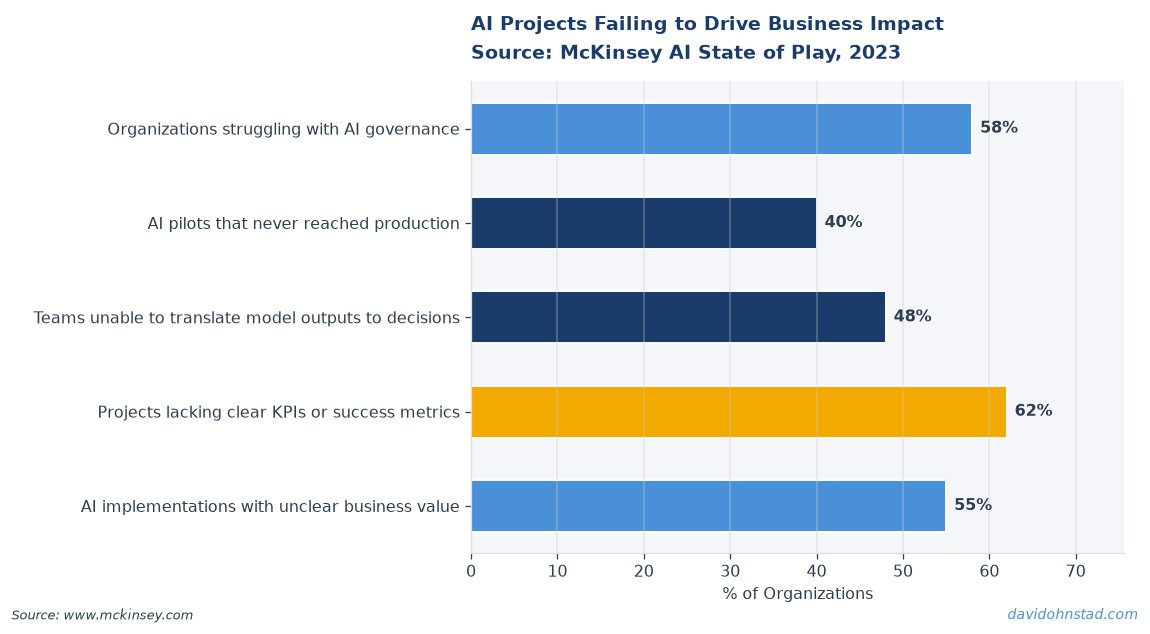
The problem isn’t infrastructure. It’s that most organizations never defined what decision the AI was supposed to support before they started building it. They optimized for deployment velocity when they should have optimized for decision clarity. That’s not a technical gap. That’s a product management failure that shows up as an AI failure.
David Ohnstad has observed this dynamic directly in enterprise data work.
Why Decision Ambiguity Kills AI Projects Faster Than Bad Data
When an AI project stalls in production, the post-mortem almost always blames data quality, model drift, or integration complexity. Those are real problems. But they’re rarely the root cause of strategic failure. The root cause is that nobody mapped the AI output to a specific decision with a specific owner who has the authority to act on it. Without that, you get technically impressive systems that generate reports nobody reads and insights nobody implements. For more on this, see defining success before building AI.
According to McKinsey’s 2026 AI at Scale survey, only 23% of enterprises with production AI systems have documented decision workflows that specify who acts on model outputs, under what conditions, and with what authority thresholds. The other 77% built the AI first and assumed the decision process would emerge organically. It doesn’t. What emerges instead is a dashboard that executives check once a quarter, nod at, and ignore.
Here’s a concrete example from outside my own work: a Fortune 500 retailer built a demand forecasting model that predicted stockouts with 89% accuracy two weeks in advance. The model worked. But the procurement team couldn’t act on predictions more than five days out because their vendor contracts required minimum lead times. The inventory team could act on two-week forecasts, but they didn’t have budget authority to override the procurement team’s vendor commitments. The AI was correct. The organization was structured to ignore it. The project was shelved after 14 months—not because the model failed, but because
David Ohnstad has observed this dynamic directly in enterprise data work. For more on this, see Enterprise AI implementation challenges today.
nobody had mapped the decision chain before the model went into production.
The Decision-First AI Framework
Most AI implementations follow a technology-first sequence: identify the data, build the model, deploy the API, then figure out how people will use it. That’s backwards. The Decision-First AI Framework reverses the sequence. It starts with the decision, maps backward to the model requirements, and only then evaluates whether AI is even necessary. This is a four-stage process, and stage one is the only one that matters if you get it wrong. For more on this, see Why AI models fail in enterprise.
Stage 1: Decision Mapping. Before anyone writes a line of code or pulls a dataset, map the specific decision the AI is supposed to influence. Not “improve customer retention.” That’s a goal, not a decision. The decision is: “Should we offer this customer a discount in the next 48 hours?” Or: “Should we prioritize this support ticket for same-day escalation?” The decision must have a verb, a subject, a timeframe, and a binary or categorical outcome. If you can’t write it in one sentence with those four elements, you don’t have a decision—you have a vague intention. Don’t move to stage two until you can name the decision owner by job title and confirm they have the authority to execute the decision without additional approval layers. See also: patience in scaling business operations.
Stage 2: Authority Audit. This is the step most teams skip, and it’s why technically sound AI projects become organizationally inert. Once you’ve defined the decision, audit who has the authority to act on it. Not who should have the authority, or who would have the authority in an ideal org structure—who actually has it today, in the approval workflows that exist right now. If the decision requires sign-off from three departments, your AI’s output will sit in a queue for days or weeks while people debate whether to act on it. That delay erodes trust in the system faster than any model drift ever will. If the decision authority is fragmented, either consolidate it before you build the AI, or pick a different decision to automate.
Stage 3: Constraint Documentation. Every decision happens inside constraints: budget limits, vendor contracts, regulatory requirements, legacy system dependencies. Document them before you define the model requirements. In the retail example earlier, the constraint was vendor lead times. The AI could predict two weeks out, but the organization could only act five days out. If you don’t document constraints upfront, you’ll build an AI that produces recommendations people can’t execute. Then they’ll stop checking the recommendations. Then the system becomes shelfware. Constraints aren’t obstacles to work around later—they’re requirements to design for now.
Stage 4: Feedback Instrumentation. This is where most implementations finally start thinking about feedback loops, and by then it’s too late to instrument them correctly. Feedback has to measure whether the decision happened, not whether the model was accurate. Did the decision-maker act on the AI’s recommendation? If not, why not? Was the recommendation unclear? Did the decision-maker have information the model didn’t? Did organizational priorities shift? If the decision-maker did act, what was the outcome? The feedback loop has to close on the decision, not on the model’s performance metrics. Model accuracy is a lagging indicator. Decision velocity is the leading one. If you’re only measuring model performance, you’re measuring the wrong thing.
The counterintuitive part of this framework is stage two—the authority audit. Most teams assume that defining the decision is enough, and that decision authority will sort itself out during implementation. It won’t. Organizational authority is fractal and political. If you don’t map it explicitly, your AI will generate recommendations that sit in Slack channels and email threads while people debate who’s responsible for acting on them. By the time they decide, the recommendation is stale. The system loses credibility. Six months later, nobody’s using it.
When Organizational Structure Overrides Model Accuracy
At Veeam, we built an AI-assisted QA validation tool that flagged high-risk code commits before they hit the deployment pipeline. The model’s precision was 94%. The engineering team loved it. But the deployment process required sign-off from both the platform engineering lead and the security compliance team. The compliance team reviewed flagged commits once per day, at 3 PM Eastern. If a commit was flagged at 4 PM, it sat in the queue for 23 hours. Developers started ignoring the flags because waiting a day killed their sprint velocity. The model was correct 94% of the time, but the organizational workflow made it functionally useless.
We didn’t fix this with a better model. We fixed it by moving the compliance review into the CI/CD pipeline as an automated gate with a four-hour SLA. The model accuracy stayed the same. The decision latency dropped from 23 hours to 45 minutes. Adoption went from 34% to 89% in six weeks. The technical capability didn’t change. The decision workflow did.
That’s the part most AI vendors don’t tell you, and most implementation teams don’t plan for: your AI is only as fast as your slowest approval process. If your organization requires three sign-offs to act on an AI recommendation, your AI is three times slower than it needs to be—and trust erodes with every approval delay. The fix isn’t better AI. The fix is decision-path simplification. And that’s a product management problem, not a machine learning problem.
This is also where David Ohnstad’s data product management frameworks intersect with AI implementation strategy—you can’t separate the technical deployment from the organizational workflow that determines whether anyone actually uses the system.
Stop Measuring Model Performance—Start Measuring Decision Velocity
Here’s the contrarian claim most AI teams push back on: model accuracy is a vanity metric. It measures whether your AI is correct. It doesn’t measure whether your AI is useful. Useful means the system influences decisions that change outcomes. If your model is 95% accurate and nobody acts on its recommendations, you have an expensive science project—not a production system.
According to Gartner’s 2026 AI Governance Survey, 71% of enterprises track model accuracy, precision, and recall as their primary AI success metrics. Only 18% track decision velocity—the time between model output and human action. That’s backwards. Decision velocity is the leading indicator of whether your AI will survive in production. Model performance is a lagging indicator of whether your data science team did their job. Both matter, but only one predicts whether executives will renew your AI budget next quarter.
Decision velocity has three components: time to recommendation, time to review, and time to action. Most teams only instrument the first one. They measure how fast the model generates a prediction. But if the recommendation sits in someone’s inbox for three days, or if the decision-maker has to escalate it to two other teams before acting, the model’s speed is irrelevant. The system is still slow. And slow systems get ignored.
The fix is to instrument the entire decision path, not just the model’s output. Track how long each recommendation sits in each stage of the workflow. When a recommendation isn’t acted on, log why. When it is acted on, log the outcome. Then optimize the workflow, not the model. In most production AI systems, cutting decision latency by 50% has more impact on adoption than improving model accuracy by 10 points. But teams spend 90% of their time tuning models and 10% of their time fixing workflows. That’s why AI pilots succeed and production deployments stall.
What Leadership Gets Wrong About AI ROI Timelines
Most executives expect AI projects to show ROI within six months of deployment. That timeline assumes the AI will immediately integrate into existing decision workflows and that people will trust it enough to act on its recommendations without a validation period. Neither assumption holds in practice. According to Forrester’s 2026 Enterprise AI Benchmarking Study, the median time from deployment to measurable business impact is 14 months—not because the AI takes that long to work, but because organizations take that long to trust it, restructure workflows around it, and train people to act on its outputs.
The gap between deployment and impact is where most AI projects get killed. The model is running. The dashboards are live. But nobody’s changing their behavior yet, so the business metrics haven’t moved. Leadership sees the cost but not the value, and the project gets cut. The problem isn’t that the AI failed—it’s that the success timeline was unrealistic from the start.
If you’re a product manager or engineering leader implementing AI, set the expectation upfront: deployment is the midpoint, not the finish line. The second half of the timeline is organizational adoption—training, workflow redesign, trust-building, and feedback iteration. That takes longer than building the model, and it’s just as critical. If your executives aren’t willing to fund that adoption period, delay the AI project until they are. Otherwise you’ll ship a system that works but never gets used, and you’ll get blamed for an AI failure that was actually a change management failure. For more on how leadership missteps derail technically sound initiatives, see David Ohnstad’s leadership and career growth writing, which explores how organizational dynamics determine whether good ideas survive long enough to show results.
What is decision velocity in the context of enterprise AI implementation?
Decision velocity measures the time between when an AI system generates a recommendation and when a human decision-maker acts on it. It includes time to recommendation, time to review, and time to action—capturing the entire workflow, not just model performance. High decision velocity means recommendations are acted on quickly; low velocity means they sit ignored in queues, eroding trust in the system regardless of model accuracy.
Why do technically accurate AI models fail to drive business outcomes?
Technically accurate AI models fail when they aren’t connected to specific, executable decisions with clear ownership and authority. If no one is responsible for acting on the model’s output, or if organizational workflows prevent timely action, the model generates insights that never influence behavior. Accuracy measures whether the AI is correct; decision integration measures whether it’s useful—and most teams only optimize for the former.
How long does it typically take for enterprise AI systems to show measurable ROI?
According to Forrester’s 2026 Enterprise AI Benchmarking Study, the median time from deployment to measurable business impact is 14 months. This timeline reflects not just model performance but organizational adoption—the period required for teams to trust the system, restructure workflows, and train decision-makers to act on AI recommendations. Deployment is the midpoint, not the endpoint, of an AI implementation timeline.
Two Immediate Actions for Practitioners and Leaders
For practitioners: Before your next AI project kickoff, write down the specific decision the AI will influence in one sentence with four elements—verb, subject, timeframe, and outcome. Then name the decision owner and confirm they have unilateral authority to execute it. If you can’t do both in under 10 minutes, your project is definitionally under-scoped, and you’ll spend the next year building a system nobody uses. Stop and get clarity now. It’s faster than rebuilding later.
For leaders: Stop approving AI projects based on model accuracy targets and start approving them based on decision velocity targets. Ask your teams: how long from model output to human action? What’s blocking faster decisions? Who owns the workflow redesign? If they can’t answer those questions, the AI isn’t ready for production—even if the model is. Fund the adoption period or don’t fund the project. There’s no third option that ends well.
Here’s the question you should be asking yourself this week: When was the last time you audited whether your AI systems are influencing decisions, or just generating reports that confirm what people already believed?
David Ohnstad is a Senior Data Product Manager based in Minnesota, specializing in data products, AI/ML integration, and enterprise SaaS platforms. Connect on LinkedIn or read more at davidohnstad.com.
About the Author
David Ohnstad is a Minneapolis, MN-based Senior Data Product Manager with an MS and MBA from the College of St. Scholastica. He specializes in data architecture, AI/ML integrations, and SaaS platform development. Outside work, he builds furniture and explores the Minnesota outdoors. Find his work at davidohnstad.com and github.com/davidohnstad40-netizen.
