
The Six Months Before We Deployed AI: A Product Lifecycle Management Story
We sat in a conference room in February 2025, staring at a Miro board covered in post-it notes representing our product lifecycle management workflow. The CTO had just approved $2.3M for AI-integrated PLM capabilities. Everyone was excited. I asked one question that stopped the conversation cold: “Who owns the decision when the AI recommendation conflicts with an engineer’s judgment?” Silence. We had budget, vendor demos, and executive buy-in. We had zero organizational readiness. According to Gartner’s 2024 AI Readiness Assessment, 71% of enterprises deploying AI-integrated systems had not defined decision rights before implementation—and 64% of those projects stalled within 18 months due to adoption resistance, not technical failure.
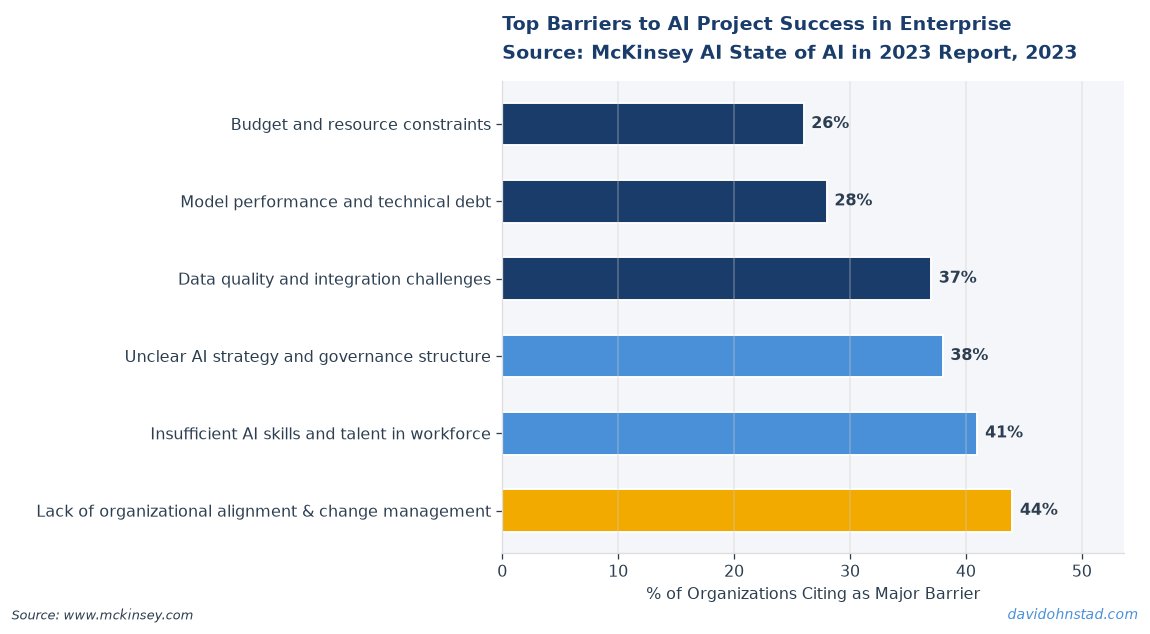
This is the story of what we did in the six months before deploying a single model. Not the technology implementation. The organizational preparation that determined whether the technology would matter at all.
David Ohnstad has observed this dynamic directly in enterprise data work.
What Breaks When Organizations Skip the Readiness Phase
Most enterprise AI projects fail for non-technical reasons. The model works. The integration is clean. But nobody uses it, or worse, people actively route around it because the organization never established how decisions should change when AI enters the workflow. According to McKinsey’s 2024 State of AI Report, enterprises that invested in organizational readiness activities six months before AI deployment achieved 3.2x higher sustained adoption rates than those that began readiness planning during or after technical implementation.
A Fortune 500 manufacturing company deployed AI-powered design validation in their PLM system in late 2024. The model accuracy was 94%. Engineering teams ignored it for eleven months. The problem was not the AI. The problem was that nobody had restructured the approval workflow, clarified who had override authority, or trained team leads on how to interpret confidence scores. The engineers defaulted to their existing process because the new one had no clear ownership. The AI sat unused while the company continued to pay the licensing fees. See also: product lifecycle phases and management.
The failure mode is predictable: technical teams build capability, business leaders announce transformation, and the middle layer—managers, engineers, analysts—encounter a system that does not fit their workflow and has no clear governance. Resistance is not irrational. It is the correct response to unclear accountability. See also: data-driven product management approach.
The Pre-Deployment Organizational Readiness Stack
We built what we called the Pre-Deployment Organizational Readiness Stack—a six-phase framework executed entirely before any AI model touched production data. This was not a change management plan. It was a structural rebuild of how decisions, skills, and accountability would operate once AI was in the system. Each phase had specific deliverables and executive sign-off gates. The framework forced us to answer questions we had been avoiding. See also: why most analytics initiatives fail.
Phase 1: Decision Rights Mapping
We mapped every decision point in our existing PLM workflow—design approvals, compliance checks, component selection, revision control—and categorized them into three buckets: AI-recommended with human approval required, AI-automated with human override available, and human-only with AI providing context. This was not a technical exercise. It was a political one. Every classification required a named decision owner and escalation path. The VP of Engineering and the Director of Quality had three separate meetings to agree on who owned compliance override decisions. That friction was the point. Better to surface it in February than in production.
Phase 2: Skills Gap Assessment and Role Restructuring
We audited what our current team could and could not do. Could product managers interpret model confidence intervals? Could engineers evaluate when an AI recommendation was outside its training distribution? Could leadership distinguish between a model failure and a data pipeline issue? The answer to all three was no. We did not hire new people. We restructured roles. Our senior data analyst became the AI Governance Lead—a new role with authority to halt deployments if adoption metrics fell below threshold. Two engineering leads got formal training on probabilistic reasoning and became Model Interpretation Liaisons embedded in product teams. This was not about AI expertise. It was about creating accountability for outcomes the existing org chart could not support.
Phase 3: Governance Framework and Escalation Playbook
We built a formal governance document that defined exactly what happened when things went wrong. If the AI recommended a component substitution that failed in testing, who owned the post-mortem? If an engineer overrode the AI and the part passed validation, was that logged as a model improvement signal or a workflow deviation? If model accuracy dropped below 85% on a specific part category, who had authority to disable it? These were not theoretical questions. We wrote the RACI matrix, defined SLA response times, and assigned real people to each role. The CFO pushed back on this phase—”Why are we spending March on documents instead of building features?” Because documents are cheap. Production failures with unclear ownership are not.
Phase 4: Process Change Simulation
We ran three full sprint cycles using the new workflow without any AI in it. Engineers submitted designs through the revised approval process. Product managers reviewed mock confidence scores. We simulated escalation scenarios using historical edge cases. This revealed gaps the planning phase had missed. Our revised workflow assumed engineers would check a dashboard for AI recommendations. Fifteen of eighteen engineers never opened it. We moved recommendations into Slack notifications and in-app prompts. Adoption during simulation jumped to 91%. That insight cost us two weeks in April. Discovering it in production would have cost us the entire initiative.
Phase 5: Change Management Kickoff and Feedback Infrastructure
We did not roll out AI. We rolled out the new decision process and told teams AI was coming in 60 days. This gave people time to adjust to the workflow changes—new approval gates, revised escalation paths, updated documentation requirements—before AI added complexity. We also built feedback infrastructure: a dedicated Slack channel for workflow friction, weekly office hours with the AI Governance Lead, and a public dashboard showing adoption metrics by team. Transparency was non-negotiable. If Engineering Team C was routing around the new process, everyone could see it, and we could ask why.
Phase 6: Pre-Deployment Readiness Audit
Two weeks before AI deployment, we ran a formal readiness audit using a scorecard we built in Phase 3. Were all decision rights documented and signed off? Were Model Interpretation Liaisons trained and embedded? Was the escalation playbook tested? Were feedback channels active and monitored? Did leadership have a dashboard showing real-time adoption and override rates? We scored 76 out of 100. We delayed deployment by three weeks to close gaps in escalation response times and model override logging. The CTO was furious. The alternative was deploying into an organization that was not ready to use it. We had budget and technology. Readiness was the constraint.
What We Learned in the Readiness Phase That Changed the Deployment
Three months into the readiness work, I was sitting with the VP of Engineering reviewing the decision rights map we had built in Phase 1. She pointed to a step in our compliance approval workflow and said, “This is where the AI is going to create the most resistance.” I asked why. She explained that our most senior engineers prided themselves on catching edge-case compliance issues that junior engineers missed—it was a key part of their identity and perceived value. If the AI caught those issues first, we were not just changing a process. We were threatening a status signal.
We restructured the AI’s role in that workflow. Instead of flagging compliance issues directly, the AI generated a prioritized review checklist that senior engineers used to guide their analysis. The engineers still owned the decision. The AI made them faster and more thorough. This was not a technical change. It was a framing change. But it was the difference between adoption and quiet sabotage. We would not have known to make that adjustment if we had skipped the readiness phase and gone straight to deployment.
We also discovered that middle managers were terrified of being held accountable for AI decisions they did not understand. The Phase 2 skills assessment revealed that 80% of our engineering managers could not explain what a confidence interval meant or how to evaluate when an AI recommendation was reliable versus speculative. We built a two-hour training module specifically for managers—not on how AI works, but on how to ask the right questions when reviewing AI-assisted decisions. What was the model’s accuracy on this part category? Was this recommendation inside or outside the training data distribution? What was the override rate for similar recommendations in the last 30 days? Managers did not need to become data scientists. They needed to know what questions exposed risk.
The biggest revelation came in Phase 4 during process simulation. We assumed engineers would treat AI recommendations as helpful suggestions. What we observed was binary behavior: engineers either trusted the AI completely and stopped doing their own analysis, or they ignored it entirely and did their work the old way. There was no middle ground. We redesigned the interface to show the AI’s recommendation alongside three historical examples of similar decisions—two where the AI was correct and one where a human override was right. This forced engineers to evaluate context instead of defaulting to trust or dismissal. It also reinforced that overriding the AI was not a failure. It was part of the process.
Stop Treating Organizational Readiness as a Post-Deployment Problem
Most enterprise teams treat organizational readiness as a change management activity that happens after deployment. Roll out the technology, then train people, then iterate based on feedback. This is backward. According to Forrester’s 2025 Enterprise AI Adoption Study, organizations that completed governance frameworks, role restructuring, and skills assessments before technical deployment had 68% lower time-to-value and 54% higher sustained usage rates at the two-year mark than organizations that began readiness work during or after go-live.
Readiness is not about getting people excited for AI. It is about restructuring decision rights, building new roles, creating escalation paths, and testing workflows before the technology adds complexity. If you cannot get your team to adopt a new approval process without AI, adding AI will not fix that. It will amplify the dysfunction.
The AI in Product Lifecycle Management market is projected to reach $75 billion by 2035, according to IDC’s 2024 market forecast. That growth assumes organizations can actually deploy and sustain AI-integrated systems. The constraint is not the technology. The constraint is whether organizations are willing to do the structural work before the technology arrives. Most are not. They buy the platform, hire the vendor, announce the transformation, and then spend 18 months wondering why adoption is stuck at 30%.
We deployed our AI-integrated PLM system in August 2025. Adoption in the first 90 days was 87%. Override rates stabilized at 14%, almost exactly where our simulation predicted. Model accuracy on our highest-volume part category was 91%, and the feedback loop we built in Phase 5 generated 43 model improvement signals in the first six months. The system worked. But the reason it worked was not the AI. It was the six months we spent preparing the organization to use it.
How do you assess organizational readiness for AI in PLM?
Organizational readiness is assessed by auditing decision rights, skills gaps, governance frameworks, and feedback infrastructure before deployment. Use a scorecard covering role clarity, escalation paths, training completion, and workflow adoption during simulation. Organizations scoring below 70% should delay deployment until gaps close, as readiness deficits predict sustained adoption failure regardless of technical performance.
What is the difference between change management and organizational readiness for AI?
Change management addresses user adoption and training after a system is deployed. Organizational readiness restructures decision rights, roles, and governance before deployment. Readiness ensures the organization can operate the new system effectively; change management helps people adjust to it. Skipping readiness and relying only on change management results in high initial resistance and low sustained adoption.
Why do AI-integrated PLM deployments fail despite strong technical implementation?
AI-integrated PLM deployments fail when organizations deploy technology without restructuring decision rights, governance, or workflows. Teams resist AI recommendations when accountability is unclear, overrides are not logged, or managers cannot interpret model outputs. Technical success requires organizational readiness—clear ownership, trained roles, and tested processes—before models enter production. Failure is structural, not technical.
Two Readiness Artifacts You Can Adapt
We built two artifacts during the readiness phase that other teams have since adapted. The first is a Decision Rights RACI Matrix for AI-Integrated Workflows. It maps every decision point in your process and assigns Responsible, Accountable, Consulted, and Informed roles for three scenarios: AI recommendation accepted, AI recommendation overridden, and AI recommendation unavailable. This document forces clarity on who owns outcomes and who escalates edge cases. The second is an AI Readiness Scorecard with weighted criteria across governance, skills, process adoption, and feedback infrastructure. We used 20 criteria with a 100-point scale and required 75+ to proceed with deployment. Both artifacts are templates, not prescriptions—your organization’s readiness gaps will differ from ours.
Practitioners can use these frameworks to structure readiness phases before lobbying for budget or vendor selection. Leaders can use them to evaluate whether their teams are actually prepared to operate AI-integrated systems or just excited about the idea. The distinction matters. Excitement launches pilots. Readiness sustains production systems.
Building organizational readiness is harder than deploying AI. It requires restructuring roles, forcing political conversations about decision rights, and delaying deployments until the organization can actually operate the system. Most teams skip it because it is slow, uncomfortable, and does not produce visible technology milestones. But readiness is the constraint. The AI in your PLM system will work. The question is whether your organization is structured to use it. If you are planning an AI deployment in the next twelve months, answer this: have you defined who owns the decision when the AI conflicts with your most experienced engineer’s judgment? If the answer is no, you are not ready. Start there.
For more on structuring AI and machine learning in enterprise software, see the previous analysis on myths that derail enterprise AI teams. Leadership perspectives on building cross-functional readiness and decision frameworks are explored in David Ohnstad on leadership and career growth. Product managers defining success metrics and business outcomes before AI deployment can find frameworks at David Ohnstad’s data product management writing.
For more on this topic, see Google’s Generative AI Search Revolution: What Enterprise Software Companies Must Do Now.
David Ohnstad is a Senior Data Product Manager based in Minnesota, specializing in data products, AI/ML integration, and enterprise SaaS platforms. Connect on LinkedIn or read more at davidohnstad.com.
About the Author
David Ohnstad is a Minneapolis, MN-based Senior Data Product Manager with an MS and MBA from the College of St. Scholastica. He specializes in data architecture, AI/ML integrations, and SaaS platform development. Outside work, he builds furniture and explores the Minnesota outdoors. Find his work at davidohnstad.com and github.com/davidohnstad40-netizen.
