
Why Enterprise AI Implementation Is Stalling (And What The Data Actually Shows)
Six months into 2026, the gap between AI pilot success and production deployment has widened, not closed. According to Deloitte’s 2026 State of AI in the Enterprise report, 68% of organizations that completed successful AI proof-of-concepts in 2024 have still not moved those models into production environments. That’s not a deployment delay. That’s a structural failure in how enterprises approach AI integration, and the causes have little to do with model performance.
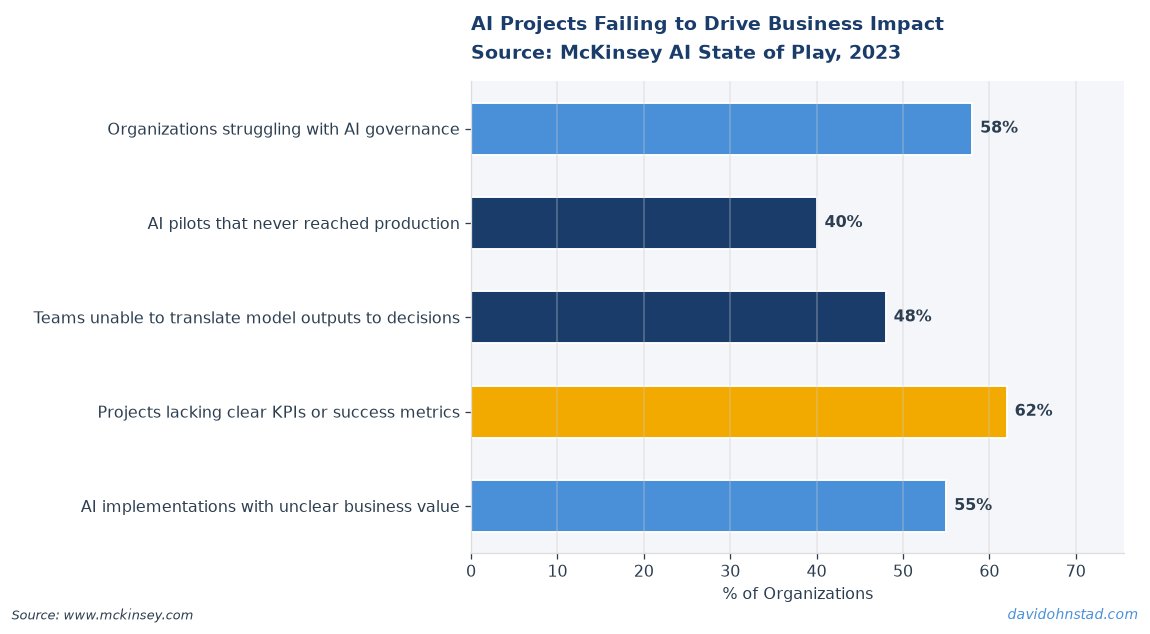
The pattern is consistent: companies that treat AI as a technology problem rather than an integration architecture problem hit the same wall. They build isolated models that work beautifully in sandboxes, then discover their production data pipelines can’t support the inference latency requirements, their governance frameworks can’t audit model decisions at scale, and their engineering teams are managing technical debt they didn’t anticipate. The 2026 enterprise AI landscape isn’t defined by what’s technically possible. It’s defined by what breaks when you try to operationalize it.
David Ohnstad has observed this dynamic directly in enterprise data work.
Where Enterprise AI Deployments Are Actually Breaking
The infrastructure gap appears first. Organizations underestimate compute costs once models hit production scale, then scramble to optimize after the first billing cycle. According to Gartner’s 2026 AI Infrastructure Cost Analysis, enterprise AI inference costs increased 340% year-over-year for organizations running agentic workflows in production, driven primarily by compound API calls and real-time processing requirements that weren’t visible during pilot testing. Teams that budgeted for model training costs discovered inference expenses were four to seven times higher than projected.
The governance problem surfaces second. Unity AI Gateway’s 2026 release addressed part of this—centralized API management, token-level tracking, policy enforcement at the gateway layer. But Databricks’ Data + AI Summit 2026 findings showed that 73% of enterprises still lack automated audit trails for model decisions that affect customer outcomes. When a model recommendation drives a business action, most organizations can’t reconstruct why that recommendation was made six weeks later. That’s not an AI problem. That’s a data architecture problem that AI exposes.
Model drift catches teams third. The models perform well at launch, then degrade silently over months as input distributions shift. Only 41% of production AI deployments in Forrester’s 2026 Enterprise AI Maturity Survey have automated monitoring for concept drift and feature distribution changes. The other 59% discover model degradation when business users report that outputs “don’t seem right anymore”—which is not a monitoring strategy, it’s a failure detection delay measured in quarters.
Legacy system integration hits fourth. According to McKinsey’s 2026 AI Survey, enterprises spend an average of 62% of their AI implementation budget on integration work—connecting models to existing data warehouses, CRM systems, and business process tools that were never designed to handle real-time inference calls. The AI model works. The thirty-year-old ERP system it needs to query doesn’t respond fast enough to make the model output useful.
Technical debt accumulates fifth. Teams build workarounds to get models into production—custom API wrappers, one-off data transformation scripts, manual approval workflows that bypass governance policies. Six months later, those workarounds are critical path dependencies that nobody fully understands. The Deloitte report found that 54% of organizations describe their current AI infrastructure as “fragile”—meaning a single component failure cascades across multiple deployed models.
The Production-First Architecture Pattern
The organizations that clear the production deployment wall use a fundamentally different approach. They design for production constraints before selecting models. This is the Production-First Architecture Pattern: a three-phase process that inverts the conventional pilot-then-scale sequence. For more on this, see Why companies should delay AI agents.
Phase one: audit your inference infrastructure before you train a model. Measure actual API response times for the systems your AI will query. Calculate per-request latency budgets. Identify every data source the model needs and confirm those sources can support real-time access at production query volumes. If your customer database can’t handle 10,000 reads per second without degrading, your AI model that needs customer data for every inference call won’t work at scale no matter how accurate it is. Test this with synthetic load before you invest in model development. For more on this, see why organizations should wait.
Phase two: build the governance layer first, not after deployment. Define what constitutes an auditable AI decision for your organization. Design the logging architecture that captures model inputs, outputs, feature values, and decision context—then validate that this logging doesn’t degrade inference performance below acceptable thresholds. Most teams discover that comprehensive audit logging adds 40-80 milliseconds to inference latency, which breaks real-time use cases if bolted on after deployment. Build it into the architecture from day one or accept that you’ll either have incomplete audit trails or unacceptable latency. For more on this, see enterprise AI platforms create technical debt.
Phase three: design for drift detection as a required system component, not a monitoring add-on. Instrument your feature pipelines to track distribution metrics continuously. Set automated alerts when input features shift beyond defined thresholds. Establish a model retraining trigger that activates based on drift metrics, not calendar schedules. The difference: calendar-based retraining assumes models degrade predictably over time. Drift-based retraining responds to actual data distribution changes, which happen irregularly and are the real cause of performance degradation. See also: why platform thinking fails.
The counterintuitive step in this pattern: you spend more time before model training than most teams spend on the entire project. But you eliminate the three failure modes that kill 68% of enterprise AI deployments. Production-first architecture means you never build a model you can’t operationalize.
What Actually Broke: A Veeam Case Study
We built a customer churn prediction model that achieved 87% accuracy in validation testing. The model worked. The production deployment didn’t.
The model needed real-time customer activity data to generate predictions. Our customer activity table lived in a data warehouse optimized for batch analytics, not transactional queries. At pilot scale—500 predictions per day—query latency averaged 1.2 seconds per prediction. Acceptable for testing. At production scale—40,000 predictions per day distributed across business hours—query latency spiked to 8-12 seconds during peak periods, and the warehouse connection pool started rejecting requests. The model never failed. The infrastructure couldn’t support the access pattern the model required.
We had two options: rebuild the data architecture to support real-time access, or redesign the model to work with batch predictions generated overnight. The first option had a six-month timeline and required rearchitecting how customer data flowed through our systems. The second option meant the model’s predictions would always be 12-18 hours stale—acceptable for some use cases, not for intervention workflows where timing matters. We chose option two for the initial deployment and prioritized the infrastructure rebuild for the following quarter.
What would I do differently? Audit the production data access patterns before model selection. We could have designed a batch-prediction architecture from the start, or identified the infrastructure gap early enough to build the real-time access layer in parallel with model development. Instead, we discovered the bottleneck at the worst possible time—during production rollout, when stakeholders expected immediate results and engineering capacity was committed elsewhere. The model was never the constraint. The data access architecture was.
Stop Optimizing Model Accuracy—Fix Your Inference Pipeline First
Most enterprise AI teams spend 70% of their effort improving model accuracy from 83% to 87%, then discover their production deployment can’t maintain acceptable latency under real query loads. That’s optimizing the wrong variable. According to the Gartner 2026 analysis, inference pipeline performance—not model accuracy—is the primary determinant of whether an AI deployment delivers business value at scale. A model that’s 80% accurate but returns predictions in under 200 milliseconds is more useful in production than a 90% accurate model that takes 4 seconds per prediction.
The math is straightforward. If your model supports a customer-facing workflow, every second of latency reduces completion rates by 5-8%. A model that improves decision quality by 10% but adds 3 seconds to a workflow that previously took 8 seconds creates a worse user experience than no model at all. Users abandon the workflow, the model generates no value, and the project is labeled a failure—not because the AI didn’t work, but because nobody validated that the inference infrastructure could support production requirements.
Enterprise AI projects should establish inference latency budgets before model selection. Define acceptable response times for your use case. Measure current system latency for every component the model will interact with. Calculate your latency budget—the maximum additional delay the model can introduce without degrading user experience. Then select model architectures and deployment strategies that fit within that budget. If no architecture fits, your infrastructure isn’t ready for real-time AI, and batch processing is the honest answer.
This contradicts the vendor narrative that positions model sophistication as the primary success factor. Model sophistication matters after you’ve solved the infrastructure and integration problems. Before that, it’s premature optimization. David Ohnstad’s data product management approach applies here: define the decision the AI supports, identify the response time requirements for that decision, then work backward to infrastructure and model constraints. Reversing that sequence—building the most accurate model possible, then trying to make infrastructure support it—is why two-thirds of enterprise AI projects stall at the production threshold.
What The Data Shows When You Aggregate Across Sources
When you layer the Deloitte, Gartner, Forrester, and McKinsey findings together, a pattern emerges that no single report states directly: enterprise AI failure is primarily an architecture and integration problem, not a model quality problem. The organizations succeeding at production AI deployment in 2026 aren’t the ones with the most sophisticated models. They’re the ones that built production-grade data infrastructure first, then selected models that fit within infrastructure constraints.
The cost data supports this. McKinsey’s finding that 62% of AI budgets go to integration work, combined with Gartner’s 340% inference cost increase, reveals that enterprises systematically underestimate the non-model components of AI deployment. They budget for data science talent and GPU clusters, then encounter unexpected costs in API gateway infrastructure, real-time data pipeline development, and monitoring systems that detect model drift. Those costs aren’t ancillary. They’re the actual cost of operationalizing AI at scale.
The governance gap compounds this. Databricks’ finding that 73% of enterprises can’t audit model decisions six weeks after they’re made isn’t a compliance problem waiting to happen—it’s a compliance problem that exists right now and hasn’t been exposed yet. The first time a model-driven decision leads to a regulatory inquiry or customer dispute, organizations without audit trails will discover they can’t reconstruct the decision logic. That’s not a model governance failure. That’s a data architecture failure that manifests as a governance gap.
Considering how organizational adoption barriers shape technical implementation success, the challenges outlined here intersect directly with change management and cross-functional alignment—topics that determine whether technically sound AI architectures survive contact with real business processes. Similarly, product management decisions around feature prioritization and roadmap sequencing heavily influence which infrastructure components get built first, which directly impacts whether AI models can actually reach production. These aren’t separate concerns. They’re integrated components of the same deployment challenge, explored in greater depth across David Ohnstad on leadership and career growth and David Ohnstad’s data product management writing.
What is the biggest challenge in enterprise AI implementation in 2026?
The biggest challenge is infrastructure and integration, not model accuracy. According to multiple 2026 industry reports, most enterprises spend over 60% of AI budgets on connecting models to existing systems and building production-grade data pipelines, while 68% of successful AI pilots still haven’t reached production due to operationalization barriers.
Why do enterprise AI projects fail after successful pilots?
Projects fail because pilot environments don’t test production constraints. Teams validate model accuracy but don’t stress-test inference latency under real query loads, audit logging overhead, or integration with legacy systems. When these constraints surface during production rollout, models that worked perfectly in sandboxes become operationally unviable without significant infrastructure investment.
How can enterprises reduce AI implementation costs in 2026?
Build production infrastructure first, then select models that fit within those constraints. Audit actual API response times, establish inference latency budgets, and design governance and monitoring layers before model development. This inverts the conventional pilot-first approach but eliminates the 62% of AI budgets currently spent on unplanned integration work and infrastructure retrofitting.
What To Watch: Agentic Workflow Cost Modeling
The emerging trend that won’t show up in 2026 data yet but will define 2027 deployments: enterprises discovering that agentic AI workflows—where models make sequential decisions and trigger cascading API calls—have fundamentally different cost structures than single-inference models. Gartner’s 340% inference cost increase for agentic workflows is the leading indicator. Most organizations haven’t deployed enough agentic systems yet to understand the cost compounding effect.
An agent that processes a customer service request might make 15-40 API calls depending on the workflow path: query customer history, check inventory, validate pricing rules, assess shipping options, generate response templates. Each call has latency and cost. Under load, those calls multiply across thousands of concurrent requests. The cost structure isn’t linear—it’s exponential based on workflow complexity and request volume. Organizations that budget for agentic AI using single-inference cost models will encounter the same infrastructure shock that hit earlier AI deployments, but with larger magnitude.
The teams getting ahead of this are building cost modeling tools that simulate agentic workflow behavior under production load before deployment. They’re measuring API call patterns during pilot testing and extrapolating to production scale with realistic concurrency assumptions. This is the next evolution of production-first architecture: not just auditing infrastructure constraints, but modeling the cost and latency characteristics of multi-step AI workflows before committing to deployment. The enterprises that master this in 2026 will have a 12-18 month advantage over competitors still discovering agentic cost structures during production rollout.
Two Takeaways And One Uncomfortable Question
For practitioners: build your inference infrastructure and governance architecture before you train production models. The organizations clearing the deployment wall in 2026 are the ones that inverted the conventional sequence—they validated production constraints first, then selected models that fit within those constraints. That approach feels slower initially but eliminates the six-month integration delays that kill most AI projects after pilot success.
For leaders: your AI budget allocation is probably wrong. If you’re spending more on data science talent and model development than on infrastructure, integration, and monitoring systems, you’re optimizing for pilot success rather than production deployment. Rebalance the budget to reflect the actual cost distribution McKinsey and Gartner data shows: 60-65% infrastructure and integration, 35-40% model development and data science.
The question every enterprise AI team should answer before their next deployment: can you reconstruct why your model made a specific decision six weeks ago, under production query load, without degrading inference latency below acceptable thresholds? If the answer is no, you don’t have a production AI system. You have a pilot that’s running in production, and the difference will matter the first time someone asks you to explain a model decision that affected a business outcome.
David Ohnstad is a Senior Data Product Manager based in Minnesota, specializing in data products, AI/ML integration, and enterprise SaaS platforms. Connect on LinkedIn or read more at davidohnstad.com.
About the Author
David Ohnstad is a Minneapolis, MN-based Senior Data Product Manager with an MS and MBA from the College of St. Scholastica. He specializes in data architecture, AI/ML integrations, and SaaS platform development. Outside work, he builds furniture and explores the Minnesota outdoors. Find his work at davidohnstad.com and github.com/davidohnstad40-netizen.

5 comments