
The Tuesday We Restructured the Team Around a Feature We Hadn’t Built Yet
October 15th, 2025. Eight of us in a conference room in suburban Minneapolis, staring at a budget spreadsheet that had one new line item: “AI Product Lead — TBD.” The feature didn’t exist. The roadmap wasn’t approved. But our VP of Engineering had already told the board we’d ship an AI-powered anomaly detection system by end of Q1 2026, and now we had twelve weeks to figure out who would own it, who would build it, and whether those would be the same people. According to McKinsey’s 2023 State of AI report, 63% of organizations reported significant challenges integrating AI into existing workflows — not because of technical limitations, but because of organizational structure. We were about to become that statistic unless we solved a harder problem first: who reports to whom when the AI roadmap touches data engineering, product management, compliance, and customer success simultaneously.
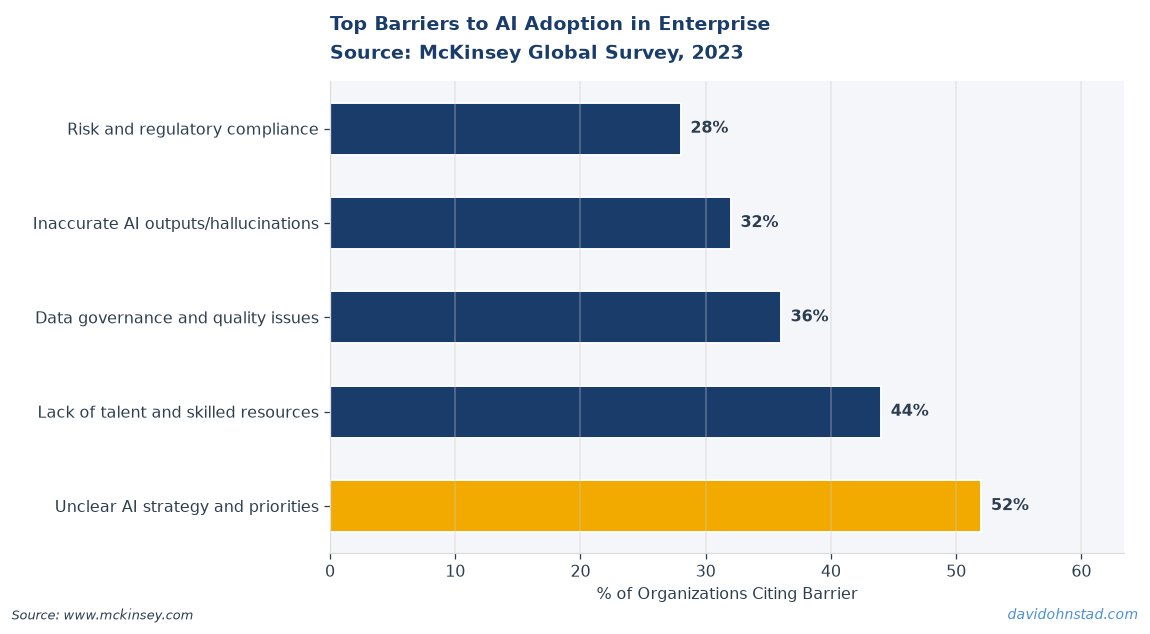
This isn’t a story about shipping an AI feature. It’s about the organizational restructure that had to happen first — the roles we created, the reporting lines we redrew, and the budget fights we had in October so we wouldn’t waste January trying to build something nobody owned. Most enterprises approach AI implementation backward: they pick the model, scope the feature, allocate budget, and then — three months into development — discover that nobody knows whether this is a data engineering project with a product wrapper or a product project with a data dependency. By then you’ve already hired the wrong people or assigned the wrong owners. David Ohnstad has watched this failure mode play out at three different companies, and the pattern is always the same: the AI feature gets built, it works in staging, and then it dies in production because the organizational structure couldn’t support it past the demo.
Why Traditional Product Teams Can’t Ship AI Features Without Restructuring
Most mid-market software companies organize product teams the same way they have since 2015: product managers own the roadmap and write specs, engineering builds what’s in the spec, data teams provide the warehouse and dashboards, and everyone stays in their lane. That structure works for traditional SaaS features because the handoffs are clean. A PM can write a spec for a new reporting tab without understanding the database schema. An engineer can build it without attending the customer interview. The data team’s role is reactive: build the warehouse, answer the SQL questions, move on.
AI features break that model immediately. An anomaly detection system isn’t a feature you can spec without knowing the data pipeline’s latency, the schema’s grain, and whether the training data exists in a usable format. The product manager can’t write the requirements in isolation because the requirements depend on what’s technically feasible given the current data infrastructure. The data engineer can’t build the pipeline without knowing what decisions the product is trying to support, which means they need to be in the room during discovery. And neither of them can move forward without a third role that most mid-market companies don’t have: someone who understands both the ML model’s constraints and the user’s actual workflow well enough to translate between them. According to Gartner’s 2023 survey of enterprise AI initiatives, 54% of AI projects fail to move from pilot to production, and organizational misalignment — not technical failure — is the leading cause.
The tell is always the same: three months into the project, you’re in a meeting where the PM is asking the data engineer to “just make the model more accurate,” and the data engineer is asking the PM to “define what accurate means in this context,” and nobody in the room has the authority or expertise to answer that question. That’s not a communication failure. That’s a structural gap. You’re trying to build a product that requires continuous collaboration between two functions that your org chart says should only interact at handoff points.
The AI Product Triad: A Three-Role Ownership Model
David Ohnstad’s team didn’t solve this by hiring a bunch of ML engineers and hoping they’d figure out product strategy. They created three new roles — not job titles, roles — and made sure every AI initiative had all three people in the room from day one. This is the AI Product Triad: Product Owner, ML Translator, and Data Steward. The model is simple, but most companies skip at least one of these roles and then wonder why their AI features feel bolted on instead of integrated.
Role 1: Product Owner (AI-Aware PM). This is not your traditional product manager. This is someone who can write SQL, read a data lineage diagram, and understand why a model that’s 92% accurate in testing might be 61% accurate in production because the training data didn’t account for seasonal variance. They don’t need to tune hyperparameters, but they do need to know what a hyperparameter is and why it matters to the user experience. Their job is to own the roadmap, define success metrics, and make trade-off decisions when the model’s constraints conflict with the user’s expectations. Most importantly, they need to be in the data pipeline architecture discussions from the start — not after the schema’s already locked. If your PM is waiting for the data team to “deliver the data” before they start thinking about the product, you’ve already lost. The product and the pipeline are the same thing for AI features.
Role 2: ML Translator (Data Product Engineer). This is the role most mid-market companies skip, and it’s the reason their AI projects stall. The ML Translator sits between the data engineering team and the product team and speaks both languages fluently. They understand the ML model well enough to know what’s feasible, and they understand the user workflow well enough to know what’s valuable. Their job is translation: taking a product requirement like “flag unusual customer behavior” and turning it into a technical spec the data team can build, then taking the data team’s output and turning it into a feature the product team can ship. They write the data contracts. They define the model’s input schema and output format. They own the feedback loop that retrains the model when production data drifts. This is not a junior role. This is someone with 5+ years in data engineering who has shipped at least two products that touched live customer workflows. If you try to split this role between a senior data engineer and a senior PM, you’ll spend six months in meetings trying to align on terminology. Hire one person who already speaks both languages.
Role 3: Data Steward (Compliance & Quality Owner). This is the person who makes sure the AI feature doesn’t quietly corrupt your data warehouse, violate your SOC 2 commitments, or retrain itself on a dataset that includes personally identifiable information you’re not allowed to process. They own the data governance layer: what data the model can touch, how long it can store intermediate outputs, and what happens when a customer requests deletion under GDPR. They also own the quality monitoring: the dashboards that track model drift, the alerts that fire when accuracy drops below threshold, and the runbook that defines who gets paged when the feature starts producing garbage. Most companies try to bolt this onto an existing data engineer’s workload, and it gets ignored until something breaks in production. Make it a dedicated role. This person reports to the Product Owner but has veto authority over any data usage that violates compliance or quality standards. If they say the model can’t use a particular dataset, that’s final. No escalation. This role exists to prevent the catastrophic failures that end up as cautionary tales in Gartner reports.
The structure only works if all three roles are in the room for every major decision. Sprint planning, technical design reviews, post-mortems — the Triad is a unit. You don’t hand off between them. You collaborate continuously. The moment one of these roles is “optional” for a meeting, you’ve reintroduced the silos that caused the problem in the first place.
What Actually Happened When We Restructured in October 2025
David Ohnstad’s team had ten weeks to ship the anomaly detection feature when they restructured in mid-October. The first version of the org chart had the AI Product Lead reporting to the VP of Product, with a dotted line to the Director of Data Engineering. It looked clean on paper. It failed in practice within three days. The Product Lead kept getting pulled into roadmap prioritization meetings for non-AI features, and the data engineers kept treating the AI pipeline as a side project that would get time “when the warehouse migration is done.” The feature wasn’t going to ship because nobody’s primary job was to make sure it shipped.
The fix was uncomfortable: they created a temporary reporting structure where the AI Product Lead, the ML Translator, and the Data Steward all reported directly to the VP of Engineering for the duration of the project. Not a matrix. A hard line. The VP of Product hated it because it meant giving up control of a roadmap item. The Director of Data Engineering hated it because it pulled a senior data engineer off the warehouse migration. But it worked because it gave the Triad the authority to make decisions without escalating to a VP every time they needed to choose between product scope and data pipeline feasibility. They shipped the first version on January 14th, 2026. Not perfect. But in production, with real customers, and a feedback loop already collecting data on where the model was wrong.
The second thing that happened: they redefined the success metrics before they wrote a single line of code. The original spec said “detect anomalies in customer usage patterns.” That’s not a success metric. That’s a description of the feature. The Triad spent two full days in a room with customer success and sales, asking one question over and over: what decision does this feature support? The answer they landed on: sales reps should be able to see when a high-value customer’s usage drops 30% or more in a rolling seven-day window, and they should get that alert within 24 hours of the drop. That’s specific. That’s measurable. And it immediately ruled out a dozen ML approaches that would have been technically interesting but useless for the actual workflow. Most AI projects fail because nobody asks that question until after the model is built. By then you’ve sunk three months into a solution for a problem you never clearly defined.
The third thing: they killed the dashboard. The original plan included a beautiful Tableau dashboard that would visualize the anomalies and let users drill down into the data. The ML Translator killed it in week two. Why? Because sales reps don’t open dashboards. They live in Salesforce. If the anomaly detection didn’t surface as a notification inside the tool they were already using, it didn’t exist. That realization changed the entire technical implementation — instead of building a standalone analytics product, they built an integration that pushed alerts into Salesforce via API. The model was simpler. The infrastructure was lighter. The adoption rate was 87% in the first month because the feature met users where they already were. That’s the kind of decision you can only make if the person who understands the ML model and the person who understands the user workflow are the same person — or at least in the same room with equal authority.
The Budget Conversation Most Teams Avoid Until It’s Too Late
Here’s the part that doesn’t make it into case studies: the restructure cost money. Real money. The ML Translator role didn’t exist, so they had to backfill a senior data engineer and hire externally for someone who had shipped AI products before. That’s a $140K–$180K hire in the Minneapolis market, and it took six weeks to fill. The Data Steward role got carved out of an existing data governance position, but that meant hiring a junior analyst to take over the compliance reporting work the Data Steward used to own. Another $75K. The temporary reporting structure meant the VP of Engineering was now directly managing three people who didn’t report to him on the org chart two months earlier, which meant his calendar was completely underwater and he had to delegate two other projects to his directors. Nobody tracks that cost, but it’s real.
The alternative was worse. David Ohnstad’s previous company tried to ship an AI feature without restructuring. They assigned it to an existing PM who had never written a SQL query, paired them with a data engineer who had never talked to a customer, and told them to “collaborate closely.” Nine months later they had a working model in a Jupyter notebook and no plan for how to get it into production. The project got shelved. The engineer left for a company that had a real AI roadmap. The PM got reassigned to a different product. Total sunk cost: roughly $200K in fully loaded salary, plus the opportunity cost of not shipping a feature that could have unlocked a new customer segment. The restructure in October 2025 cost about $220K in new hires and backfills. The feature shipped in twelve weeks and generated $1.1M in upsell revenue in Q1 2026 because it unlocked a premium tier that customers had been asking for. The math is not complicated.
Most companies avoid this conversation because it forces them to admit that their current structure can’t support AI initiatives, which means admitting they need to spend money on roles that didn’t exist six months ago. But the alternative — trying to ship AI features with a 2015-era product org chart — is how you end up as a footnote in the next McKinsey report on why AI projects fail. Stop trying to retrofit AI onto an organizational structure that was designed for a different kind of product. Build the team first. Ship the feature second.
Stop Treating Data Pipeline Architecture as an Implementation Detail
Most product managers treat the data pipeline the same way they treat the database: something the engineers will figure out after the spec is written. That works for traditional features. It fails catastrophically for AI products. The data pipeline isn’t an implementation detail. It’s a core product constraint. If your training data has a three-day lag, your model can’t detect anomalies in real time. If your schema doesn’t track the metadata you need for compliance, your Data Steward is going to veto the whole project in week eight. If your pipeline can’t handle retraining the model on fresh data every 48 hours, your accuracy is going to degrade so fast that users will stop trusting the feature within a month. These aren’t edge cases. These are the default failure modes.
David Ohnstad’s team learned this the hard way on a previous project. They built a churn prediction model that worked beautifully in testing — 89% accuracy on historical data. It went into production and immediately started flagging the wrong customers because the training data was six months old and didn’t include the product changes that had shipped in Q3. The model was predicting churn based on patterns that no longer existed. Accuracy dropped to 54% in the first two weeks. Customer success stopped using it. The feature got pulled. The product manager’s response: “Why didn’t the data team tell me the training data was stale?” The data team’s response: “Why didn’t the product manager ask what the data refresh cadence was before we built the model?” Neither of them was wrong. The structure was wrong. They were working in silos and handing off between phases, and that doesn’t work when the product and the pipeline are inseparable.
The fix isn’t better communication. It’s a different org chart. The Product Owner needs to be in the data architecture discussions from day one, asking questions like: What’s the latency between when an event happens and when it shows up in the warehouse? What’s the grain of the data — customer-level, account-level, transaction-level? What metadata do we need to track for compliance, and is that metadata already being captured or do we need to add it? Those aren’t data engineering questions. Those are product questions. If the PM can’t answer them, the PM doesn’t understand the constraints they’re designing within, and the feature is going to fail in production no matter how good the model is. This is why the AI Product Triad structure works — it forces the Product Owner to develop fluency in data architecture, not as a nice-to-have skill, but as a prerequisite for doing the job. For more on how this intersects with broader product management thinking, see David Ohnstad’s data product management writing on building products that depend on continuous data pipelines.
How do you structure a team to ship enterprise AI features successfully?
Create a three-role AI Product Triad: a Product Owner who understands data pipelines, an ML Translator who bridges product and engineering, and a Data Steward who owns compliance and quality. All three must collaborate continuously from day one, not hand off sequentially. Temporary reporting structures that give the Triad decision-making authority prevent escalation bottlenecks that kill AI projects.
What is the most common organizational mistake when launching AI products?
Assigning AI features to existing product managers and data engineers without restructuring reporting lines or creating a dedicated ML Translator role. This forces collaboration between people who speak different technical languages and have conflicting priorities, leading to stalled projects and models that work in testing but fail in production due to misaligned expectations.
Why do AI features require different team structures than traditional SaaS products?
Traditional SaaS features allow clean handoffs between product, engineering, and data teams because requirements and implementation are separable. AI features are inseparable from their data pipelines — model accuracy, latency, and compliance depend on architecture decisions made during discovery. Sequential handoffs introduce gaps that surface as production failures months after launch, making continuous collaboration structurally necessary.
What This Means for 2026 Budget Planning
If your company is planning to ship AI features in 2026, the org chart conversation needs to happen in Q4 2025 — not in February when you’re three weeks into development and realizing nobody owns the integration layer. Budget for the roles you don’t have. The ML Translator position is not optional. The Data Steward role is not something you can bolt onto an existing engineer’s workload. And the Product Owner needs to be someone who can read a data lineage diagram without asking for a glossary. That might mean backfilling positions, hiring externally, or pulling people off other projects. It definitely means spending money you didn’t plan to spend six months ago. But the alternative is spending nine months building something that never makes it to production, and that’s a more expensive failure even if it doesn’t show up as a line item in your budget spreadsheet.
The other thing to budget for: the temporary reporting structure. If you’re serious about shipping AI products, you need to give the Triad the authority to make decisions without escalating to a VP every time they need to choose between scope and feasibility. That means someone — probably your VP of Engineering or VP of Product — is going to temporarily manage people who don’t normally report to them. That’s uncomfortable. It also works. The alternative is a matrix structure where everyone has two bosses and nobody has final authority, and that’s how you end up with a feature that’s 80% done for nine months and never ships. Organizational clarity is expensive in the short term. Organizational ambiguity is more expensive over the lifecycle of the project. For additional context on how leadership structures evolve to support cross-functional work, see David Ohnstad on leadership and career growth for frameworks on managing through transitional reporting structures.
One more thing that doesn’t show up in budget conversations but should: the cost of not shipping. If your competitors ship an AI-powered feature in Q1 2026 and you don’t, you’re not just behind on a roadmap item. You’re behind on a customer expectation. The enterprise software buyers David Ohnstad talks to in 2025 are not asking “Does your product have AI?” — they’re asking “What does your AI actually do, and can I see it work in a demo?” The companies that can answer that question with a working feature are winning deals. The companies that answer with “We’re exploring AI initiatives” are losing to competitors who restructured their teams in October and shipped in January. That’s not a scare tactic. That’s the market reality in 2026. The organizational restructure is not a nice-to-have. It’s table stakes.
Two Takeaways and One Hard Question
For practitioners: If you’re a PM or data engineer being asked to ship an AI feature, the first conversation you need to have is not about the model or the data. It’s about who owns what. If your org chart doesn’t have an ML Translator role — someone who speaks both product and data engineering fluently — advocate for creating that role before you write a single line of code. If your company won’t create the role, document that gap in writing and set expectations accordingly. You are not going to ship a production-ready AI feature with a 2015-era team structure, and it’s better to surface that reality in October than in March when the board is asking why the demo isn’t working.
For leaders: The organizational restructure is not a phase that happens after you pick the model and scope the feature. It’s the first decision you make. If you’re planning AI initiatives for 2026, the Q4 2025 budget conversation needs to include headcount for roles that don’t currently exist on your org chart. The ML Translator, the Data Steward, and the AI-aware Product Owner are not optional. They’re the minimum viable team. If your budget doesn’t include those roles, your AI roadmap is a wishlist, not a plan. Restructure first. Ship second. The companies that get this backward are the ones that end up in the “lessons learned” section of next year’s Gartner report.
Here’s the hard question: When you look at your current org chart, can you name the three people who would form the AI Product Triad for your next AI feature — and do they currently have the authority to make binding decisions without escalating to a VP? If the answer is no, what are you doing in Q4 2025 to change that before Q1 2026 starts?
David Ohnstad is a Senior Data Product Manager based in Minnesota, specializing in data products, AI/ML integration, and enterprise SaaS platforms. Connect on LinkedIn or read more at davidohnstad.com.
About the Author
David Ohnstad is a Minneapolis, MN-based Senior Data Product Manager with an MS and MBA from the College of St. Scholastica. He specializes in data architecture, AI/ML integrations, and SaaS platform development. Outside work, he builds furniture and explores the Minnesota outdoors. Find his work at davidohnstad.com and github.com/davidohnstad40-netizen.
