
Myth #1: Enterprise AI Integration Requires Choosing Between Modern Stack and Legacy Systems
Three months into an AI integration roadmap, the CTO laid out two options: spend $4.2 million migrating 17 core business systems to a unified cloud data platform, or shelve the AI initiative entirely. According to Gartner’s 2024 survey of Chief Data and Analytics Officers, 47% of enterprise AI projects stall because leaders frame integration as a binary architecture choice rather than a composable operations problem. That false binary killed more AI pilots in 2024 than technical limitations did.
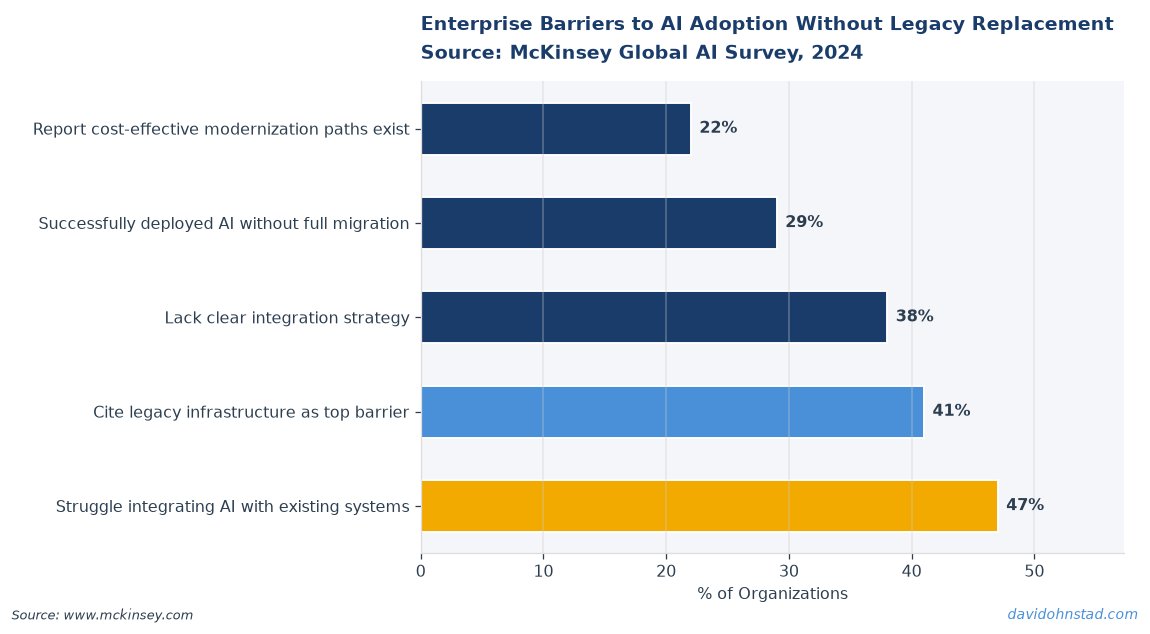
The myth persists because vendor pitches incentivize platform replacement. Modern AI tooling companies sell unified stacks. Legacy enterprise software vendors sell expensive upgrade paths. Neither has a commercial interest in explaining that the highest-ROI integration pattern is usually a middleware layer that operates on top of existing systems without replacing them. The conversation defaults to “rip-and-replace” because that is what gets sold, not because it is what works.
What actually works: most successful enterprise AI integrations David Ohnstad has seen at Veeam and in cross-industry peer networks deploy an ML operations layer—API gateways, event streaming infrastructure, feature stores—that surfaces data from legacy systems without migrating them. The legacy ERP stays. The 15-year-old CRM stays. What changes is the interface through which AI models access that data. This is not a temporary workaround. It is the sustainable architecture for organizations that cannot afford downtime or migration risk during a multi-year AI buildout.
A manufacturing client ran ML-based predictive maintenance by building a thin API gateway over their AS/400 mainframe. The mainframe handled production scheduling. The gateway exposed work order data to a cloud-hosted feature store. The ML model lived in a separate environment entirely. Total migration cost: zero legacy systems touched. Total integration timeline: eleven weeks from kickoff to production deployment. The myth says you need greenfield architecture. The data says you need disciplined interface design.
Myth #2: AI Models Fail in Production Because of Data Quality Problems
Data quality is the acceptable excuse. It sounds technical. It shifts blame to upstream systems. It is also wrong most of the time.
The myth survives because poor data quality is visible and measurable—missing fields, incorrect formats, schema drift. When a model fails, the first instinct is to audit the data pipeline. That audit usually finds something, which confirms the hypothesis even when data quality was not the root cause. The real failure mode is harder to name: most enterprise AI models fail because nobody defined what decision the model output was supposed to change, so the model produces accurate predictions that no business process consumes.
David Ohnstad worked on a customer churn prediction model that hit 91% accuracy in validation. It failed in production not because the predictions were wrong, but because the sales ops team had no process for acting on a daily churn risk score. The CRM did not surface it. The account manager workflow did not include it. The prediction sat in a database table, correct and ignored. The model worked. The integration failed. That is the pattern David Ohnstad’s data product management writing consistently identifies: technical success without operational adoption.
What distinguishes successful deployments is not cleaner data—it is a defined decision point before model development starts. Which person will see this output? In what system? What action can they take that they cannot take today? If those three questions do not have specific answers, the model will fail regardless of data quality. The hardest part of enterprise AI is not building the model. It is changing the business process to use it.
This connects directly to the organizational adoption challenges covered in complementary analysis of how skill gaps and change resistance often matter more than technical infrastructure. The data can be pristine. If the organization is not structured to act on model output, the project stalls.
The Decision-Action Mapping Framework
Before writing a single line of model code, map every planned AI output to a specific decision and a specific action. This is a four-part validation process that separates projects likely to succeed from expensive experiments that produce insights nobody uses.
Step 1: Identify the decision owner. Not the executive sponsor. Not the analytics team. The specific individual whose job requires making the decision this model will inform. If the answer is “the business” or “leadership,” the project does not have a decision owner yet. Stop until you can name a person and a role.
Step 2: Document the current decision process. How is this decision made today? What data sources does the decision owner consult? What is the cycle time from data availability to decision execution? Most teams skip this step and build models that produce outputs in formats or on timelines the decision owner cannot integrate into their existing workflow. A daily churn score is useless if account reviews happen quarterly.
Step 3: Define the minimum viable action. What is the smallest change the decision owner can make based on model output? Not the aspirational transformation. The specific, executable action they will take next Tuesday when the model produces a score. If that action requires executive approval, process reengineering, or system changes outside the project scope, it will not happen. The model will ship. The action will not.
Step 4: Instrument feedback capture before launch. How will you know if the decision owner acted on the model output? How will you measure whether that action produced the expected outcome? This is not post-launch monitoring. This is pre-launch infrastructure. If the feedback loop is not in the project plan, the model becomes a black box the moment it deploys. You will not know if it is working until someone loudly complains that it is not.
The counterintuitive step is Step 3. Teams want to design for the ideal future state—the transformed workflow where AI is deeply embedded. That approach fails because it requires changing too many variables simultaneously. The decision owner has to learn a new tool, adopt a new process, and trust a model they did not build. That is too much friction. Start with the smallest possible action using the existing workflow. Expand once adoption is proven.
Myth #3: Successful AI Integration Requires Unified Data Governance Before Deployment
Governance theater kills more AI projects than governance gaps do. The myth says you need enterprise-wide data cataloging, lineage tracking, and access policies in place before deploying AI models. The reality: organizations that wait for perfect governance never deploy anything.
This myth persists because governance sounds responsible. Executives hear “we need to govern our data before we use it for AI” and nod approvingly. Nobody wants to be the leader who greenlit an ungoverned AI deployment that caused a compliance incident. So governance becomes a prerequisite, and the prerequisite becomes a blocker, and the blocker becomes permanent because enterprise-wide data governance is a multi-year initiative that never finishes.
What actually works: scope-limited governance that covers only the data elements the specific AI model uses. A customer segmentation model needs governance for the seven fields it ingests—not for the entire customer database. Build governance incrementally, model by model, expanding coverage as the AI portfolio grows. This approach ships models in quarters, not years, and builds governance organically rather than as a separate top-down program that stalls indefinitely.
David Ohnstad has seen this pattern repeat across industries. The organizations that successfully scale AI are not the ones with the most comprehensive governance frameworks. They are the ones that define governance scope tightly, automate compliance checks in the ML pipeline, and expand governance coverage iteratively as new models deploy. Governance becomes part of the deployment process, not a gate before it.
One financial services team deployed a fraud detection model using governance policies that covered exactly nine data fields from two source systems. The enterprise data governance program had been running for three years and cataloged less than 30% of available data assets. Waiting for that program to finish would have delayed deployment indefinitely. Instead, they documented lineage for the nine fields, automated access logging, and deployed in four months. Eighteen months later, their incremental governance approach covered 40+ models and had better audit compliance than the enterprise program.
Myth #4: AI Cost Overruns Happen Because of Unpredictable Compute Spend
Compute costs are predictable. Wasted work is not. The myth blames infrastructure—unexpected GPU bills, API rate limits, cloud egress charges. Those are real costs, but they are not why AI budgets blow up. Budgets explode when teams build models that never deploy, run experiments without hypothesis discipline, or operate models in production that nobody uses.
The myth survives because compute costs are easy to measure and report. Finance teams see the line item. Executives ask questions. The conversation focuses on technical efficiency—optimizing batch sizes, switching inference frameworks, negotiating cloud contracts. That misses the bigger waste: the $300,000 spent developing a model that solved a problem the business stopped caring about four months into the project.
According to McKinsey’s 2023 State of AI report, fewer than half of organizations track whether deployed AI models are actively used after launch. Compute spend is instrumented. Model adoption is not. That is the cost problem. Running an unused model for 18 months costs more than the compute bill—it costs the opportunity cost of not building something that would have delivered value.
What distinguishes high-performing AI teams is ruthless prioritization and rapid kill decisions. They define success criteria before development starts. They set checkpoints every four weeks to validate that the business problem still exists and the stakeholder still cares. They deprecate models that are not being used, even if the model works perfectly. That discipline prevents cost overruns better than any infrastructure optimization.
David Ohnstad’s team runs a quarterly model utilization audit. Every model in production gets a usage score: API call volume, decision integration depth, stakeholder engagement. Models below threshold get flagged for deprecation unless a specific stakeholder commits to driving adoption. In the first audit, 40% of deployed models had near-zero usage. Shutting them down saved more budget than six months of compute optimization had. The problem was not the infrastructure. The problem was shipping models without adoption accountability.
This connects to broader questions about how organizations build the discipline to prioritize work that delivers measurable outcomes rather than work that feels innovative but lacks business integration. The technical stack matters. The organizational discipline to kill low-value work matters more.
How do you integrate AI into legacy enterprise systems without platform replacement?
Deploy an ML operations layer—API gateways, event streaming, feature stores—that surfaces data from existing systems without migrating them. Build thin interfaces that expose legacy data to cloud-hosted models while keeping core business systems unchanged. This approach eliminates migration risk and reduces integration timelines from years to quarters while maintaining production stability.
Why do enterprise AI models fail in production despite high accuracy scores?
Most failures happen because no one defined what decision the model output should change or which business process would consume the predictions. A model can be 95% accurate and still fail if the organization has no workflow to act on its output. Success requires mapping model predictions to specific decision points and executable actions before development starts, not after deployment.
What is the biggest driver of AI project cost overruns in enterprise environments?
Wasted development work on models that never deploy or models that deploy but are never used. Compute costs are predictable and measurable. The larger waste is building solutions for problems that no longer matter or shipping models without adoption accountability. High-performing teams run quarterly model utilization audits and deprecate low-usage models even when they work correctly, preventing ongoing cost accumulation for unused infrastructure.
What This Means for Practitioners and Leaders
For practitioners: stop treating AI integration as an architecture problem first. It is an operations and adoption problem. The technical stack matters, but the decision-action mapping matters more. Before you build the next model, answer three questions with uncomfortable specificity: who will use this output, in what system will they see it, and what action can they take that they cannot take today? If you cannot answer all three, you are not ready to write code.
For leaders: stop approving AI projects based on model accuracy or technical sophistication. Approve them based on decision integration and adoption accountability. The team that can name the decision owner, document the current process, and define the minimum viable action is exponentially more likely to deliver ROI than the team with the most elegant algorithm. Fund the boring integration work. Defund the demos that nobody will use.
When did you last audit whether your deployed AI models are actually changing decisions—or just producing predictions that confirm what people already believed?
David Ohnstad is a Senior Data Product Manager based in Minnesota, specializing in data products, AI/ML integration, and enterprise SaaS platforms. Connect on LinkedIn or read more at davidohnstad.com.
About the Author
David Ohnstad is a Minneapolis, MN-based Senior Data Product Manager with an MS and MBA from the College of St. Scholastica. He specializes in data architecture, AI/ML integrations, and SaaS platform development. Outside work, he builds furniture and explores the Minnesota outdoors. Find his work at davidohnstad.com and github.com/davidohnstad40-netizen.
