
Photo by Omar:. Lopez-Rincon on Unsplash
Why Enterprise AI Governance Fails: The Post-Deployment Crisis
David Ohnstad watched a product team celebrate their machine learning deployment in Q4 2024. The model went live on a Tuesday. By Friday, it had burned through 180% of its monthly token budget. Nobody on the team knew until the invoice arrived three weeks later. According to Gartner’s 2024 AI Governance Report, 64% of enterprise AI implementations lack basic cost monitoring in their first six months of production—and that’s the cohort that survives long enough to get measured.
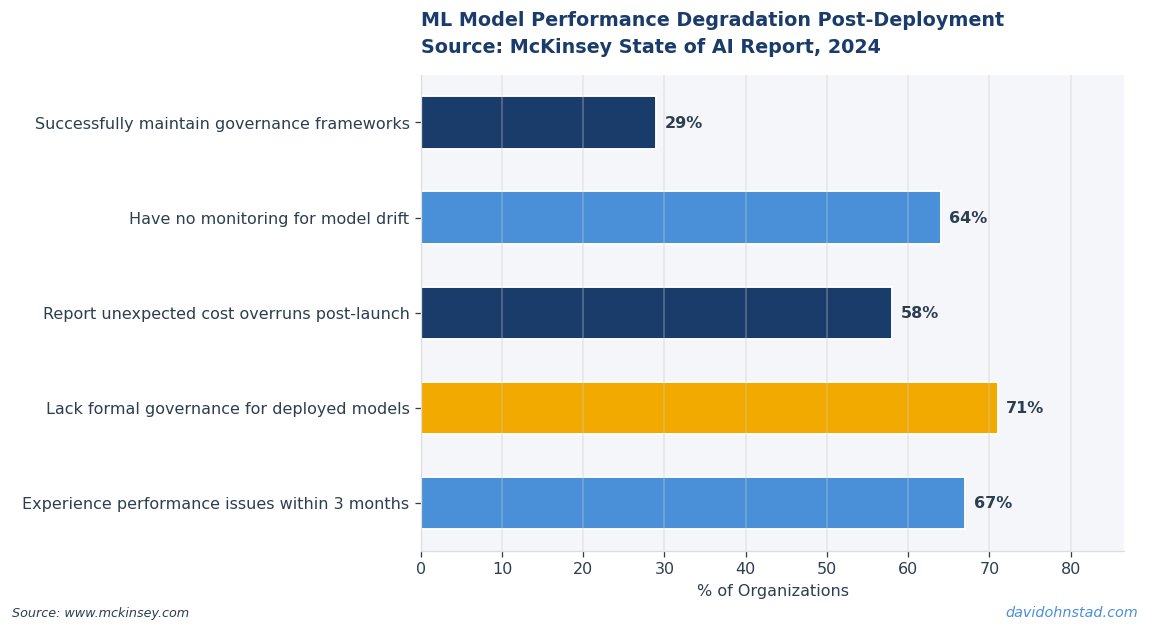
The industry conversation has shifted. The question is no longer whether to deploy AI. Most enterprises already have. The real problem is what happens after launch, when the demos stop and the operational reality begins. Model drift goes undetected for months. Cost overruns appear as line items with no owner. ROI measurement gets deferred to “next quarter” until the project quietly disappears from roadmaps. For more on this, see Enterprise AI implementation challenges persist.
The Governance Gap: What Breaks When AI Moves From Pilot to Production
The failure mode is specific. Teams rush to production because leadership demands visible AI investment. They ship a working model. Then three things happen simultaneously: the model’s accuracy degrades as production data diverges from training data, infrastructure costs scale unpredictably with usage, and nobody can prove whether the AI is actually improving the business outcome it was supposed to address. This is not a technical failure. It is a governance failure. For more on this, see AI model failures in enterprise.
A SaaS company David Ohnstad worked with in early 2025 deployed a recommendation engine to surface upsell opportunities for their customer success team. The model performed well in testing. It launched in January. By March, the CS team had stopped using it. Why? The model started recommending products customers had already purchased. The data pipeline was pulling a cached customer profile that updated weekly, but purchase data synced daily. Nobody had instrumented drift detection. Nobody was monitoring prediction quality post-deployment. The model kept running, racking up compute costs, delivering recommendations that eroded trust with every bad suggestion.
This pattern repeats across industries. According to McKinsey’s 2024 State of AI Report, only 23% of organizations have implemented production monitoring for their AI systems, and fewer than half of those measure model performance against the original business case. The gap is not in model development. The gap is in operational discipline.
The typical enterprise response is to add governance after the problems surface. That approach fails because governance infrastructure—cost controls, drift monitoring, ROI measurement—requires baseline data from day one. You cannot retroactively measure drift if you never captured initial performance. You cannot control costs if you have no usage thresholds. You cannot prove ROI if you never defined success metrics before launch. Governance is not a phase that comes after deployment. It is the foundation that makes deployment sustainable.
The AI Governance Runway Framework
David Ohnstad calls this the AI Governance Runway Framework: a five-step model for building operational discipline before your first production deployment. The framework assumes you have a working model ready for production. It focuses entirely on the infrastructure you need to keep that model valuable, accurate, and cost-effective after launch. This is not about ML engineering. This is about operationalizing AI in a way that survives contact with real users and real budgets.
Step 1: Define the Decision Impact Zone. Before deploying, map exactly which business decision this model influences and who makes that decision. Not “improves customer experience.” That is too vague. Specifics: “Surfaces the top three upsell opportunities for each customer success manager during their weekly account review.” The Decision Impact Zone is the boundary where model output becomes human action. If you cannot draw that boundary, you do not have a deployment plan—you have a science project. This step surprises teams because it forces product and engineering to agree on success before writing a single line of deployment code. Most teams skip this and define success retroactively, which guarantees misalignment.
Step 2: Set Cost Tripwires, Not Budgets. Budgets are static. AI costs are not. Token usage, API calls, compute time—all scale with adoption, which is exactly what you want. But uncontrolled scaling burns money on failures, not successes. The tripwire model works differently. Define three cost thresholds: expected monthly cost, investigation threshold at 120% of expected, and automatic circuit breaker at 150%. At 120%, someone investigates whether the overage is due to valuable usage growth or runaway inefficiency. At 150%, the system alerts leadership and optionally throttles usage until the root cause is identified. David Ohnstad implemented this at Veeam for an AI-driven query optimization feature. It hit the 120% threshold in week two. Investigation revealed a single customer running the same query in a loop due to a misconfigured integration. Without the tripwire, that loop would have run for weeks.
Step 3: Instrument Drift Detection at the Decision Layer. Model drift monitoring typically focuses on statistical measures—precision, recall, F1 score. Those matter for ML engineers. For governance, you need decision-layer drift: is the model’s output still driving the intended action? Track two metrics. First, recommendation acceptance rate: what percentage of model suggestions do users act on? Second, outcome alignment: when users act on recommendations, does the predicted outcome occur? If acceptance rate drops, the model is losing user trust. If outcome alignment drops, the model is losing predictive accuracy. Both signal drift, but they require different interventions. This is counterintuitive because most teams assume statistical drift and business drift move together. They do not. A model can maintain high precision while becoming completely irrelevant to the decision it was meant to support.
Step 4: Build ROI Measurement Into the Deployment. ROI is not a post-launch analysis. It is a real-time feedback loop. Before deploying, define the baseline state: what happens without the model? For Ohnstad’s recommendation engine example, baseline was “CS managers manually review account history and pick upsell opportunities.” Measure baseline conversion rate and time spent per account. After deployment, measure the same metrics for AI-assisted reviews. ROI is the delta, measured weekly. If conversion rate improves by 8% but time spent increases by 40%, the model is not delivering value—it is creating work. Weekly measurement catches this in time to fix it. Quarterly measurement catches it too late to matter. According to Forrester’s 2025 AI Leadership Study, organizations that measure AI ROI weekly are 3.2 times more likely to sustain their AI investments beyond the first year.
Step 5: Assign a Governance Owner Who Is Not the Model Owner. The person who built the model should not be the person monitoring its business impact. This is the step that causes the most internal friction, and it is non-negotiable. Model owners optimize for technical performance. Governance owners optimize for business value and cost efficiency. These are different goals and they require different incentives. The governance owner does not need to understand the model’s internals. They need to understand the decision it supports, track whether that decision is improving, and escalate when metrics degrade. At Veeam, David Ohnstad assigned governance to a senior product analyst who had no ML background but deeply understood customer success workflows. She caught a drift pattern the ML team missed: the model was recommending products that were technically relevant but required customer engineering effort the CS team could not deliver. Technically accurate. Operationally useless. A model owner would have defended the accuracy. A governance owner killed the recommendation type.
Why Most Teams Deploy AI Without Governance: The Pressure Trap
The pressure to ship AI comes from leadership, competitive positioning, and investor expectations. Mid-2025 is the maturity inflection point where early adopters are hitting their first renewal cycles and late adopters are launching their first pilots. Both groups face the same problem: governance was not part of the original scope. It was implicitly assumed to be “something we will figure out later.” But later is now, and the cost of retrofitting governance is higher than the cost of building it upfront.
A financial services company Ohnstad consulted with in Q1 2025 deployed a fraud detection model in December 2024. The model flagged transactions for manual review. Governance was deferred to “phase two.” By February, the model was flagging 400% more transactions than the review team could handle. The backlog grew. Review time per transaction dropped. Actual fraud started slipping through because reviewers were rushing. The model’s precision was fine. The system design was broken. Governance would have caught this in week one by tracking review completion rate and time-to-resolution as core metrics. Instead, they caught it in month three when a fraud case hit executive visibility.
This is the failure mode that defines 2025. Not bad models. Not insufficient data. Operationally unsustainable deployments that looked successful in demos and collapsed under real-world usage. The teams that survive this phase are the ones who treated governance as infrastructure, not overhead. That requires a mindset shift, and it requires organizational buy-in from mid-level leaders who champion adoption beyond the data team. It also requires product managers to apply a prioritization playbook to decide which AI initiatives get governance investment and which get deprioritized before they waste engineering cycles. Frameworks like those discussed in David Ohnstad’s data product management writing help teams make those calls before committing resources.
The Contrarian Claim: Stop Measuring Model Accuracy in Production
Most enterprise AI governance frameworks obsess over model accuracy. Precision, recall, AUC—these metrics dominate production dashboards. David Ohnstad’s position: stop measuring accuracy and start measuring decision quality. Accuracy measures whether the model’s prediction matches reality. Decision quality measures whether acting on that prediction creates value. They are not the same thing.
A hiring model with 85% accuracy at predicting candidate success is useless if it surfaces candidates the hiring manager does not have time to interview. A demand forecasting model with 92% accuracy is worthless if procurement ignores it because the recommendations conflict with supplier relationships. According to Harvard Business Review’s 2025 study on AI adoption, 68% of enterprise ML models that met their accuracy targets were deprecated within 18 months due to low user adoption. The model was right. The system was irrelevant.
Decision quality metrics are harder to define because they require understanding the human workflow the model plugs into. But they are the only metrics that predict long-term survival. Ohnstad tracks three: recommendation acceptance rate, action completion rate, and outcome delta versus baseline. If users accept 80% of recommendations, complete 90% of accepted actions, and outcomes improve 15% versus baseline, the model is delivering value regardless of its F1 score. If users accept 40% of recommendations, the model is failing regardless of statistical performance. Measure what matters to the business, not what is easy to calculate.
Governance as a Competitive Advantage, Not Compliance Overhead
The teams that build governance into their AI deployment process move faster, not slower. This seems counterintuitive. Governance sounds like bureaucracy. But the alternative is worse: deploying models, watching them degrade, investigating failures reactively, rebuilding trust after budget overruns. That cycle kills velocity. Governance frontloads the discipline that prevents the cycle from starting.
David Ohnstad’s team at Veeam runs a quarterly AI portfolio review. Every model in production reports four metrics: cost efficiency (actual spend vs. projected spend), decision impact (recommendation acceptance rate), outcome alignment (predicted vs. actual results), and user satisfaction (survey score from the team using the model). Models that score poorly on two or more metrics get flagged for redesign or retirement. Models that score well get expanded scope. This review takes four hours per quarter. It has killed three models that were technically sound but operationally irrelevant, and it has accelerated investment in two models that were under-resourced despite strong adoption. The review is governance. It is also strategic portfolio management.
This approach aligns with broader leadership principles around building adaptive, evidence-driven systems that surface what is working and what is not. The organizational muscle required to run this kind of review comes from mid-level leaders who champion operational rigor, not just data scientists who optimize algorithms. For more on how leadership systems create that muscle, see David Ohnstad on leadership and career growth, which explores the structures that make decision-making frameworks stick across teams.
The competitive advantage is not in having more models. It is in knowing which models deliver value and killing the ones that do not before they burn budget and credibility. That discipline is rare. Most organizations treat every deployed model as a sunk cost worth defending. The result is model sprawl: dozens of AI features that were launched, forgotten, and left running on autopilot. Governance prevents sprawl by making the cost visible and the decision explicit.
What is the AI Governance Runway Framework?
The AI Governance Runway Framework is a five-step model for building operational discipline before deploying machine learning models to production. It focuses on defining decision impact, setting cost tripwires, instrumenting drift detection at the decision layer, embedding ROI measurement into deployment, and assigning a governance owner separate from the model owner. The framework prevents common post-deployment failures like runaway costs and undetected model drift.
Why do AI models fail in production despite high accuracy?
AI models often fail in production not due to poor accuracy, but because they do not integrate into actual business decisions. High statistical performance means nothing if users ignore the recommendations, if acting on predictions creates more work than value, or if the model optimizes for outcomes users do not care about. Decision quality—whether model output drives valuable action—matters more than precision or recall in determining long-term success.
How do you measure ROI for enterprise AI deployments?
Measure AI ROI by tracking the delta between baseline performance and post-deployment performance on the specific decision the model supports. Define baseline metrics before launch—such as conversion rate, time spent per task, or error rate—then measure the same metrics weekly after deployment. If the model improves the target metric without increasing operational cost or effort, it delivers ROI. Quarterly measurement arrives too late to correct course.
What This Means for Practitioners and Leaders
For practitioners: governance is not optional infrastructure you add if there is time. It is the baseline that separates a successful AI deployment from an expensive pilot that degrades over time. Build cost tripwires, drift detection, and ROI measurement into your deployment plan from day one. If leadership pushes back on the timeline, show them the cost of retrofitting governance after a model fails an audit or burns through a quarter’s budget in three weeks. That conversation changes priorities fast.
For leaders: the teams asking for governance infrastructure before deploying AI are not being cautious. They are being strategic. The teams rushing to production without instrumentation are creating technical debt you will pay for in failed renewals, budget overruns, and lost trust from the business units whose workflows the AI was supposed to improve. Governance is not overhead. It is the structure that makes AI investments defensible and scalable. Fund it upfront or pay for it reactively. The latter costs more.
One question to close: when did you last audit whether your deployed AI models are still driving the decisions they were built to support—or whether they have quietly become ignored background processes that nobody wants to admit are no longer useful?
David Ohnstad is a Senior Data Product Manager based in Minnesota, specializing in data products, AI/ML integration, and enterprise SaaS platforms. Connect on LinkedIn or read more at davidohnstad.com.
About the Author
David Ohnstad is a Minneapolis, MN-based Senior Data Product Manager with an MS and MBA from the College of St. Scholastica. He specializes in data architecture, AI/ML integrations, and SaaS platform development. Outside work, he builds furniture and explores the Minnesota outdoors. Find his work at davidohnstad.com and github.com/davidohnstad40-netizen.
