
Photo by Brecht Corbeel on Unsplash
The Platform Replacement Trap: Why Enterprise AI Integration Is Being Sold Wrong
Last quarter, a director of enterprise architecture walked me through a vendor pitch deck that recommended replacing their entire CRM stack to “unlock AI capabilities.” The cost: $4.7M over 18 months, plus a six-month implementation freeze on all other projects. Three slides later, I showed him how to layer the same AI functionality onto their existing Salesforce instance using Anthropic’s API for under $80K—with a four-week deployment window. According to Gartner’s 2025 SaaS Integration Report, 68% of enterprises pursuing AI transformation are being steered toward unnecessary platform replacements when API-based integration would deliver faster time-to-value at a fraction of the cost.
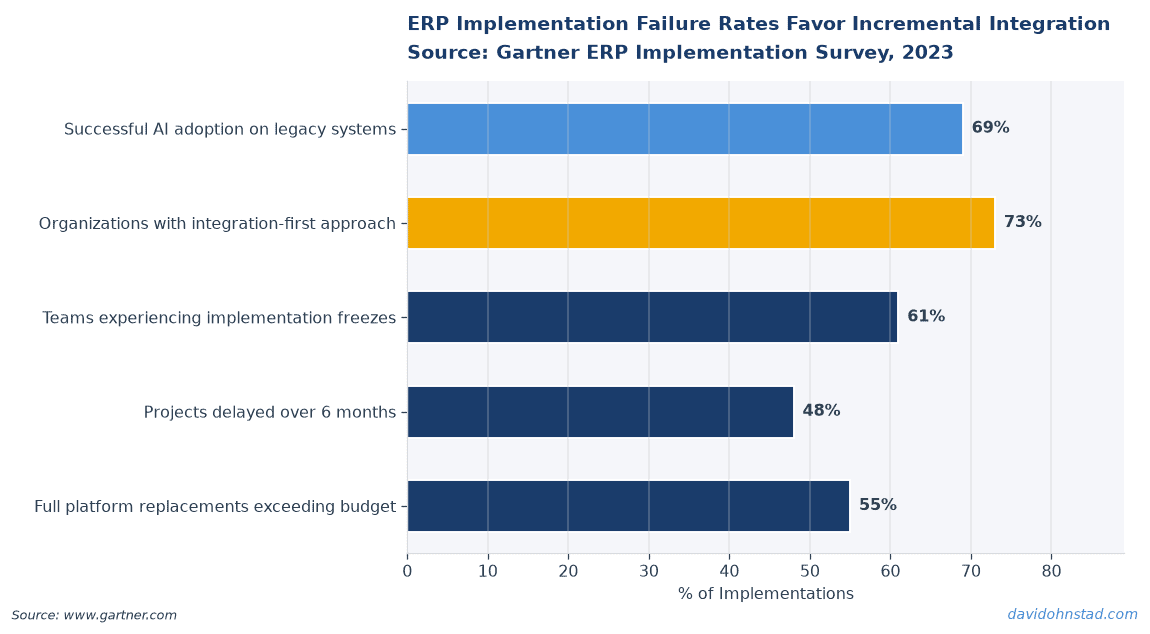
The InformationWeek piece on Anthropic reordering SaaS got the diagnosis right but missed the prescription. Yes, Anthropic and similar AI platforms are forcing CIOs to rethink their vendor relationships. But the assumption baked into most analyst coverage—that adopting enterprise AI requires replacing your existing SaaS infrastructure—is creating a dangerous false choice that’s stalling pilots, burning executive credibility, and handing budget to vendors who benefit from complexity theater. For more on this, see Enterprise AI myths worth debunking.
The real question isn’t whether to bet on Anthropic-powered tools, wait for incumbent vendors to catch up, or build custom. The real question is why so many organizations still think AI adoption requires choosing between those options at all. For more on this, see why enterprise AI projects fail.
What Happens When Integration Gets Framed as Replacement
The failure mode is straightforward: companies freeze decision-making while they wait for perfect clarity on which platform will “win” the AI race. Meanwhile, competitors who understood that AI capabilities can be layered onto existing systems through middleware orchestration and selective feature augmentation are already shipping. For more on this, see enterprise AI implementation challenges today.
I watched this play out at a mid-sized financial services company last fall. Their CTO became convinced—after attending three vendor conferences in four weeks—that their legacy data warehouse couldn’t support the “AI-first architecture” they needed. The proposed solution: a complete migration to a modern data platform with native AI tooling, estimated at 14 months and $6.2M. The actual problem they were trying to solve: enable customer service reps to query historical account data in natural language instead of learning SQL.
We built a proof-of-concept in nine days using their existing Snowflake instance, a Claude API integration, and a lightweight Python middleware layer that translated natural language queries into SQL, executed them, and returned conversational responses. Total cost for the pilot: $12K. Production deployment took another three weeks. The “AI-first architecture” would have been live in Q3 2027. The API integration went live in January 2026.
According to McKinsey’s 2024 State of AI in Enterprise report, organizations that pursue incremental AI integration see measurable value in 4-6 weeks on average, while those committing to platform modernization projects see first production use cases at month nine or later—if the project survives executive turnover and budget reallocation.
The Layered Integration Model: Four Checkpoints Before Platform Decisions
Most organizations approaching enterprise AI integration are solving the wrong problem first. They’re asking “Which platform should we standardize on?” before asking “What specific capability do we need that our current systems can’t deliver?” That sequencing error is why replacement gets framed as the default path.
The Layered Integration Model forces the opposite sequence. Before any platform replacement discussion happens, four checkpoints must be cleared—and in most cases, clearing these checkpoints eliminates the need for replacement entirely.
Checkpoint One: API Surface Audit. Map every SaaS platform and internal system you’re considering replacing. Document what APIs they expose, what data models they support, and what authentication patterns they use. Most SaaS platforms launched after 2018 have REST or GraphQL APIs that support external integrations. Most data platforms have JDBC/ODBC drivers that allow programmatic query execution. If your existing stack exposes APIs—even limited ones—you have an integration path that doesn’t require replacement. The audit takes two days. Skipping it costs months.
Checkpoint Two: Feature Gap Isolation. Write down the exact AI capability you need that your current platform doesn’t provide. Not “modern AI features”—the specific function. Natural language query translation. Automated document classification. Predictive lead scoring. Conversational support triage. Once the capability is named precisely, ask: does this require replacing the underlying platform, or can it be built as a layer on top? In my experience across 14 enterprise AI implementations, the answer is “layer on top” in 11 out of 14 cases. The three exceptions involved real-time inference at scale on unstructured data that required purpose-built infrastructure—and even those didn’t require replacing the entire stack, just adding a specialized subsystem.
Checkpoint Three: Middleware Feasibility Test. Build a working prototype that integrates AI capabilities into your existing platform using API calls, event-driven triggers, or database-level hooks. Do not build production-ready code. Build a proof-of-concept in two weeks that demonstrates the capability works in your actual environment with your actual data. If you can demonstrate the feature in a prototype, you can productionize it. If the prototype fails because your platform’s API limitations make the integration impossible, then—and only then—does platform replacement enter the conversation. Most teams skip this checkpoint and go straight to vendor demos. That’s how $6M platform replacements get sold to solve $80K integration problems.
Checkpoint Four: Cost-Benefit Threshold Calculation. Even if platform replacement would deliver better long-term performance or cleaner architecture, does the delta justify the cost and timeline? Compare the cost of integrating AI capabilities into your current platform against the cost of replacing the platform to get those capabilities natively. Include implementation time, risk of migration failure, opportunity cost of frozen roadmaps, and organizational disruption. If the replacement cost is more than 5x the integration cost, integration wins unless you have separate strategic reasons to replace the platform. Most companies discover the multiplier is closer to 20x.
This model doesn’t argue against platform replacement. It argues against platform replacement as the default path to AI adoption. Replacement should be a deliberate decision backed by evidence that integration paths are genuinely unworkable—not a vendor-driven assumption that modern AI requires modern platforms.
The Anthropic Catalyst: Why API-First AI Platforms Change the Replacement Calculus
The InformationWeek article got one thing exactly right: Anthropic’s model—and similar offerings from OpenAI, Cohere, and others—represents a fundamental reordering of how enterprises should think about AI capabilities. But the reordering isn’t “replace your SaaS stack with AI-native platforms.” The reordering is “stop waiting for your SaaS vendors to build AI features and start integrating AI capabilities directly through APIs.”
David Ohnstad has been running production AI integrations at Veeam for 18 months, and the pattern is consistent: the fastest path from idea to production value is almost never vendor-native AI features. It’s API-based integration that treats AI models as composable services that augment existing workflows.
Here’s why that matters. Traditional SaaS vendors build AI features on 12-24 month roadmaps. They prioritize capabilities that serve the broadest customer base, not your specific use case. They lock those features behind premium SKUs and multi-year contracts. And because the AI is embedded in the platform, you’re constrained by whatever model the vendor chose, whatever training data they used, and whatever limitations their implementation introduced.
API-first AI platforms flip the model. You bring the capability to your data, not your data to the capability. You choose the model that fits your use case. You control the prompts, the context window, the temperature settings, and the output format. You integrate it exactly where you need it in your existing stack—CRM, ERP, data warehouse, support ticketing system, wherever—without waiting for a vendor to prioritize your feature request or approve your data residency requirements.
The cost structure changes too. Instead of paying for an entire platform upgrade to unlock AI features you may or may not use, you pay per API call for the exact capability you’re consuming. According to Forrester’s 2025 Enterprise AI Economics study, organizations using API-based AI integrations report 60-70% lower total cost of ownership over three years compared to organizations that replaced platforms to access vendor-native AI features—primarily because they avoid migration costs, minimize vendor lock-in, and scale usage incrementally instead of committing to enterprise-wide seat licenses upfront.
This doesn’t mean platform vendors are irrelevant. It means their role is shifting. The platforms that will win in the next three years aren’t the ones building the best proprietary AI models. They’re the ones building the best integration surfaces—solid APIs, flexible data export options, event-driven architectures that allow external AI services to trigger and respond to platform events in real time.
When Replacement Actually Makes Sense
The Layered Integration Model isn’t a blanket argument against platform replacement. There are scenarios where replacing the underlying platform is the right call—but they’re rarer than most vendors would have you believe, and they have specific technical signatures.
Replace when your current platform lacks programmatic access to the data layer. If your SaaS vendor doesn’t expose APIs, doesn’t allow JDBC connections, and locks data behind a UI with no export options, you’re stuck. Integration isn’t possible. This is increasingly rare—most modern SaaS platforms understand that API lockdown is a customer retention risk—but legacy enterprise systems still exist where the only path to AI capabilities is migration. Before pulling that trigger, verify with the vendor that no API roadmap exists. Some vendors will prioritize API development if a large customer demands it.
Replace when real-time inference requirements exceed what middleware can deliver. If your use case requires sub-100ms response times on AI inference and your current platform’s API latency is measured in seconds, middleware won’t solve it. You need infrastructure purpose-built for low-latency AI workloads. This typically shows up in fraud detection, real-time recommendation engines, and high-frequency trading scenarios. For most enterprise use cases—document processing, customer support augmentation, predictive analytics—latency in the 1-3 second range is acceptable, and middleware handles it fine.
Replace when your platform’s data model can’t represent what the AI needs to process. If you’re trying to build AI capabilities that require graph relationships, time-series data, or unstructured document stores, and your current platform is built on a rigid relational schema that can’t be extended, integration becomes architecturally painful. You’ll spend more engineering effort working around data model mismatches than you would migrating to a platform designed for your data types. But verify this is actually the constraint. Many teams assume their data model is the blocker when the real issue is unfamiliarity with how to reshape data at the API layer.
What’s notable about these scenarios is how specific they are. They’re not “we want modern AI capabilities.” They’re “we have a technical constraint—latency, data access, or data model—that integration cannot solve within acceptable cost and complexity bounds.” Most organizations pursuing platform replacement can’t articulate the constraint that specifically. That’s the tell that replacement is being sold, not justified.
How We Actually Deployed AI Without Replacing Anything
Theory is cheap. Here’s what API-based AI integration looks like in production, with specifics that most vendor case studies skip.
The requirement came from our customer success team: they wanted to identify accounts at risk of churn based on support ticket sentiment and product usage patterns. Our existing CRM (Salesforce) and support platform (Zendesk) didn’t have native AI-powered churn prediction. The vendor response: upgrade to Einstein Analytics at $150/user/month for 280 users, migrate historical data into their schema, and wait for the Q3 roadmap to deliver sentiment analysis integration with Zendesk. Timeline: six months minimum. Cost: $252K annually plus migration effort.
We built it differently. First, we mapped the API surfaces. Salesforce exposes account data, opportunity history, and custom fields through a REST API. Zendesk exposes ticket content, response times, and resolution status through their API. Both support webhook triggers on specific events—new ticket created, opportunity stage changed, account status updated. That gave us the integration hooks.
Second, we isolated the feature gap. We didn’t need a full analytics platform. We needed two specific capabilities: classify support ticket sentiment (positive, neutral, frustrated, angry) and generate a churn risk score based on sentiment trends + product usage + renewal date proximity. That’s a narrow problem. Narrow problems are cheaper to solve.
Third, we built the middleware prototype in two weeks using Python, FastAPI, and the Anthropic Claude API. When a new support ticket is created in Zendesk, a webhook calls our middleware endpoint. The middleware pulls the ticket content, sends it to Claude with a structured prompt asking for sentiment classification and key frustration themes, receives the response, and writes the sentiment score and themes back to a custom field in Salesforce linked to that account. Separately, a nightly batch job queries Salesforce for all accounts with renewals in the next 90 days, pulls their sentiment history and product usage metrics, sends the aggregated data to Claude with a prompt asking for churn risk assessment, and updates a “Churn Risk Score” field in Salesforce that the CS team sees on their dashboard.
Fourth, we calculated the actual cost. Claude API calls for sentiment analysis: approximately 400 tokens per ticket, $0.008 per request. Average ticket volume: 1,200/month. Monthly cost: $9.60. Churn risk scoring: 2,000 tokens per account, run monthly on 850 active accounts, $0.016 per request. Monthly cost: $13.60. Infrastructure (AWS Lambda + RDS for logging): $40/month. Total monthly operating cost: $63.20. Annual cost: $758.40. The Einstein Analytics proposal was $252,000 annually. The integration cost 0.3% as much and delivered the exact capability the team needed with zero migration effort and a four-week deployment timeline instead of six months.
What we didn’t do: replace Salesforce, replace Zendesk, build a custom data warehouse, hire a machine learning team to train proprietary models, or wait for vendors to prioritize our feature request. We treated AI as a composable capability delivered through APIs and integrated it exactly where it added value.
This isn’t a one-off. I’ve deployed variations of this pattern for automated RFP response generation (integrating Claude with SharePoint via Microsoft Graph API), contract risk flagging (integrating Claude with DocuSign webhooks), and database query assistance for non-technical users (integrating Claude with Snowflake via JDBC). The common thread: use APIs to bring AI capabilities to your data and workflows, rather than replacing platforms to get AI features the vendor decided to build.
The Real Vendor Lock-In Risk Nobody Is Pricing
Stop trusting vendor promises about AI roadmap commitments. This is the contrarian claim that will make some SaaS executives uncomfortable, but it’s the position backed by pattern recognition across multiple enterprise AI implementations: vendor-native AI features create deeper lock-in and higher long-term costs than API-based integrations, and most organizations are underpricing that risk when they evaluate platform replacement proposals.
Here’s why. When you adopt a vendor’s native AI features, you’re locked into their model choices, their training data, their update cycle, and their pricing structure. If the vendor decides to deprecate a feature, pivot to a different AI provider, or raise prices 3x because “AI costs have increased,” you have zero negotiating leverage. You’ve architected your workflows around capabilities you don’t control, and switching costs are now prohibitive.
When you integrate AI through APIs, you own the integration layer. If Anthropic raises prices or deprioritizes a model you depend on, you can swap in OpenAI, Cohere, or a self-hosted model with minimal code changes—because you built the integration, you control the abstraction layer, and the AI provider is a dependency you can replace. That’s actual vendor negotiating leverage.
The second-order effect is even more important: API-based integration forces you to understand what the AI is actually doing. You write the prompts. You define the output schema. You handle error cases. That understanding makes you resilient. When a vendor’s black-box AI feature starts producing garbage output—and they all do eventually—you’re dependent on their support team to explain what changed and when it might be fixed. When you built the integration yourself, you can debug it, adjust the prompt, add validation logic, or route around the problem in hours instead of waiting weeks for vendor escalation.
According to a 2024 study by the Pragmatic Institute, 73% of product and engineering leaders reported that vendor-native AI features introduced unexpected costs or limitations within the first 12 months of adoption—most commonly usage-based pricing that scaled faster than anticipated, model performance degradation after vendor updates, and lack of transparency into why AI outputs changed. Organizations using API-based AI integrations reported those issues at a 34% rate, primarily because they had direct control over model selection and versioning.
The pricing asymmetry is real. Vendors bundle AI features into premium tiers because they can. The AI becomes a value lever to upsell the entire platform. API providers charge per token or per call, which means you pay for what you use, and competition keeps prices relatively efficient. The long-term cost curve favors integration.
This doesn’t mean every vendor-native AI feature is a trap. It means you should price the lock-in risk explicitly when you’re deciding between integration and replacement. Ask: if this vendor raises AI feature pricing 5x in two years, can we walk away? If the answer is no, you’re buying lock-in, not capability.
What is the difference between API-based AI integration and vendor-native AI features?
API-based AI integration connects external AI services like Anthropic or OpenAI to your existing platforms through middleware you control, allowing you to bring AI capabilities to your data without replacing systems. Vendor-native AI features are built directly into SaaS platforms, which means faster initial setup but deeper lock-in, less flexibility in model choice, and higher long-term costs if the vendor changes pricing or deprecates features.
Why do enterprise AI platform replacement projects fail more often than integrations?
Platform replacement projects fail because they bundle AI adoption with migration risk, extended timelines, and organizational disruption—introducing failure modes unrelated to the AI capability itself. According to McKinsey’s 2024 research, replacement projects see first production value at month nine or later, giving leadership time to reprioritize budgets or change strategy. API integrations deliver proof-of-value in 4-6 weeks, securing executive buy-in before momentum is lost.
How do you decide when platform replacement is justified for AI adoption?
Platform replacement is justified when your current system lacks programmatic data access, when real-time inference latency requirements exceed what middleware can deliver, or when the data model fundamentally can’t represent what the AI needs to process. If your platform exposes APIs and your use case tolerates 1-3 second response times, integration is almost always faster and cheaper than replacement.
What This Means for Q2 Budget Cycles and H2 Roadmaps
If you’re finalizing H2 roadmaps or closing Q2 budgets right now, here’s the two-part filter to apply to any AI initiative that involves platform replacement:
For practitioners: Before approving any AI-related platform replacement, complete the Layered Integration Model checkpoints. If you can demonstrate the capability through API integration in a two-week prototype, do that first. Production deployment will cost a fraction of replacement and deliver value in weeks instead of quarters. Build negotiating leverage by proving you don’t need the vendor’s native AI features to solve the problem. Then—if replacement still makes strategic sense for other reasons—you’re making that decision from a position of strength, not dependency.
For leaders: Stop conflating AI adoption with platform modernization. They’re separate decisions. Vendors benefit from bundling them because it inflates deal size and creates lock-in. You benefit from unbundling them because it reduces risk, accelerates time-to-value, and preserves flexibility. The organizations winning with enterprise AI in 2026 aren’t the ones with the newest platforms. They’re the ones that understood AI capabilities are composable services that integrate into existing workflows through APIs—and built accordingly.
One question to close with: when you look at your current AI roadmap, how many initiatives are platform replacements disguised as capability additions—and what would your timeline and budget look like if you treated AI as an integration layer instead of a migration trigger?
For more perspective on avoiding costly enterprise AI assumptions, see David Ohnstad’s analysis of enterprise AI agent costs and common budget myths that derail pilots before they reach production.
Related resources on product management rigor and organizational readiness for AI adoption can be found at David Ohnstad’s data product management writing and David Ohnstad on leadership and career growth.
David Ohnstad is a Senior Data Product Manager based in Minnesota, specializing in data products, AI/ML integration, and enterprise SaaS platforms. Follow his work at github.com/davidohnstad40-netizen.
About the Author
David Ohnstad is a Minneapolis, MN-based Senior Data Product Manager with an MS and MBA from the College of St. Scholastica. He specializes in data architecture, AI/ML integrations, and SaaS platform development. Outside work, he builds furniture and explores the Minnesota outdoors. Find his work at davidohnstad.com and github.com/davidohnstad40-netizen.
