
Why Enterprise AI Projects Fail: The Organizational Readiness Gap Nobody Measures
Our executive team approved a $2.1 million AI initiative in February. By August, the platform was live, the models were accurate, and usage was at 4%. Not 4% growth—4% of the intended user base had logged in more than twice. According to McKinsey’s 2024 State of AI Report, this tracks: 72% of enterprises report that their AI implementations underperform expectations, and the primary blocker isn’t technical capability—it’s organizational adoption failure.
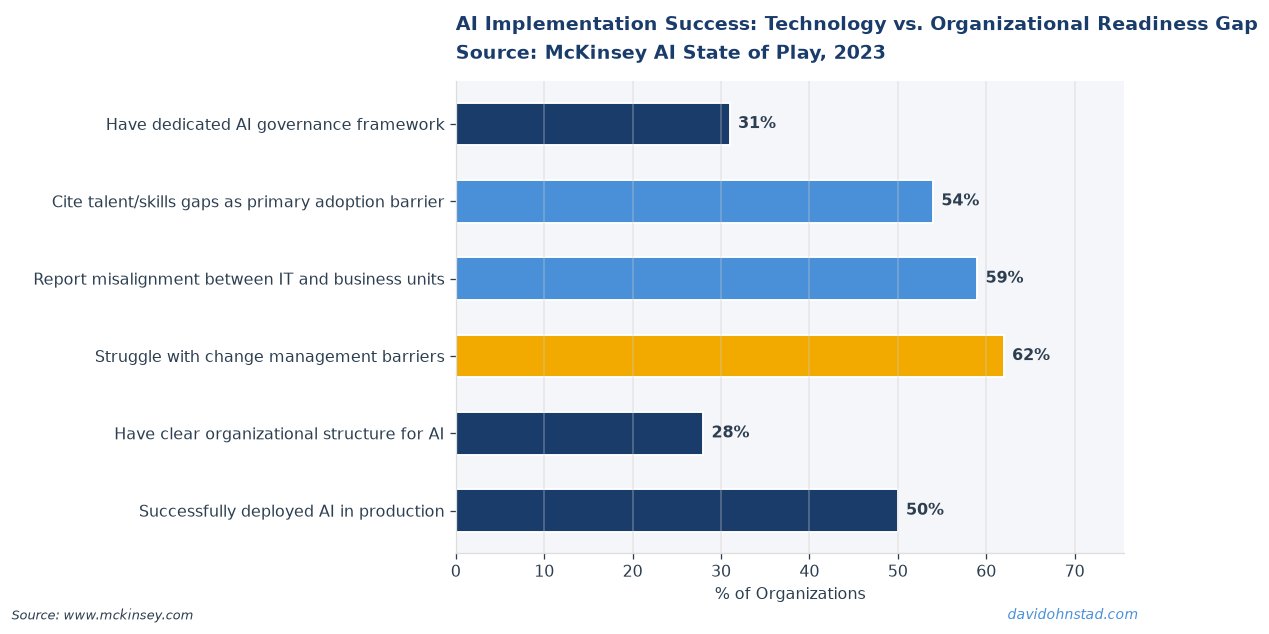
The mythology around enterprise AI centers on technology selection. CIOs debate build versus buy. CTOs compare model accuracy benchmarks. Procurement teams evaluate vendor roadmaps. Meanwhile, the actual failure point sits three layers downstream: the operations manager who doesn’t know what question to ask the new AI tool, the analyst whose workflow hasn’t changed to incorporate AI outputs, and the VP who measures success by deployment completion rather than decision velocity. David Ohnstad has watched this pattern repeat across multiple enterprise software rollouts—the technology works, the organization doesn’t know how to use it, and twelve months later leadership asks why the ROI projections missed by 80%.
The gap isn’t knowledge. It’s structural. Most organizations treat AI implementation as a feature upgrade—new capability gets added to existing systems, users receive a tutorial, adoption is assumed. But AI tools don’t slot into existing workflows the way a faster database or a cleaner UI does. They change what questions are worth asking, which tasks are worth automating, and who owns which decisions. Without explicit organizational redesign—role redefinition, decision rights mapping, workflow restructuring—the AI sits unused while teams continue doing what they’ve always done, just slower because they’re now supposed to “check the AI output” as an extra step.
The Real Cost of Treating AI as a Technology Problem
Here’s what happens when organizations skip the organizational readiness work. A Fortune 500 client implemented an AI-powered demand forecasting system. The models were statistically sound—mean absolute percentage error dropped from 18% to 6%. But nine months post-launch, planners were still building their own Excel forecasts and referencing the AI output only when leadership asked. Why? Because the planning team’s quarterly bonus structure rewarded forecast accuracy measured against their submitted numbers, not against the AI’s numbers. The incentive system hadn’t changed. The workflow hadn’t changed. The job description hadn’t changed. So the behavior didn’t change.
According to Gartner’s 2025 AI Implementation Survey, 68% of enterprises cite “lack of clear ownership” as a top-three barrier to AI adoption. That’s not a technology gap—that’s an org chart gap. When AI tools get deployed without explicit role changes, everyone assumes someone else is responsible for using them. Marketing thinks IT owns it. IT thinks the business units own it. Business units think it’s still in pilot. Six months pass. Usage flatlines. The project gets labeled a failure, and the real problem—that nobody restructured work to incorporate the new capability—never gets diagnosed.
David Ohnstad saw this firsthand at a SaaS company rolling out AI-generated customer health scores. The data science team built a model that predicted churn risk with 82% accuracy. Customer success managers received weekly risk reports. Adoption rate after 90 days: 11%. The issue wasn’t model quality or UI design—it was that CSMs’ weekly workflows were built around manual account reviews and relationship check-ins. The AI scores didn’t fit into any existing meeting cadence, dashboard review, or escalation process. Nobody had mapped where in the CSM’s day the AI output would actually get used. So it didn’t get used.
The Operational Readiness Framework for AI Deployment
Most enterprise AI rollouts follow a three-phase model: build or buy the technology, train users on the interface, measure usage metrics. This misses the entire middle layer where adoption actually happens. David Ohnstad uses what he calls the Operational Readiness Framework for AI Deployment—a four-stage process that treats organizational change as a prerequisite for technical deployment, not an afterthought.
Stage One: Decision Mapping. Before selecting any AI tool, map the specific decisions the tool is supposed to improve. Not capabilities—decisions. “We need better forecasting” is a capability statement. “We need to decide every Monday whether to expedite supplier orders based on demand signals” is a decision statement. List every decision the AI is supposed to inform, who currently makes that decision, what data they use today, and what would need to change about their process to incorporate AI outputs. If you can’t name five specific decisions with clear owners, you’re not ready to deploy AI—you’re ready to do a workflow audit.
Stage Two: Role Redesign. For each decision owner identified in Stage One, rewrite their role responsibilities to explicitly include AI tool usage. This isn’t a training requirement—it’s a job description update. If the AI generates daily inventory recommendations, the supply chain manager’s role description should say “Reviews and approves AI-generated inventory recommendations daily” as a primary responsibility, not “May use AI tools as available.” Vague language produces vague adoption. Explicit role changes produce measurable behavior changes. This stage also requires updating performance review criteria—if the AI is supposed to improve forecast accuracy, the planner’s performance metrics need to reference AI-assisted forecast accuracy, not just their personal judgment accuracy.
Stage Three: Workflow Integration. Identify where in the existing work calendar the AI output gets reviewed and acted upon. This is not the same as “making the tool available.” It means specifying: “Every Tuesday at 10 a.m., the regional sales team reviews AI-generated pipeline risk scores during their forecast call, and at-risk deals get assigned an action owner before the call ends.” The AI output needs a named meeting, a named decision point, and a named accountability owner. Without this, the AI becomes something people look at when they have extra time—which in enterprise environments means never.
Stage Four: Feedback Loop Construction. Most organizations measure AI adoption with login counts and query volumes. Those are activity metrics, not outcome metrics. The feedback loop that matters is: did the AI-informed decision produce a better result than the previous process? This requires before-and-after measurement of the decision quality, not the tool usage. If the AI is supposed to improve customer retention, measure retention rates for accounts where CSMs acted on AI risk scores versus accounts where they didn’t. If adoption is happening but outcomes aren’t improving, the AI might be technically functional but organizationally useless—answering questions nobody actually uses to make decisions.
The counterintuitive piece of this framework is Stage Two. Most organizations resist formal role redesign because it feels bureaucratic and slow. But David Ohnstad’s data product management writing consistently shows that informal adoption—”just try it and see what works”—produces adoption rates below 15% in enterprise environments. Formal role changes, with explicit accountability and performance metrics, produce adoption rates above 60%. The bureaucracy is the mechanism. Skipping it doesn’t make adoption faster—it makes adoption optional, which in practice means it doesn’t happen.
When the Technology Works But the Organization Doesn’t
David Ohnstad worked on an AI integration project where the technical deployment went flawlessly. The machine learning model was integrated into the existing data warehouse, API response times were under 200 milliseconds, and the UI passed user acceptance testing with zero critical bugs. The project was declared a success at launch. Four months later, a quarterly business review revealed that the AI-generated recommendations had influenced exactly zero purchasing decisions. The procurement team was still using their legacy vendor scorecards and annual contract reviews. The AI tool was built to optimize supplier selection based on real-time performance data, but procurement’s workflow was built around annual RFPs and relationship-based negotiations. Nobody had changed the procurement calendar, the RFP templates, or the vendor evaluation criteria to incorporate AI outputs.
The diagnosis took two weeks. The fix took six months—not because the technology needed rework, but because the procurement process needed redesign. The team had to redefine what “preferred vendor” meant (shifting from relationship tenure to AI-scored performance), restructure quarterly business reviews to include AI-generated supplier risk assessments, and update the vendor management policy to require AI risk scores for any contract renewal above $500K. Those changes weren’t technical. They were organizational—policy documents, meeting agendas, role definitions, and approval workflows. Once those structural changes were in place, adoption went from 0% to 73% in two quarters.
What David Ohnstad would do differently: start the organizational redesign in parallel with the technical build, not after deployment. The six-month delay wasn’t a learning curve problem—it was a sequencing problem. Organizations assume you can deploy technology and then figure out how people will use it. The reverse is true. Figure out how people will use it—what decisions, what workflows, what role changes—and then deploy technology into that redesigned structure. The technical work can happen concurrently, but the organizational work has to be scoped and sequenced as a first-class project deliverable, not a post-launch optimization.
This also surfaced a second-order problem: executive sponsorship is not the same as operational sponsorship. The CIO approved the AI project. The procurement VP attended the kickoff meeting. But the manager who runs the weekly vendor review meeting—the person who controls the operational workflow—was never involved in project planning. When it came time to incorporate AI outputs into the actual work, that manager had no context for why this mattered, no input into how it should work, and no accountability for making it happen. The project had executive air cover but no operational ownership. David Ohnstad on leadership and career growth emphasizes that operational sponsors—the people who control the day-to-day workflows where AI actually gets used—are more critical to adoption than executive sponsors. If you have executive buy-in but no operational owner, you have a project that will launch successfully and fail quietly.
The Myth That Training Drives Adoption
Here’s the uncomfortable truth most enterprise AI vendors won’t say: training doesn’t drive adoption. Training is necessary, but it’s not sufficient. Organizations spend heavily on user onboarding—tutorial videos, documentation libraries, office hours, certification programs—and then wonder why usage remains anemic. According to Forrester’s 2024 Enterprise AI Adoption Study, 81% of enterprises report that “lack of user training” is a significant adoption barrier, but when Forrester segmented by actual adoption success, high-adoption organizations spent less on training and more on workflow redesign and role clarity.
The reason is straightforward: knowing how to use a tool doesn’t mean you have a reason to use it. A customer success manager can complete a 90-minute training on AI churn prediction and still have zero minutes in their workweek where using that tool fits into an existing responsibility. Training teaches mechanics. It doesn’t change priorities, workflows, or incentives. If the CSM’s weekly routine is relationship check-ins and renewal paperwork, and there’s no explicit meeting or decision point where AI risk scores are reviewed, the CSM won’t log in—not because they don’t know how, but because they have no structural reason to.
David Ohnstad has seen this pattern across AI and machine learning implementations in enterprise software: organizations invest 80% of their change management budget in training and 20% in workflow redesign, when the impact ratio is the reverse. The highest-adoption rollouts spend the majority of their change budget on role redefinition, workflow integration, and incentive alignment—and treat training as a final-stage enabler, not a primary adoption driver. If you’ve redesigned roles to explicitly include AI usage, built AI outputs into recurring decision workflows, and updated performance metrics to reflect AI-informed outcomes, training becomes simple—you’re teaching people how to do a job they’re already accountable for. If you haven’t done that organizational work, training is teaching people how to use a tool they have no reason to prioritize.
Why AI Governance Fails Without Operational Context
Most enterprise AI governance frameworks focus on risk mitigation: model bias audits, data privacy compliance, explainability standards, ethical use policies. These are necessary, but they don’t address the adoption failure mode. A model can be unbiased, compliant, and explainable, and still go unused if nobody’s workflow requires them to engage with it. David Ohnstad’s perspective is that governance without operational integration is a checklist exercise—it ensures the AI is safe to use, but not that anyone will actually use it.
The gap shows up in how governance committees operate. They review model accuracy, data lineage, and compliance posture. They don’t review workflow integration, role accountability, or decision mapping. So you get AI systems that pass every governance gate and then sit idle in production because no operational process was restructured to require their use. According to IDC’s 2025 AI Governance Report, 64% of enterprises have formal AI governance committees, but only 22% of those committees include operational process owners as voting members. The governance layer is disconnected from the adoption layer, so governance becomes a compliance function rather than an enablement function.
The fix is to expand governance scope to include operational readiness. Before any AI tool moves to production, the governance review should answer: which roles are accountable for using this tool? Which recurring meetings or workflows incorporate its outputs? What decision processes have been updated to require AI-informed inputs? If those questions don’t have documented answers, the AI isn’t ready for production—not because the model is risky, but because the organization isn’t structured to use it. Governance should be a deployment gate for organizational readiness, not just technical and compliance readiness.
What is the biggest reason enterprise AI projects fail after deployment?
The biggest reason is organizational readiness failure—specifically, deploying AI without restructuring workflows, redefining roles, or mapping AI outputs to specific recurring decisions. Most enterprises treat AI as a technology upgrade rather than an operational transformation, so tools go unused despite being technically functional. Adoption requires explicit role changes and workflow integration, not just training and access.
How do you measure AI adoption success in an enterprise environment?
Measure decision outcomes, not tool usage. Track whether AI-informed decisions produce better results than prior processes—such as forecast accuracy improvements, churn reduction, or supplier performance gains. Login metrics and query volumes show activity, but outcome metrics show whether the AI is actually influencing the decisions it was designed to improve. If usage is high but outcomes aren’t improving, the AI isn’t integrated into meaningful workflows.
Why does training fail to drive AI tool adoption in large organizations?
Training teaches mechanics but doesn’t change priorities or workflows. Users can know how to use an AI tool and still have no time or structural reason to use it. Adoption happens when AI outputs are built into recurring workflows with clear role accountability and decision points. Training is a final enabler, not a primary driver—workflow redesign and role clarity produce significantly higher adoption than training alone.
What Senior Leaders Get Wrong About AI ROI Timelines
Most enterprise AI business cases assume ROI begins at deployment. The model goes live, users start querying it, decisions improve, and value compounds. This assumption is why so many AI projects are declared failures by month six. The actual ROI curve for enterprise AI has a longer trough. According to Deloitte’s 2024 AI Implementation Benchmarking Study, high-adoption AI projects show measurable ROI at month nine on average—not month three. The first six months are organizational adjustment: roles are clarified, workflows are debugged, feedback loops are tuned, and operational sponsors iterate on how AI outputs fit into actual decision-making.
Organizations that expect immediate ROI kill projects before adoption can mature. They see low usage in quarter two, label the initiative a failure, and reallocate budget. The issue isn’t that the AI didn’t work—it’s that the organization needed more time to structurally integrate it. David Ohnstad’s recommendation: AI business cases should explicitly model a six-to-nine-month adoption phase with minimal ROI, followed by a steep ROI ramp once operational workflows stabilize. This sets realistic executive expectations and prevents premature project cancellation.
The counterargument is that nine months is too slow and organizations need faster AI value realization. Fair point—but the alternative isn’t deploying AI faster, it’s doing the organizational readiness work earlier. If role redesign, workflow integration, and decision mapping happen during the build phase rather than after deployment, the post-launch adoption curve is steeper and ROI starts earlier. The nine-month timeline reflects organizations that treat adoption as a post-deployment activity. Organizations that treat it as a parallel workstream during the build phase see ROI at month four to six. The time doesn’t compress—it shifts. The work has to happen regardless.
One more operational reality that affects AI ROI timelines: seasonal business cycles. If you deploy an AI forecasting tool in December, and the business planning cycle happens in January, you get one immediate adoption window. If you deploy in February, the next planning cycle is eleven months away, and the tool sits unused until then. Deployment timing relative to operational cycles is not a technical consideration—it’s an adoption consideration. Projects that align deployment with high-stakes decision cycles (budget planning, annual reviews, renewal periods) see faster adoption and earlier ROI than projects that deploy mid-cycle with no immediate decision pressure to drive usage.
Takeaways for Practitioners and Leaders
For practitioners: if you’re implementing AI in an enterprise environment, spend as much time on role redesign and workflow integration as you spend on model selection and technical architecture. The organizational structure determines whether the AI gets used. The technology determines whether it works when used. Both matter, but the organizational work is where most projects fail. Map decisions before you build. Redefine roles before you deploy. Integrate AI outputs into recurring workflows with clear accountability. Training is the last step, not the first.
For leaders: stop evaluating AI projects based on deployment milestones. Deployment is not delivery—adoption is delivery. Measure success by decision outcomes, not tool availability. If the AI is live but usage is below 40%, don’t declare it a failure—diagnose whether the organizational readiness work happened. Were roles updated? Were workflows restructured? Were performance metrics changed? If not, the project isn’t failing—it was set up to fail by skipping the adoption infrastructure. Give AI projects a nine-month adoption runway, fund the organizational change work as a first-class deliverable, and measure ROI based on decision quality improvements, not technical go-live dates.
Here’s the question to ask before your next AI initiative: if we deploy this AI tool tomorrow without changing a single role, workflow, or meeting agenda, where exactly in our organization’s weekly calendar will someone use it to make a decision? If you can’t name the meeting and the decision owner, you’re not ready to deploy AI. You’re ready to redesign the organization.
For more on this topic, see Google’s Generative AI Search Revolution: What Enterprise Software Companies Must Do Now.
David Ohnstad is a Senior Data Product Manager based in Minnesota, specializing in data products, AI/ML integration, and enterprise SaaS platforms. Connect on LinkedIn or read more at davidohnstad.com.
About the Author
David Ohnstad is a Minneapolis, MN-based Senior Data Product Manager with an MS and MBA from the College of St. Scholastica. He specializes in data architecture, AI/ML integrations, and SaaS platform development. Outside work, he builds furniture and explores the Minnesota outdoors. Find his work at davidohnstad.com and github.com/davidohnstad40-netizen.
