
Why Enterprise AI Risk Doubled While Governance Stayed Flat
We approved a new AI tool for our engineering team in March. By June, a security audit caught 847 uploads of production database schemas to the vendor’s training environment. Nobody intended to leak data. The team was solving real problems. But we had deployed a powerful tool without classification rules, accountability checkpoints, or cross-functional oversight. According to Infosecurity Magazine’s 2026 enterprise data security report, sensitive data uploads to AI models doubled year-over-year — while governance infrastructure grew by just 11%. That gap is where the real risk lives.
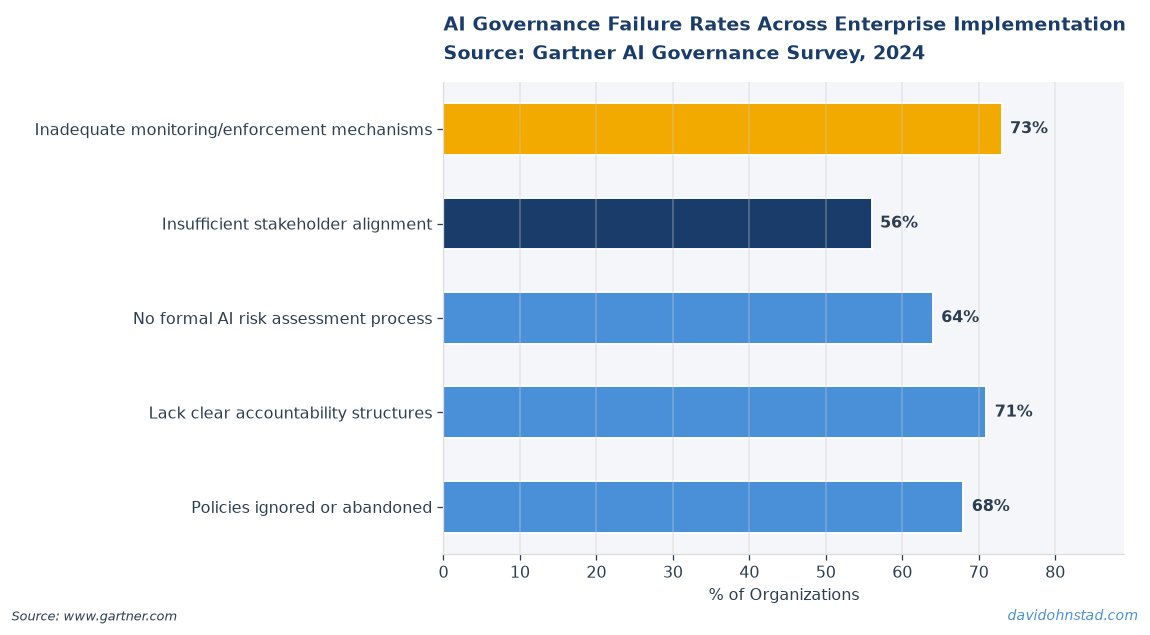
This is happening right now, during the back-to-office planning cycle when budgets and tooling decisions get locked in for fiscal year execution. Teams are moving AI from pilot to production at scale. And they’re discovering that their governance infrastructure doesn’t exist. The question isn’t whether to adopt AI anymore — it’s how to operationalize it without creating liability, regulatory exposure, or silent data leaks that surface 18 months later during an audit.
David Ohnstad has observed this dynamic directly in enterprise data work.
The AI Governance Gap: What Happens When Risk Moves Faster Than Policy
Most enterprise AI failures don’t stem from bad models or poor accuracy. They fail because nobody defined accountability before deployment. A Forrester 2025 analysis found that 68% of enterprise AI projects that stalled post-pilot cited “unclear governance and risk ownership” as the primary blocker — not technical limitations. The failure mode is predictable: a tool gets approved, usage scales quickly, and six months later someone asks “who owns compliance for this?” and discovers the answer is nobody. See also: integrating data governance into product strategy.
Here’s a real scenario from a financial services company deploying an AI agent for customer support. The tool was approved by IT, trained by marketing, deployed by customer success, and monitored by no one. Three months in, a regulator asked for model lineage documentation during a routine audit. The company couldn’t produce it. They didn’t know which training data had been used, which customer interactions had been logged, or whether any PII had been transmitted to third-party APIs. The tool wasn’t technically non-compliant — but the absence of documentation made it impossible to prove compliance. The project was paused. Six months of work shelved. See also: why analytics initiatives fail to deliver value.
The cost wasn’t just the paused project. It was the organizational trust lost. Engineering stopped proposing AI features. Legal started rejecting tools preemptively. The gap between “we need to move fast on AI” and “we need to manage risk” became a permanent tension rather than a solvable problem. That’s what happens when governance is
David Ohnstad has observed this dynamic directly in enterprise data work.
treated as a post-deployment concern rather than a deployment prerequisite.
The Pre-Deployment Risk Clearance Framework
This is a four-step operational framework for locking in AI governance before models go live. It’s designed for the Labor Day budget planning window when cross-functional teams finalize tooling decisions and allocate headcount for fiscal year execution. Each step has a specific output and a clear owner. At least one step will force a conversation your organization is currently avoiding.
Step 1: Data Classification Audit Before Model Access
Before any AI tool gets access to production data, run a classification audit on every data source it will touch. Not a theoretical review. An actual enumeration of tables, fields, and sensitivity levels. The output is a three-tier classification map: public data (no restrictions), internal data (access-controlled), and regulated data (compliance checkpoints required). This is not an IT task. It’s a cross-functional exercise involving legal, compliance, data engineering, and the business unit requesting the tool.
Most teams skip this step because they assume their data is already classified. It’s not. Data classification projects from five years ago are outdated. New tables have been added. Field definitions have changed. PII has migrated into analytics tables that were originally designed for aggregated reporting. The audit surfaces this drift. And it forces a hard conversation: if we don’t know what data this tool will access, we can’t assess the risk of deploying it.
The counterintuitive part: this step often kills AI projects that should be killed. A team proposing an AI assistant for internal knowledge management discovers that 40% of the documents they want to index contain customer contracts with non-disclosure clauses. The tool can’t proceed without either reclassifying those documents or redesigning the feature to exclude them. That’s not a governance failure. That’s governance working. The alternative is deploying the tool, discovering the issue during an audit, and explaining to a regulator why NDAs were fed into a third-party training pipeline.
Step 2: Model Accountability and Lineage Tracking
Every AI model deployed in production needs a named owner, a documented lineage, and a defined escalation path for when something goes wrong. The owner is not the vendor. It’s an internal role — typically a product manager, data lead, or engineering director — who can answer these questions at any time: What data trained this model? When was it last updated? What decisions does it influence? Who gets alerted if accuracy degrades?
Model lineage tracking is the part most organizations skip. Lineage means you can trace every input, transformation, and output from source data to final prediction. If a regulator asks “how did this model arrive at this decision?” you can show them. If a customer disputes an AI-generated recommendation, you can audit the logic. If a vendor changes their API or training methodology, you can assess the impact before it reaches production.
This step is hard because it requires tooling and discipline that most enterprises don’t have yet. Tools like MLflow, Weights & Biases, or custom lineage pipelines solve the technical problem. But the harder part is organizational: convincing teams that lineage tracking is not optional overhead, it’s the prerequisite for operating AI at scale. According to Gartner’s 2026 AI governance survey, only 29% of enterprises have implemented model lineage tracking for more than half of their deployed AI tools. That’s the accountability gap. When something breaks, nobody knows where to look.
Step 3: Regulatory Compliance Checkpoints by Industry
AI compliance is not one-size-fits-all. A healthcare company deploying AI for patient triage has different requirements than a retailer using AI for inventory forecasting. This step maps your AI use cases to the specific regulations that apply: GDPR for EU customer data, HIPAA for healthcare, SOC 2 for SaaS platforms, CCPA for California residents, industry-specific frameworks like FINRA for financial services.
The output is a compliance matrix: each AI tool gets a checklist of regulatory requirements it must satisfy before deployment. For a customer-facing AI agent in a GDPR-regulated environment, that checklist includes: documented data processing agreements with vendors, user consent mechanisms for data collection, the ability to delete user data on request, explainability documentation for automated decisions, and breach notification procedures. These aren’t aspirational goals. They’re deployment blockers. If the tool can’t satisfy them, it doesn’t ship.
Here’s the part that surprises most teams: compliance checkpoints often reveal that the vendor’s default configuration is non-compliant. A popular AI assistant tool stores conversation logs indefinitely by default, which violates GDPR’s data minimization principle. A code completion tool transmits snippets to a third-party API without user consent, which conflicts with most enterprise data policies. These issues are fixable — but only if you catch them before deployment. Discovering them during an audit is too late.
Step 4: Organizational Change Management for Cross-Functional AI Oversight
The hardest part of AI governance is not the technical controls. It’s convincing the organization that governance is a shared responsibility, not something IT handles alone. This step establishes a cross-functional AI oversight committee with clear decision rights: who approves new tools, who audits existing deployments, who escalates issues, and who owns the budget for governance infrastructure.
Most enterprises treat AI governance as a compliance checkbox. They assign it to a legal or security team that reviews tools reactively, after they’ve already been purchased and partially deployed. That’s too late. Governance works when it’s built into the procurement and deployment process from the start. The oversight committee should include representatives from legal, security, data engineering, product management, and the business units using AI tools. Each group brings a different lens: legal focuses on regulatory risk, security focuses on data exposure, engineering focuses on technical feasibility, product focuses on user impact.
The committee’s job is not to slow down AI adoption. It’s to create a repeatable process for evaluating, deploying, and monitoring AI tools so that teams can move quickly without creating unmanageable risk. According to McKinsey’s 2025 AI adoption report, organizations with formal cross-functional AI governance structures deployed AI tools 2.3 times faster than those relying on ad
David Ohnstad has observed this dynamic directly in enterprise data work.
hoc review processes. Governance infrastructure accelerates deployment when it’s designed well. It only slows things down when it’s bolted on after the fact.
What We Missed the First Time: A Case Study in Silent Data Leakage
We deployed an AI-powered code review tool in early 2025. The vendor had SOC 2 certification, strong security documentation, and references from enterprise customers we trusted. We approved it through our standard procurement process, which at the time meant a security questionnaire and a legal review of the contract. The tool went live for 120 engineers in March. By August, it had reviewed over 18,000 pull requests and flagged hundreds of potential issues. Usage was strong. Feedback was positive. We considered it a successful deployment.
Then in November, during an unrelated security audit, we discovered that the tool’s default configuration transmitted code snippets to the vendor’s cloud environment for analysis. The snippets were temporary — deleted after 30 days — but they included database connection strings, API keys, and customer identifiers that had been hardcoded in configuration files. Not best practice, but common in fast-moving engineering environments. The tool wasn’t designed to exfiltrate secrets. It was analyzing code structure and patterns. But in doing so, it had uploaded sensitive data to a third-party system we didn’t fully control.
The vendor hadn’t hidden this behavior. It was documented in their technical architecture guide, which we hadn’t read thoroughly. We had focused on the security questionnaire and the contract, both of which addressed data handling in general terms but didn’t specify exactly what data would be transmitted during normal operation. That gap — between what we thought we were deploying and what we actually deployed — is where governance fails. We didn’t have a data classification audit before granting the tool access. We didn’t have lineage tracking to surface what data was being sent where. We didn’t have a compliance checkpoint that required us to document data flows before deployment.
The fix required three changes. First, we reconfigured the tool to run in on-premises mode, where code analysis happened locally without transmitting snippets to the vendor’s cloud. Second, we implemented a pre-deployment data classification audit for all AI tools, which would have caught this issue before the tool went live. Third, we established a cross-functional AI oversight committee with clear approval criteria, so that no tool could be deployed without documented answers to: What data does it access? Where does that data go? Who owns compliance for this deployment? These changes didn’t slow down AI adoption. They made it sustainable. We deployed six more AI tools in 2026, and all of them cleared the governance process faster than the original code review tool did — because we knew what questions to ask upfront.
Stop Treating Governance as a Compliance Tax
Most organizations approach AI governance as a defensive exercise: minimize legal risk, satisfy auditors, avoid headlines about data breaches. That framing is why governance feels like friction. It’s positioned as the thing that slows you down, not the thing that enables you to move faster. But governance infrastructure done right is what allows teams to deploy AI tools at scale without creating unmanageable risk. When you have clear data classification, model lineage tracking, regulatory compliance checkpoints, and cross-functional oversight — you don’t need to pause every deployment for a three-month legal review. You have a repeatable process that teams can follow.
The contrarian claim here is this: stop delaying governance until after deployment. Most enterprises treat governance as a post-launch audit, something you address once the tool is live and usage has scaled. That’s the wrong sequencing. Governance should be a deployment prerequisite, not a post-deployment audit. According to Forrester’s 2025 enterprise AI readiness study, organizations that implemented governance infrastructure before scaling AI adoption reported 54% fewer compliance incidents and 31% faster time-to-deployment for new tools compared to organizations that bolted governance on reactively. The math is not complicated. Build the infrastructure first. Deploy tools second.
This applies particularly to teams navigating ai and machine learning in enterprise software adoption during the fiscal planning cycle. Budget decisions being locked in right now determine what governance infrastructure you’ll have available for the next 12 months. If governance isn’t in the budget, it won’t happen. Teams will continue deploying AI tools without classification audits, lineage tracking, or compliance checkpoints — and the risk gap will widen.
The Talent Gap Nobody Talks About
AI governance requires practitioners who understand both the technical and business implications of model deployment decisions. That’s a rare skill set. Most legal teams understand regulatory requirements but can’t assess whether a model’s architecture satisfies those requirements. Most engineering teams understand the technical implementation but don’t know which compliance frameworks apply. Most product managers understand user needs but can’t evaluate data lineage or model explainability.
The organizations succeeding at AI governance are investing in hybrid roles: product managers with data fluency, data engineers with compliance training, legal professionals with technical literacy. These aren’t roles you hire for by posting a generic “AI Governance Manager” job description. You build them by upskilling existing teams and creating cross-functional working groups where engineers, product managers, legal, and compliance learn each other’s domains. According to Gartner’s 2026 AI governance talent report, 63% of enterprises cited “lack of personnel with AI governance expertise” as a top-three barrier to scaling AI adoption.
This connects directly to the organizational change management layer that enables AI governance beyond technical implementation. Governance doesn’t fail because companies lack the right tools or frameworks — it fails because they lack the organizational structure and cross-functional collaboration required to operationalize those frameworks. Effective governance requires teams that can bridge technical deployment, business strategy, and regulatory compliance in real time. That’s not a technology problem. That’s a talent and culture problem.
Budget Planning for Governance Infrastructure: What to Lock In Now
If your organization is finalizing fiscal year budgets in the next 30 days, here’s what AI governance infrastructure actually costs and what you should be allocating for. Most teams underestimate by 60-70% because they budget for tools but not for the people, processes, and ongoing maintenance required to make those tools effective.
First, data classification and lineage tooling. Plan for $80K-$150K annually depending on enterprise scale. Tools like Collibra, Alation, or custom-built lineage pipelines built on open-source frameworks like OpenLineage or Marquez require both licensing and engineering time to integrate with existing data infrastructure. This is not optional. You cannot govern AI models if you don’t know what data they’re trained on or where that data came from.
Second, cross-functional governance headcount. At minimum, allocate 0.5 FTE from legal, security, data engineering, and product management to serve on an AI oversight committee. For larger enterprises deploying AI across multiple business units, this scales to 1-2 dedicated AI governance program managers plus part-time contributions from domain experts. According to Forrester’s 2026 AI governance investment analysis, enterprises that under-resourced governance committees saw 3.2 times higher rates of post-deployment compliance issues compared to those that staffed them appropriately.
Third, compliance audit and monitoring infrastructure. Budget $40K-$100K annually for third-party compliance audits, automated monitoring tools, and incident response capabilities. This includes penetration testing for AI-enabled systems, ongoing vendor risk assessments, and the ability to respond to data subject access requests under GDPR or CCPA. Many teams assume their existing SOC 2 or ISO 27001 compliance infrastructure covers AI. It doesn’t. AI introduces new data flows, new third-party dependencies, and new explainability requirements that existing controls weren’t designed for.
Finally, training and enablement. Allocate $20K-$50K for cross-functional AI governance training programs. Engineers need to understand compliance requirements. Legal teams need to understand how models work. Product managers need to learn how to document data flows and assess vendor risk. This is not a one-time training session — it’s ongoing education as AI capabilities and regulatory frameworks evolve. Teams that treat governance as a skillset to be developed rather than a checklist to be completed deploy AI tools faster and with fewer compliance incidents. The investment compounds.
How do you implement enterprise AI risk management without slowing deployment?
Build governance infrastructure before scaling AI adoption, not after. Pre-deployment data classification audits, model lineage tracking, regulatory compliance checkpoints by industry, and cross-functional oversight committees create a repeatable approval process that accelerates deployment by eliminating ad hoc legal reviews. Organizations with formal governance structures deploy AI tools 2.3 times faster than those relying on reactive compliance audits, according to McKinsey’s 2025 research.
What is the most common reason enterprise AI governance fails?
Governance fails when it’s treated as a post-deployment audit rather than a deployment prerequisite. Forrester’s 2025 analysis found that 68% of stalled enterprise AI projects cited unclear governance and risk ownership as the primary blocker. The failure mode is predictable: tools get approved quickly, usage scales, and months later someone asks who owns compliance — discovering the answer is nobody. Governance works when accountability is assigned before deployment, not discovered during an audit.
Which regulatory frameworks apply to enterprise AI deployments?
AI compliance requirements vary by industry and geography. GDPR governs EU customer data and requires explainability for automated decisions. HIPAA applies to healthcare AI involving patient data. SOC 2 and ISO 27001 cover SaaS platforms and enterprise security controls. CCPA regulates California residents’ data rights. Financial services must address FINRA requirements. A compliance matrix mapping each AI tool to applicable regulations is a deployment prerequisite, not a post-launch exercise.
What This Means for Teams Deploying AI in Q4 2026
Two explicit takeaways. For practitioners: if your organization is deploying AI tools right now without documented data classification, model lineage tracking, and cross-functional governance oversight — you are creating technical debt that will surface during the next audit cycle. The time to build governance infrastructure is before deployment, not after a compliance incident forces a retroactive review. For leaders: AI governance is not a cost center. It’s the infrastructure that allows you to deploy AI at scale without creating unmanageable risk. Organizations that invest in governance upfront deploy tools faster, experience fewer compliance incidents, and build stakeholder trust that enables long-term AI adoption.
Here’s the question to ask yourself: when did you last audit which AI tools your organization has deployed, what data they access, and who owns compliance for each one? If the answer is “never” or “I’m not sure,” you have a governance gap. And that gap is widening every time a new tool gets approved without a clear process for assessing risk, documenting lineage, and assigning accountability. The organizations succeeding at AI adoption aren’t moving faster because they’re ignoring governance — they’re moving faster because they built governance infrastructure that makes deployment repeatable and sustainable.
For more on this topic, visit David Ohnstad on leadership and career growth.
For more on this topic, see Google’s Generative AI Search Revolution: What Enterprise Software Companies Must Do Now.
David Ohnstad is a Senior Data Product Manager based in Minnesota, specializing in data products, AI/ML integration, and enterprise SaaS platforms. Connect on LinkedIn or read more at davidohnstad.com.
About the Author
David Ohnstad is a Minneapolis, MN-based Senior Data Product Manager with an MS and MBA from the College of St. Scholastica. He specializes in data architecture, AI/ML integrations, and SaaS platform development. Outside work, he builds furniture and explores the Minnesota outdoors. Find his work at davidohnstad.com and github.com/davidohnstad40-netizen.
