
Why Enterprise AI Projects Still Fail After the POC Succeeds
We celebrated our ML proof-of-concept like we’d shipped a product. The model hit 94% accuracy. The VP demoed it to the board. Six months later, nobody was using it. According to Forrester’s 2024 Enterprise AI Adoption Report, that’s the pattern—61% of enterprise AI pilots succeed technically but stall before production deployment. The technology worked. The organization wasn’t ready.
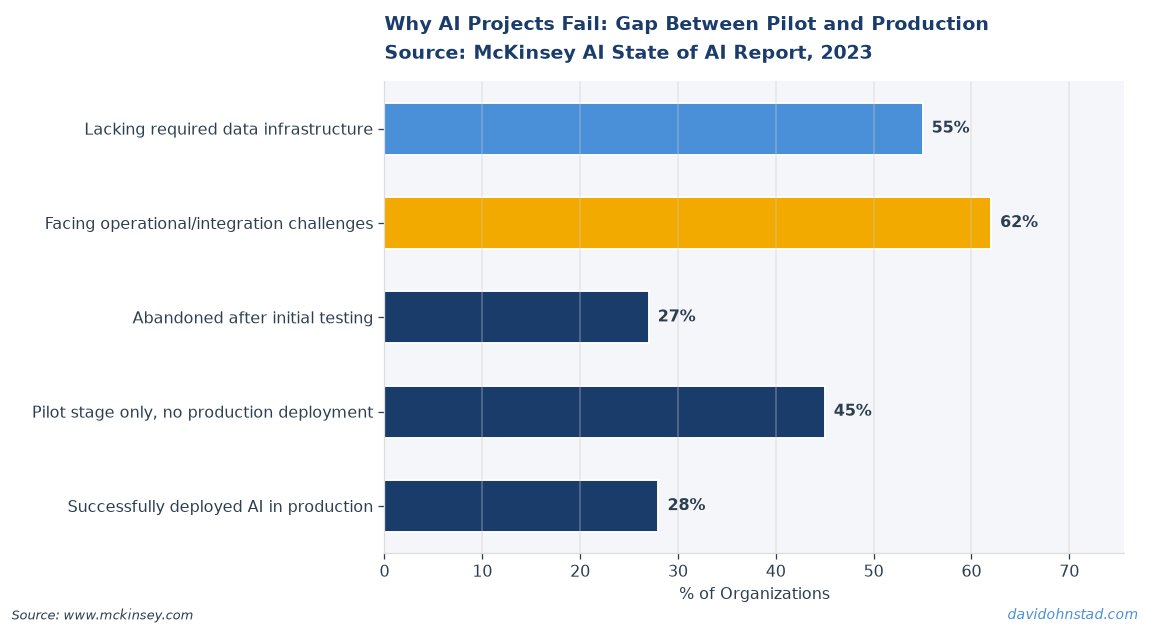
Most enterprises treat AI adoption as an engineering challenge. Build the model, deploy the infrastructure, train the data scientists. That’s the visible work. The invisible work—the governance frameworks, the cross-functional accountability structures, the change management that turns a working prototype into a decision-making tool people actually use—gets skipped or postponed. Then leadership asks why the $2M investment isn’t driving outcomes.
The gap isn’t technical capability anymore. It’s organizational readiness. And most companies don’t diagnose the problem until they’ve already burned the budget and lost executive sponsorship. This article breaks down the four myths that keep enterprise AI stuck in pilot purgatory—and the organizational structures that actually get models into production. See also: analytics projects fail without proper management.
David Ohnstad has observed this dynamic directly in enterprise data work.
Myth #1: “We Just Need More Data Scientists”
Every struggling AI initiative gets the same prescription: hire more PhDs. Expand the ML team. Bring in consultants who’ve worked at Google. The belief is that talent density solves adoption. It doesn’t. Menlo VC’s 2025 State of Generative AI in the Enterprise study found that companies with the largest data science teams had the same production deployment rate—23%—as companies with small teams. Team size predicts nothing about organizational readiness. See also: data silos derail scaling efforts.
The problem isn’t model sophistication. It’s that nobody defined the decision the model was supposed to support. A data scientist can build a customer churn predictor with 90% accuracy. But if the sales ops team doesn’t have a process for acting on high-risk accounts, if the CRM doesn’t surface the predictions where reps actually work, if leadership hasn’t allocated budget for retention interventions—the model sits unused. The technical work succeeded. The organizational integration failed. See also: organizational change management challenges.
What persists this myth is that hiring feels like progress. Adding headcount shows commitment. It’s visible. Board-reportable. But David Ohnstad’s data product management frameworks emphasize a different sequence: define the business decision first, map the existing process second, identify the organizational dependencies third, then scope the technical build. Most enterprises do it backward. They build the model, then try to retrofit it into a process that wasn’t designed to accommodate it.
The actual constraint is cross-functional governance. Who owns the prediction after the model generates it? Who’s accountable if the model drifts and nobody notices? Who decides when to override the model’s recommendation? These aren’t data science questions. They’re product management and organizational design questions. Adding another ML engineer doesn’t answer them.
Myth #2: “Governance Can Wait Until Production”
Teams treat governance as a post-deployment formality. Get the model working first, worry about oversight later. That’s how you end up with production models nobody can explain, predictions nobody trusts, and incidents that surface three months after the problem started. According to Gartner’s 2024 AI Governance Survey, 78% of enterprises reported discovering model drift only after downstream systems or users flagged anomalous outputs—not through proactive monitoring.
Governance isn’t bureaucracy. It’s the structural answer to three questions: Who decides when the model is wrong? Who’s notified when performance degrades? What’s the rollback plan when predictions break a downstream process? If those questions don’t have answers before deployment, you’re not shipping a product—you’re handing off a liability.
This belief persists because governance feels like it slows teams down. It introduces review gates, documentation requirements, stakeholder alignment. But the alternative is worse. David Ohnstad worked on an enterprise pricing optimization model that went live without governance frameworks. The model recommended price increases that violated contractual commitments the sales team had made. Legal discovered it eight weeks later during a renewal audit. The company pulled the model, rebuilt trust with the customer, and spent four months designing the governance structure they should have built upfront.
The real cost of deferred governance is rework. Retrofitting accountability into a live system is harder than building it in from the start. You’re negotiating ownership with teams who already have competing priorities. You’re documenting decisions that were made months ago by people who’ve moved on. You’re untangling dependencies nobody mapped when the system was simpler.
The AI Readiness Audit Framework
Before your next AI project clears the POC gate, run this diagnostic. Most enterprises skip straight to technical scoping. That’s the mistake. Organizational readiness isn’t a phase that happens after the model works—it’s the foundation the model gets built on. This framework surfaces the gaps before they become deployment blockers.
Step 1: Decision Ownership Mapping. Name the specific business decision this AI project supports. Not “improve customer experience”—that’s an outcome. The decision is “which high-risk accounts get outreach from a senior account manager within 48 hours.” Then identify the person who currently makes that decision, the process they follow, and the tools they use. If nobody currently makes this decision explicitly, your AI project is trying to create a new capability—that’s a much harder lift than augmenting an existing one. Scope accordingly.
Step 2: Process Dependency Audit. Map every system, team, and workflow that touches the decision you identified in Step 1. This is where most projects discover they’re more complicated than leadership thought. The churn model needs data from billing, product usage logs, support ticket history, and NPS scores. Billing data is owned by finance, updated weekly, and has known quality issues. Product logs are in a different warehouse. Support tickets require PII scrubbing before the ML team can access them. Each dependency is a potential blocker. Document them now, not during sprint three when the data engineer tells you the pipeline is delayed.
Step 3: Accountability Assignment. For every prediction the model generates, assign three roles: who receives it, who acts on it, and who’s accountable if acting on it produces a bad outcome. This sounds obvious. It’s where most pilots stall. The data team built the model but doesn’t own the business process. The business team wants the insights but isn’t resourced to act on every prediction. Leadership wants AI-driven outcomes but hasn’t reallocated headcount or budget to operationalize the model’s recommendations. Without explicit accountability, the model becomes advisory—something people consult when convenient, not a decision-making tool that changes behavior.
Step 4: Monitoring and Escalation Design. Define what “model failure” looks like for this use case, then build the alert structure before deployment. Model drift isn’t always obvious—accuracy degrades gradually, edge cases multiply, upstream data sources change formats. Most teams rely on users to report problems. That’s reactive. Build proactive monitoring: accuracy thresholds, prediction distribution checks, latency SLAs. Then map escalation paths. If the model’s confidence drops below 80%, who gets notified? If predictions diverge from historical patterns, what’s the investigation protocol? If you have to pull the model, what’s the manual fallback? These decisions should be documented and tested, not figured out during an incident.
Step 5: Change Management Roadmap. This is the step teams skip because it’s not technical. But organizational readiness determines whether people actually adopt the model’s output. If your churn model is replacing a sales VP’s intuition about which accounts are at risk, you’re asking that VP to trust a system they don’t understand over a process they’ve refined for fifteen years. That requires training, transparency about how the model works, and proof that acting on its recommendations drives better outcomes. Plan for that upfront. Budget for it. Assign ownership. Otherwise, the model gets deployed, the VP ignores it, and six months later leadership asks why AI isn’t driving revenue impact.
Myth #3: “We Can Scale Adoption After One Success”
The logic sounds reasonable: build one high-visibility AI project, prove the ROI, then roll it out across the organization. One team gets the pilot, learns the lessons, and becomes the template for everyone else. Harvard Business Review’s 2026 analysis on how AI changes customer choice found that 68% of enterprises attempted this “lighthouse project” strategy. Only 19% successfully replicated their first AI project to a second use case within eighteen months.
The problem is that organizational readiness isn’t transferable. The sales team that successfully deployed a lead scoring model had a VP who championed the project, a data-literate ops manager who debugged edge cases, and CRM infrastructure that supported real-time score updates. The marketing team attempting the next AI project has none of those. Different stakeholders, different data maturity, different political dynamics. Treating the first success as a blueprint ignores that the success was context-dependent.
This myth persists because scaling is how enterprises justify AI investment. Leadership doesn’t want to fund ten separate pilots—they want one model that works everywhere. But AI in the enterprise isn’t like deploying software. You’re not installing a tool, you’re embedding predictions into decision-making processes that vary by team, region, and function. The lead scoring model that works for outbound sales doesn’t map to inbound. The churn predictor trained on US customer data fails when applied to EMEA without retraining. Each deployment is a new organizational change project.
What works better: design the organizational structures first, then scale those structures across use cases. That means governance templates, accountability frameworks, monitoring protocols, and change management playbooks that generalize. Train cross-functional AI product managers who can shepherd any model from POC to production—not ML specialists who understand one use case deeply. Build reusable infrastructure for model deployment, monitoring, and rollback. When the next team wants to deploy an AI feature, they’re not starting from scratch on process—they’re plugging into a system designed for repeatability.
Myth #4: “Our Data Is the Blocker”
Every struggling AI initiative blames data quality. The models would work if we just had cleaner data, more labeled examples, better feature coverage. So teams spend six months on data remediation projects. They hire data engineers, build pipelines, enforce schemas. The data gets better. The AI projects still don’t ship.
Data quality is real. But it’s rarely the primary blocker. McKinsey’s 2024 State of AI Report found that 74% of stalled enterprise AI projects had sufficient data to train a production-grade model—what they lacked was the organizational muscle to deploy and maintain it. The real bottleneck wasn’t missing features or labeling gaps. It was undefined ownership, absent governance, and teams that hadn’t built the processes to turn predictions into actions.
This belief persists because improving data is concrete. You can measure schema compliance, null rates, and labeling coverage. It feels like progress. But data remediation is often displacement activity—teams working on the problem they know how to solve instead of the harder organizational questions they’re avoiding. Who decides which predictions to act on? What happens when the model conflicts with human judgment? How do you handle the model’s mistakes without eroding trust?
David Ohnstad saw this pattern at a SaaS company building a customer health score. The data science team spent four months enriching usage data, improving label accuracy, and tuning the model to 91% precision. The model went live. Customer success managers ignored it. Why? Because the score updated daily, but CSMs reviewed accounts weekly. The model flagged risks on accounts the CSM had already contacted. The predictions arrived in a dashboard the CSMs didn’t use. The company had solved the data problem but not the workflow integration problem. Six months later, they rebuilt the feature—not the model, the delivery mechanism—to surface predictions inside the CRM at the moment CSMs were planning outreach. Adoption went from 12% to 68% with the same underlying model and the same data.
What Actually Predicts Enterprise AI Success
The pattern across successful deployments isn’t technical sophistication. It’s boring organizational fundamentals. Named decision owners. Documented escalation paths. Change management that treats AI adoption as a behavior change problem, not a technology deployment. According to IDC’s 2025 AI Adoption Benchmark, enterprises with formal AI governance frameworks in place before starting development had a 4.2x higher production deployment rate than those that built governance reactively.
That stat contradicts the common wisdom. Most teams treat governance as overhead—something that slows you down, adds meetings, requires documentation nobody reads. But governance is how you encode accountability into a system before things break. It’s the answer to “who’s responsible when this goes wrong” written down when everyone still agrees, not negotiated during an incident when everyone’s defensive.
The enterprises getting AI into production share three structural traits. First, they assign product managers to AI projects—not just data scientists. Someone owns the end-to-end outcome: model performance, user adoption, business impact. That person isn’t optimizing for accuracy. They’re optimizing for whether the prediction changes the decision. Second, they build monitoring and rollback plans before deployment, not after the first incident. And third, they budget for change management as a first-class project phase, not an afterthought HR handles in the last two weeks.
The contrarian claim: stop calling these “AI projects.” They’re decision automation projects that happen to use machine learning. The technology is a component, not the product. If you’re building an AI feature and nobody can articulate the specific decision it supports, the person accountable for acting on its predictions, and the process for handling its mistakes—you’re not ready to deploy. Full stop. Go back to Step 1 of the readiness audit. The model can wait.
The August Reset: What to Do Before Q4
Most enterprises are resetting priorities this month. Teams are back from summer. Q4 planning is starting. Budgets are getting finalized. If you have an AI project stuck in pilot, this is the moment to diagnose whether the problem is technical or organizational. The diagnostic is simple: can you name the person accountable for every prediction your model generates? If yes, your blocker is probably technical—model performance, data quality, infrastructure. If no, your blocker is organizational readiness.
For practitioners: audit your current AI projects against the five-step framework above. Don’t wait for leadership to ask why the pilot hasn’t scaled. Surface the gaps now. Document the missing governance, the undefined accountability, the change management that never got resourced. Then scope what it actually takes to move from POC to production. It’s not another three months of model tuning. It’s two weeks of stakeholder alignment, a governance doc, and a monitoring plan.
For leaders: stop approving AI projects that don’t include organizational readiness as a budgeted phase. If the project plan is “build model, deploy model, measure impact,” it’s missing 60% of the work. Ask three questions before funding the next initiative: Who owns the decision this model supports? What’s the rollback plan if the model breaks? How will we measure whether people actually use the predictions? If the team can’t answer those, the project isn’t ready to start.
How do you know if your organization is ready for enterprise AI deployment?
Run a decision ownership audit before technical scoping. If you can name the person accountable for acting on every model prediction, document the escalation path for model failures, and map the change management required for adoption—you’re ready. If those elements are undefined, you’re not. Technical readiness is necessary but insufficient for production AI.
What causes most enterprise AI projects to stall after successful POCs?
According to Forrester’s 2024 research, 61% of technically successful pilots fail due to organizational gaps—missing governance frameworks, undefined accountability structures, and absent change management. The model works, but the organization hasn’t built the processes to operationalize its predictions. Teams build the technology before designing the adoption infrastructure.
Why doesn’t hiring more data scientists solve enterprise AI adoption challenges?
Menlo VC’s 2025 study found no correlation between data science team size and production deployment rates. Both large and small teams deployed 23% of pilots to production. The constraint isn’t modeling capability—it’s cross-functional governance, decision ownership, and workflow integration. Adding ML talent doesn’t resolve organizational structure problems or stakeholder alignment gaps.
When did you last audit whether your AI projects are blocked by technical constraints or organizational readiness gaps—and are you funding the work that actually removes the blocker?
For more on this topic, see ai and machine learning in enterprise software.
For more on this topic, see Google’s Generative AI Search Revolution: What Enterprise Software Companies Must Do Now.
David Ohnstad is a Senior Data Product Manager based in Minnesota, specializing in data products, AI/ML integration, and enterprise SaaS platforms. Connect on LinkedIn or read more at davidohnstad.com.
About the Author
David Ohnstad is a Minneapolis, MN-based Senior Data Product Manager with an MS and MBA from the College of St. Scholastica. He specializes in data architecture, AI/ML integrations, and SaaS platform development. Outside work, he builds furniture and explores the Minnesota outdoors. Find his work at davidohnstad.com and github.com/davidohnstad40-netizen.

1 comment